
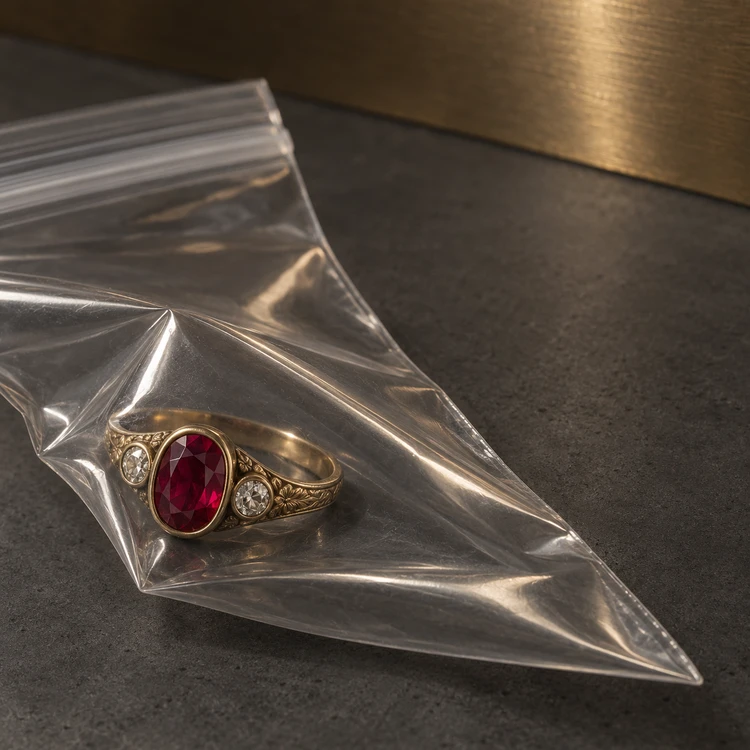
Necklaces Packaging Guide: Size, Thickness and Quantity
Posted by AppleZipBags Team on Sep 11th 2026
Choosing packaging for necklaces becomes much easier when the decision is divided into three parts:
size → thickness → quantity.
First, determine how the necklace will be arranged inside the package.
Second, measure the complete finished package rather than relying on the necklace’s wearable length.
Third, choose the film thickness and purchasing quantity that fit your actual inventory workflow.
For many everyday jewelry applications, a clear resealable bag around 2–2.5 mil provides a practical starting point, provided the dimensions suit the necklace, pendant, card or insert.
Apple Zip Bags offers resealable jewelry packaging bags for necklaces and other compact jewelry items.
The strongest workflow is:
arrange → measure → size → choose thickness → test → standardize → calculate quantity.
Quick Necklaces Packaging Guide
| Necklace Type | Size Approach | Main Concern | Quantity Approach |
|---|---|---|---|
| Fine chain | Small/carded | Tangling | Test 100, then scale |
| Small pendant | Small | Pendant width | 100 → 1,000 |
| Large pendant | Small–medium | Pendant size/depth | Test actual piece |
| Choker | Small–medium | Structure | Depends on flexibility |
| Layered necklace | Medium/carded | Multiple chains | Standardize carefully |
| Beaded necklace | Medium | Thickness/weight | Test before bulk |
| Statement necklace | Medium–large | Width/volume | Often lower-volume |
| Necklace on card | Size to card | Finished assembly | Excellent for bulk |
| Wholesale necklace | Standardized sizes | SKU organization | Often 1,000 |
| Repair necklace | Individual bag | Components/ID | Volume dependent |
The most important rule is:
necklace length is not packaging length.
Part 1: Choosing Necklace Bag Size
Bag size should be based on the dimensions of the necklace after it has been arranged for packaging.
A necklace described as:
-
16 inches
-
18 inches
-
20 inches
-
24 inches
does not need a bag of the same length.
Most necklaces are packaged in a more compact configuration.
Wearable Length vs. Packaged Size
Consider an 18-inch pendant necklace.
When worn, the chain extends 18 inches.
When packaged, it may be:
-
Coiled
-
Mounted on a card
-
Secured to an insert
The finished package may occupy only a few inches in width and height.
Therefore:
wearable length and packaging dimensions are separate measurements.
Arrange the Necklace Before Measuring
Before selecting the bag:
-
Arrange the necklace.
-
Position the pendant.
-
Secure the chain if needed.
-
Add the card or insert.
-
Measure the completed arrangement.
Apple Zip Bags' packaging bag size guide recommends measuring the finished packaged item and allowing appropriate room for closure.
Measure Width
Measure the widest part of the finished arrangement.
This may be determined by:
-
Pendant
-
Card
-
Beads
-
Decorative centerpiece
-
Layered chains
Do not measure only the chain.
Measure Height
Measure from the top of the complete package to the bottom.
For a carded necklace, this is generally the card height.
For a loose necklace, measure the arranged coil or presentation.
Measure Thickness
Necklaces can occupy more depth than expected.
Thickness may come from:
-
Pendant
-
Large beads
-
Layered chains
-
Chunky links
-
Necklace card
-
Insert
A bag can appear large enough from the front but still be too tight once the product’s depth is considered.
Leave Closure Clearance
The necklace should remain entirely below the resealable closure.
Leave enough space to:
-
Insert the necklace easily
-
Close the zipper
-
Reopen the bag
-
Remove the product
-
Apply labels if needed
Fine chains should never sit inside the zipper track.
Choose the Smallest Comfortable Fit
The ideal bag should be:
compact without being restrictive.
Too small can cause:
-
Bent cards
-
Compressed pendants
-
Chains trapped near the closure
-
Difficult packing
Too large can create:
-
Excess movement
-
More tangling opportunity
-
Larger inventory footprint
-
Less organized presentation
The goal is not the smallest possible bag.
It is:
the smallest bag that works comfortably.
Best Size Approach for Fine Chains
Fine chains are delicate and prone to:
-
Tangling
-
Knotting
-
Catching
A small package with controlled movement can work well.
A card or insert can provide additional stability.
Best Size Approach for Pendant Necklaces
For pendant necklaces, measure:
arranged chain + pendant width + pendant height + pendant depth.
A fine chain does not necessarily mean the necklace needs a tiny bag.
The pendant may control the required dimensions.
Best Size Approach for Small Pendants
Small pendants are strong candidates for standardized packaging.
Examples include:
-
Initial necklaces
-
Tiny heart pendants
-
Small stars
-
Birthstones
-
Minimal charms
If many products share similar cards, one small bag size may work across a large number of SKUs.
Best Size Approach for Large Pendants
Large pendants may be:
-
Wide
-
Thick
-
Heavy
-
Irregular
Measure the pendant carefully.
Do not force a large pendant into a bag chosen only for the chain.
Best Size Approach for Chokers
Chokers vary significantly.
A flexible chain choker may fold or coil compactly.
A structured or semi-rigid choker may require:
-
More width
-
More depth
-
Larger packaging
Choose based on actual construction.
Best Size Approach for Layered Necklaces
Layered necklaces require additional organization because several chains can tangle.
A strong packaging method is:
layered necklace → card with separate attachment points → resealable bag.
The bag is then sized to the complete carded assembly.
Best Size Approach for Beaded Necklaces
Beaded necklaces can be much bulkier than fine chains.
Consider:
-
Bead diameter
-
Number of strands
-
Pendant size
-
Weight
-
Overall volume
Do not compress thick beads into a flat package.
Best Size Approach for Statement Necklaces
Statement necklaces may contain:
-
Wide decorative centers
-
Multiple stones
-
Large beads
-
Rigid components
-
Heavy pendants
These often require larger packaging.
When necessary, use larger jewelry bag sizes rather than squeezing the product into a small standardized bag.
Best Size Approach for Necklace Cards
Once a necklace is mounted on a card, the card usually becomes the main sizing reference.
Suppose:
Necklace length = 18 inches
Card = 3 × 4 inches
The bag should be sized around:
3 × 4 inches + necklace thickness + closure clearance.
Standardize Necklace Cards
Standardized cards can simplify bag purchasing dramatically.
A jewelry business may use:
Small Card
For:
-
Fine chains
-
Small pendants
-
Minimalist necklaces
Medium Card
For:
-
Standard pendants
-
Layered necklaces
-
Chunkier chains
Large Card
For:
-
Statement necklaces
-
Large pendants
Fewer card sizes can mean fewer bag SKUs.
Standardize Core Necklace Bag Sizes
Many businesses can organize a large portion of inventory using approximately:
2–3 core packaging sizes.
For example:
Small
Best candidates:
-
Fine chains
-
Small pendants
-
Compact cards
Medium
Best candidates:
-
Standard pendant necklaces
-
Layered necklaces
-
Beaded designs
Large
Best candidates:
-
Statement pieces
-
Oversized pendants
-
Large cards
Standardization simplifies:
-
Purchasing
-
Storage
-
Reordering
-
Training
-
Inventory management
Part 2: Choosing Necklace Bag Thickness
After determining the dimensions, choose the film thickness.
Size and thickness solve different problems.
Size determines whether the necklace fits correctly.
Thickness determines how substantial the film is.
Do not try to solve a sizing problem with thicker material.
2 Mil Necklace Bags
2 mil packaging may work for:
-
Lightweight chains
-
Minimal pendants
-
Low-frequency handling
-
Simple inventory storage
when the bag dimensions are correct.
2.5 Mil Necklace Bags
For many everyday necklace applications:
2.5 mil provides a practical middle ground.
Apple Zip Bags' 1,000-pack small jewelry bags use 2.5 mil material for jewelry and other small-item packaging.
This thickness can work well for many:
-
Fine chains
-
Pendants
-
Carded necklaces
-
Handmade jewelry
-
Inventory applications
when appropriately sized.
4 Mil Necklace Bags
A heavier film may be considered when packaging:
-
Heavy chains
-
Large pendants
-
Sharp decorative components
-
Frequently handled inventory
But more thickness should have a clear purpose.
A 4 mil bag is not automatically better than a 2.5 mil bag.
Understanding Mil Thickness
One mil equals:
0.001 inch.
Therefore:
| Thickness | Inches |
|---|---|
| 1 mil | 0.001" |
| 2 mil | 0.002" |
| 2.5 mil | 0.0025" |
| 4 mil | 0.004" |
The Uline Bag Guide provides general guidance on common plastic-bag thickness categories and their typical uses.
Thickness Does Not Prevent Tangling
This is one of the most important necklace-packaging principles.
A necklace does not become untangled simply because the bag is thicker.
Tangling is more directly influenced by:
-
Chain arrangement
-
Empty space
-
Card use
-
Inserts
-
Number of chains
-
Package movement
A properly arranged fine chain in a well-sized 2.5 mil bag may be easier to manage than a loose chain inside an oversized 4 mil bag.
Thickness Does Not Fix a Poor Fit
Suppose a large pendant barely fits inside a small 2.5 mil bag.
Moving to the same dimensions in 4 mil film does not solve the fit problem.
The correct solution may be:
move up a bag size.
Dimensions come first.
Thickness Does Not Mean Anti-Tarnish
A thicker bag is not automatically:
-
Anti-tarnish
-
Archival
-
UV protective
-
Waterproof
-
Hermetic
These are separate material specifications.
Material-Specific Necklace Storage
Necklaces may contain:
-
Sterling silver
-
Gold
-
Platinum
-
Pearls
-
Opals
-
Diamonds
-
Colored gemstones
Different materials can have different care requirements.
GIA's jewelry care guidance discusses storing jewelry separately to reduce unnecessary contact and provides material-specific care considerations.
A standard resealable bag may be useful for:
organization and separation
without serving as the complete long-term preservation solution.
Sterling Silver Necklaces
Sterling silver can require specialized tarnish-control measures.
Do not assume ordinary clear or colored plastic becomes anti-tarnish simply because the film is thicker.
Use materials specifically intended for that purpose when tarnish control is required.
Pearl Necklaces
Pearls require careful handling because of their surface characteristics.
Do not compress pearl strands merely to fit a smaller bag.
The packaging should accommodate the necklace comfortably.
Heavy Pendants
A heavy pendant can create concentrated pressure on flexible packaging.
Depending on the product, a better system may involve:
-
Card
-
Insert
-
Pouch
-
Box
rather than relying only on thicker film.
Part 3: Clear vs. Colored Necklace Bags
After size and thickness, consider visibility.
For most inventory systems:
clear bags are the strongest general-purpose option.
They let employees see:
-
Pendant
-
Chain style
-
Finish
-
Gemstone
-
Decorative details
without opening the package.
Clear Bags for Pendant Verification
Suppose one chain style comes with:
-
Heart pendant
-
Star pendant
-
Moon pendant
-
Initial pendant
A clear bag makes those variations easy to distinguish.
Clear Bags for Finish Verification
Necklace designs may come in:
-
Gold tone
-
Silver tone
-
Rose gold tone
Transparent packaging supports visual confirmation.
Clear Bags for Gemstone Verification
Gemstone necklaces may vary by:
-
Stone color
-
Stone shape
-
Pendant style
Clear packaging makes those differences visible.
Necklace Length Still Requires a Label
A clear bag does not reliably tell an employee whether a coiled chain is:
-
16 inches
-
18 inches
-
20 inches
-
22 inches
Therefore:
necklace length should be labeled clearly when it varies by SKU.
What Should a Necklace Label Include?
A useful inventory label can include:
SKU: NCK-2048
Length: 18"
Finish: Gold Tone
Style: Pendant
Pendant: Heart
Qty: 1
Colored Necklace Bags
Colored bags can be useful for:
-
Collection coding
-
Product categories
-
Repair workflows
-
Branding
For example:
Pink = pendant necklaces
Blue = chains
Purple = gemstone necklaces
Green = layered necklaces
Color should remain a broad organizational tool.
Clear Bags With Colored Labels
For many businesses, the strongest compromise is:
clear bag + colored label.
This provides:
-
Product visibility
-
Category coding
-
Exact SKU identification
without requiring a separate bag color for every category.
Keep Jewelry Information Accurate
If labels or packaging identify:
-
Precious metal
-
Gemstone
-
Treatment
-
Weight
-
Length
those descriptions should accurately represent the product.
The FTC Jewelry Guides address truthful representations involving precious metals, gemstones, pearls and related jewelry characteristics.
Part 4: Choosing Necklace Bag Quantity
Once size and thickness are established, determine how many bags to buy.
For many businesses, the practical decision is:
100 vs. 1,000.
The best quantity depends on:
-
Monthly necklace volume
-
Packaging certainty
-
Card standardization
-
Number of SKUs sharing the bag
-
Storage
-
Reorder frequency
When to Buy 100 Necklace Bags
A 100-pack is useful when:
-
Testing a new bag size
-
Testing a necklace card
-
Trying a new color
-
Launching a collection
-
Monthly volume is low
Apple Zip Bags offers 100-pack small 2.5 mil jewelry bags for lower-volume packaging and testing.
Buy 100 When Testing a Card
A card may appear to fit based on measurements but reveal problems during actual packing.
Test:
-
Width
-
Height
-
Necklace thickness
-
Pendant
-
Closure clearance
-
Label placement
before buying 1,000.
Buy 100 When Testing a New Pendant Collection
A new pendant line may contain products with different:
-
Widths
-
Thicknesses
-
Shapes
-
Weights
Start smaller until the packaging requirements become clear.
Buy 100 When Testing Colors
Colored packaging can look attractive but may:
-
Reduce product visibility
-
Make gemstone colors harder to identify
-
Require additional bag SKUs
Test the system before scaling.
Buy 100 for Low-Volume Necklace Styles
Suppose a specialized statement necklace uses only:
20 bags per month.
A 100-pack lasts:
5 months.
A 1,000-pack would last:
50 months.
Smaller quantities may make more sense.
When to Buy 1,000 Necklace Bags
Larger quantities become more practical when:
-
The size is proven
-
Card dimensions are standardized
-
Several SKUs share the bag
-
Monthly consumption is predictable
-
Small-pack reorders happen frequently
Buy 1,000 When Multiple Necklace SKUs Share One Bag
Suppose one small clear bag works for:
-
Initial necklaces
-
Small heart pendants
-
Birthstone pendants
-
Minimalist chains
Now many SKUs contribute to the same packaging demand.
That makes bulk purchasing easier to justify.
Buy 1,000 When Necklace Cards Are Standardized
If dozens of necklaces use the same:
3 × 4-inch card
and one bag consistently fits that card:
the packaging becomes a core supply.
At that point, purchasing 1,000 can be more efficient than repeatedly ordering smaller packs.
Calculate Monthly Necklace Bag Usage
Use:
necklaces packaged per month × bags per necklace = monthly bag usage
Example
Necklaces packaged monthly:
400
Bags per necklace:
1
Monthly usage:
400 bags.
A 100-pack lasts:
0.25 month.
A 1,000-pack lasts:
2.5 months.
Calculate From Necklaces, Not Orders
Suppose:
Monthly customer orders = 300
Average necklaces per order = 1.8
Actual packaging usage:
300 × 1.8 =
540 bags per month.
Packaging planning should follow:
units packaged
rather than only:
orders shipped.
Calculate Months of Supply
Use:
bags on hand ÷ monthly usage = months of supply.
Suppose:
1,000 bags on hand
Monthly usage = 250
Then:
1,000 ÷ 250 =
4 months of supply.
This makes quantity decisions much easier.
Example: Small Handmade Necklace Shop
Monthly necklaces packaged:
40
A 100-pack lasts:
2.5 months.
A 1,000-pack lasts:
25 months.
If cards, branding or product dimensions may change:
100 is probably more flexible.
Example: Growing Ecommerce Necklace Store
Monthly necklaces packaged:
450
A 100-pack lasts less than:
one quarter of a month.
A 1,000-pack lasts approximately:
2.2 months.
For a proven standard size, larger quantities become much more practical.
Example: Wholesale Necklace Supplier
Suppose one wholesale order includes:
-
40 pendant necklaces
-
30 chain necklaces
-
20 gemstone necklaces
-
10 layered necklaces
Total:
100 units.
If every necklace is individually packaged:
one wholesale order can consume:
an entire 100-pack.
At that volume, 1,000-count packaging can make sense quickly.
Standardization Makes Bulk Buying Easier
Suppose your business currently stocks:
8 slightly different necklace bag sizes.
Demand is divided across all eight.
If you can responsibly consolidate those into:
3 core sizes,
each remaining packaging SKU will move faster.
That can make larger quantities easier to justify.
Plain vs. Branded Necklace Packaging
Plain bags are easier to use across:
-
Necklace styles
-
Collections
-
Seasons
Branding can be added through:
-
Necklace cards
-
Stickers
-
Labels
-
Inserts
Apple Zip Bags' comparison of custom printed jewelry bags vs. plain bags explains how branding, budget and volume influence that decision.
Necklace Cards Are Excellent Branding Surfaces
For necklace sellers, the card may be a stronger branding surface than the bag itself.
A card can carry:
-
Logo
-
Brand colors
-
Product information
-
Social handles
-
Care instructions
The bag can remain functional and clear.
Avoid Overbuying Before a Rebrand
If you plan to change:
-
Necklace cards
-
Logo
-
Branding
-
Package colors
be cautious about buying large quantities of specialized bags.
A card redesign could change the required bag dimensions.
Track Necklace Bags as Inventory
Packaging should be tracked like other supplies.
Example SKUs:
NCK-BAG-S-CLR-25
Small clear 2.5 mil necklace bag.
NCK-BAG-M-CLR-25
Medium clear 2.5 mil necklace bag.
NCK-BAG-L-CLR-25
Large clear 2.5 mil necklace bag.
This makes monthly usage easier to analyze.
Set Reorder Points
Do not wait until the final bag is used.
A simple framework is:
expected usage during supplier lead time + safety stock.
For example:
Daily usage = 15 bags
Lead time = 6 days
Expected lead-time usage:
15 × 6 =
90 bags.
Add safety stock:
100 bags
Potential reorder point:
190 bags.
Keep More Safety Stock for Core Sizes
If one small necklace bag supports hundreds of products, running out can affect a large percentage of the catalog.
Maintain more safety stock for:
high-use standardized sizes
than for specialty statement-necklace packaging.
Necklace Packaging for Ecommerce
A practical workflow might be:
necklace → card/organized coil → clear resealable bag → SKU/length label → inventory bin.
When an order arrives:
pick → verify pendant/style → verify finish → verify length → add presentation packaging → ship.
Necklace Packaging for Etsy Sellers
Etsy sellers often benefit from smaller initial quantities because:
-
Product lines are evolving
-
Cards may change
-
Branding may change
-
Bestselling necklaces are still being identified
Once a packaging configuration consistently supports bestselling SKUs, it becomes a stronger candidate for bulk purchasing.
Necklace Packaging for Wholesale
Wholesale businesses often benefit from standardized packaging.
Each individual necklace can be:
-
Counted
-
Labeled
-
Sorted
-
Distributed
more efficiently when one necklace equals one packaged unit.
Necklace Packaging for Repairs
Repair shops may use resealable bags to keep together:
-
Necklace
-
Pendant
-
Clasp
-
Broken chain section
-
Loose component
with the correct repair ID.
A clear bag makes it easier to verify the contents without repeatedly opening the package.
One Necklace Per Bag
For individually inventoried products:
one necklace per labeled bag
is usually a practical system.
It keeps:
-
Chain
-
Pendant
-
Length
-
Finish
-
SKU
together.
Necklace Sets
If several necklaces are sold as one set, use a packaging method that keeps each chain organized.
A card or insert with multiple attachment points can help reduce crossing and tangling.
Necklace Bags Are Usually Inner Packaging
A small resealable bag is generally best used for:
-
Inventory
-
Separation
-
Identification
-
Organization
It is not automatically the complete shipping package.
Shipping Necklaces Safely
Shipping exposes necklaces to:
-
Movement
-
Compression
-
Chain tangling
-
Pendant impact
FedEx's jewelry shipping guidance recommends suitable inner protection, cushioning and sturdy outer packaging for jewelry shipments.
A complete packaging structure may look like:
necklace → card/insert → resealable bag → pouch or jewelry box → cushioning → outer shipping package.
Limit Movement During Transit
The UPS packaging guidance recommends appropriate cushioning and secure outer packaging to help protect items in transportation.
This is especially relevant for:
-
Heavy pendants
-
Fragile beads
-
Fine chains
-
Statement necklaces
Common Necklace Packaging Mistakes
Choosing Bag Length From Necklace Length
Wearable length does not determine packaging length.
Measuring Before Arranging the Necklace
Measure the finished package.
Ignoring Pendant Dimensions
The pendant may control the size.
Ignoring Necklace Cards
Size the bag to the carded assembly.
Ignoring Thickness
Beads and pendants create depth.
Using a Bag That Is Too Tight
Do not compress jewelry or bend cards.
Using a Bag That Is Too Large
Excess space can increase movement.
Letting Chains Reach the Zipper
Keep the necklace below the closure.
Ignoring Layered Chains
Separate multiple chains where possible.
Choosing Thickness Before Size
Fit comes first.
Assuming Thicker Bags Prevent Tangling
They do not.
Assuming Standard Bags Are Anti-Tarnish
Thickness alone does not provide anti-tarnish properties.
Using Color Instead of SKU Labels
Exact identification still matters.
Forgetting to Label Necklace Length
Visually similar products may differ only in length.
Buying 1,000 Before Testing
Validate the package first.
Buying 100 Forever
Once a core bag is used constantly, larger quantities may become more efficient.
Treating the Bag as Complete Shipping Protection
Add structural protection where needed.
Necklace Packaging Checklist
Before ordering necklace bags, ask:
-
What type of necklace is this?
-
What is the wearable length?
-
How will it be arranged?
-
Will it be coiled?
-
Will it be carded?
-
Will an insert be used?
-
What is the finished package width?
-
What is the finished package height?
-
What is the total depth?
-
Is there a pendant?
-
What is the pendant width?
-
What is the pendant height?
-
What is the pendant thickness?
-
Is the necklace layered?
-
Is the chain delicate?
-
Is the necklace heavy?
-
Does the card fit?
-
Is there closure clearance?
-
Could the chain enter the zipper?
-
Is the bag too large?
-
Is the bag too tight?
-
Is 2 mil sufficient?
-
Would 2.5 mil be more appropriate?
-
Is heavier film genuinely necessary?
-
Does the jewelry require specialized storage?
-
Should the bag be clear?
-
Would color coding help?
-
Does the SKU label fit?
-
Is necklace length clearly shown?
-
Is finish identified?
-
Is pendant variation identified?
-
Can several SKUs share one bag?
-
Can necklace cards be standardized?
-
How many necklaces are packaged monthly?
-
Should I test with 100?
-
Is the package proven enough for 1,000?
-
Is a rebrand coming?
-
Does the necklace need a pouch or box?
-
Is the final shipping protection sufficient?
Frequently Asked Questions
What size bags are best for necklaces?
Choose the bag based on the finished arranged necklace or necklace-card dimensions, not on wearable chain length.
Does an 18-inch necklace need an 18-inch bag?
No.
An 18-inch necklace can usually be coiled or mounted on a much smaller card.
How do I measure a necklace for packaging?
Arrange the necklace as it will be packaged and measure:
maximum width + height + thickness.
Then include the pendant, card and closure clearance.
What thickness is best for necklace bags?
For many general inventory applications:
2–2.5 mil
provides a practical starting range.
Is 2.5 mil good for necklace packaging?
For many everyday applications, yes.
It offers a useful middle ground for general jewelry organization and inventory when the dimensions are appropriate.
Is 4 mil better for necklaces?
Not automatically.
Use heavier film only when the necklace's weight, handling or physical characteristics justify it.
Do thicker bags prevent necklaces from tangling?
No.
Tangling is more strongly influenced by:
-
Chain arrangement
-
Card use
-
Empty space
-
Multiple strands
Should necklace bags be clear?
For inventory, clear bags are generally useful because the pendant, chain, finish and gemstone remain visible.
Can colored bags be used for necklaces?
Yes.
They can support category coding and branding.
However, clear bags with colored labels may offer more flexibility.
Should necklace length be on the label?
Yes when the same necklace design is sold in multiple lengths.
Should every necklace have its own bag?
For individually inventoried necklaces, one necklace per labeled package generally simplifies organization.
What quantity should a new necklace business buy?
A 100-pack is often practical while testing:
-
Sizes
-
Cards
-
Colors
-
Product lines
When should I buy 1,000 necklace bags?
Consider 1,000 once:
-
The size is proven
-
Cards are standardized
-
Multiple SKUs use the bag
-
Monthly usage is predictable
How do I calculate necklace bag usage?
Use:
necklaces packaged per month × bags per necklace.
How many necklace bag sizes should I stock?
Many businesses can cover much of their catalog using approximately:
2–3 core sizes
if cards and inserts are also standardized.
Are resealable bags enough for shipping necklaces?
For jewelry requiring physical protection, use appropriate additional inner packaging, cushioning and outer shipping materials.
Final Verdict: Necklace Packaging Size, Thickness and Quantity
A practical necklaces packaging guide comes down to three decisions:
size → thickness → quantity.
For size:
do not use wearable necklace length as the bag measurement.
Instead:
arrange the necklace first.
For fine chains:
use a compact arrangement or card that limits unnecessary movement.
For pendant necklaces:
measure:
arranged chain + pendant dimensions.
For layered necklaces:
consider a card or insert that keeps chains separated.
For carded necklaces:
size the bag to:
the complete necklace-card assembly.
For statement necklaces:
use a larger package rather than compressing the jewelry.
Then choose thickness.
For many everyday inventory applications:
2–2.5 mil
is a practical range, with 2.5 mil providing a versatile general-purpose middle ground.
Finally, choose quantity.
Use:
100 when testing.
Move toward:
1,000 once the size, card, label and workflow are standardized and monthly consumption is predictable.
The strongest progression is:
arrange → measure → size → choose thickness → test → standardize → calculate usage → buy in volume.
When size, thickness and quantity are managed together, necklace packaging becomes easier to:
organize → identify → store → pick → verify → present → fulfill.