
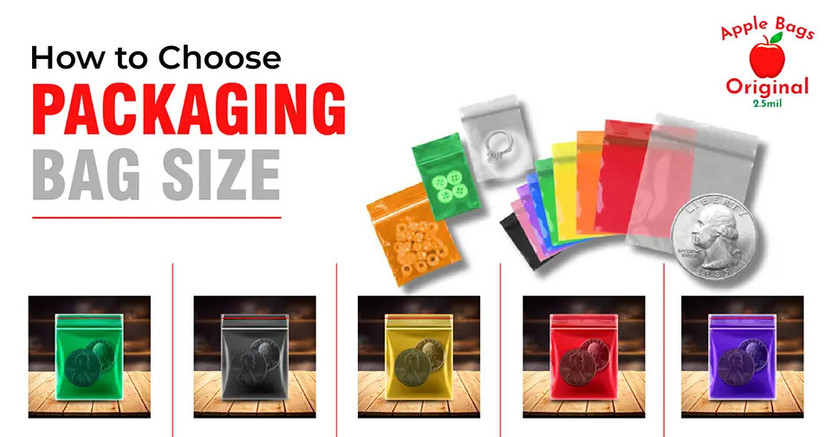
How to Choose Packaging Bag Size: A Complete Guide for Businesses
Jun 26th 2026
The choice of the packaging bag size is very critical than most companies assume it to be. A small bag may spoil the products or make it hard to pack and oversize bag may lead to higher material and waste storage area and higher shipping costs.
When it comes to packaging food products, retail goods, industrial products or eCommerce deliveries and collections, the proper selection of a packaging bag size adds to enhancing product protection levels, product presentation, and cut down operational costs.
Here are some tips in our guide that will clarify how to select the size of the packaging bag, what considerations should be made, what are the most common ways of sizing and how do weighing errors aid the packaging process.
Why Packaging Bag Size Matters
The packaging bag size will directly influence product safety, shipping expenses, customer experience, and efficiency in packaging.
By choosing the appropriate bag size, it helps:
- Protect products during transportation
- Reduce packaging waste
- Lower shipping costs
- Improve warehouse storage efficiency
- Create a professional appearance
- Prevent product movement inside the package
- Enhance customer satisfaction
To companies that deliver hundreds or thousands of products on a daily basis, a packaging bag size can save a lot of money in the long run.
| Measurement | What It Means |
| Width | Distance across the front of the bag |
| Height | Length from bottom to top |
| Depth / Gusset | Expansion space on sides or bottom |
| Capacity | Total volume the bag can hold |
| Weight Capacity | Maximum product weight supported |
Understanding these measurements is the first step in choosing the right packaging solution.
Step 1: Measure Your Product Accurately
Measure your product before choosing a packaging bag.
Record:
- Length
- Width
- Height
- Weight
For irregularly shaped products, measure the widest and tallest points.
Example
If you sell packaged snacks that measure:
- Length: 8 inches
- Width: 5 inches
- Height: 2 inches
The bag you will need is one that will fit these dimensions and still be roomy enough to enable sealing and protection of the products.
Proper packaging will eliminate unneeded expenditure on packaging and will also enhance consistency of the packaging.
Step 2: Consider Product Weight
Weight of the product is equally of great importance as dimensions in choosing a packaging bag.
A thin plastic bag can be appropriate in terms of clothing but can be inappropriate in terms of a heavy hardware part or a large food item.
Weight Considerations
| Product Type | Recommended Bag Type |
| Clothing | Poly mailers |
| Snacks | Stand-up pouches |
| Coffee | Gusseted bags |
| Hardware items | Heavy-duty poly bags |
| Agricultural products | Woven polypropylene bags |
Appropriate weighing machines are used to get the most appropriate packaging material and bag strength.
Step 3: Allow Space for Product Protection
Products should fit securely without being compressed.
Adding a small amount of extra space helps accommodate:
- Protective inserts
- Bubble wrap
- Cushioning materials
- Product movement during transit
Yet, too much unoccupied space might raise the prices of shipping and negatively impact the customer experience.
The rule of thumb is to have sufficient capacity that can be used in terms of protection but does not incorporate a high package volume.
Step 4: Understand Bag Types and Their Sizing Requirements
Different packaging bags require different sizing approaches.
Flat Bags
Flat bags are suitable for products with minimal thickness.
Common applications include:
- Documents
- Clothing
- Printed materials
Gusseted Bags
Gusseted bags expand to accommodate bulkier products.
These bags require consideration of:
- Width
- Height
- Gusset depth
Stand-Up Pouches
Stand-up pouches should have adequate capacity to accommodate the product and displaying the shelf. Manufacturers often specify recommended fill capacities.
Vacuum Bags
Vacuum packing is a process that requires proper sizing in order to provide a tight seal. Selecting the right type of bag assists in giving the best fitting sizes as well as product security.
Step 5: Factor in Shipping Costs
Shipping companies often calculate fees based on:
- Actual weight
- Dimensional weight
- Package dimensions
Using oversized bags can increase dimensional weight charges, even when the product itself is lightweight.
Example
Two products could be exactly the same weight but one package could be bigger and this package might be expensive to ship due to its size.
The choice of the size of a packaging bag can decrease transportation costs and make it more profitable.
Step 6: Consider Storage and Shelf Space
Retail products often compete for limited shelf space.
Choosing the right packaging dimensions can improve:
- Product visibility
- Shelf efficiency
- Inventory organisation
- Warehouse storage capacity
For eCommerce businesses, compact packaging can also reduce storage costs and simplify fulfilment operations.
Step 7: Test Packaging Before Full Production
Before ordering large quantities of packaging bags, conduct real-world testing.
Evaluate:
- Product fit
- Sealing performance
- Durability
- Shipping performance
- Customer presentation
Testing helps identify sizing issues before they affect production or customer satisfaction.
Common Packaging Bag Size Categories
Small Packaging Bags
Typically used for:
- Jewellery
- Accessories
- Small electronic parts
- Cosmetics
Medium Packaging Bags
Commonly used for:
- Clothing
- Food products
- Health supplements
- Retail merchandise
Large Packaging Bags
Ideal for:
- Bulk food products
- Industrial supplies
- Agricultural materials
- Large retail products
The right category depends on your product dimensions, weight, and packaging requirements.
`
Choosing Based Only on Product Dimensions
Many businesses forget to account for protective materials and sealing requirements.
Ignoring Product Weight
Heavy products may require stronger packaging materials, even if dimensions are small.
Ordering Large Quantities Without Testing
Testing samples first can prevent costly mistakes and excess inventory.
Using Oversized Packaging
Excessively large bags increase material usage, shipping costs, and storage requirements.
Neglecting Future Product Variations
If product sizes may change, consider packaging solutions that offer flexibility.
How Digital Scales Help Determine the Right Bag Size
Accurate weighing plays an important role in packaging selection.
Digital weighing scales help businesses:
- Measure product weight accurately
- Verify package weight limits
- Improve shipping cost calculations
- Reduce product giveaway
- Maintain consistency across packaging operations
For manufacturers, warehouses, and fulfilment centres, reliable weighing equipment helps ensure every package meets weight specifications before shipment.
Frequently Asked Questions
How do I determine the correct packaging bag size?
Take the measurement of the length, width, height and weight of your product and include sufficient room to carry protective materials and sealing needs.
Should packaging bags be larger than the product?
Yes but slightly. The bag must be able to be packed and secure, but not have too much empty space.
Does packaging size affect shipping costs?
Yes. When packages are larger, the dimension weight charges and the transportation costs could be high.
How important is product weight when choosing a bag?
The weight of the product assists in the measuring of the needed bag strength and the type of material to be used which makes it an important factor when choosing the packaging.
What is the best way to measure products for packaging?
Get the dimensions and weight measurements right by using proper measuring equipment and digital scales to weigh goods to be able to pick the type of packaging to use.
Final Thoughts
The selection of the size of a packaging bag is crucial to the protection of the products, costs, operational effectiveness, and customer satisfaction. When business owners pay attention to dimensions of products, their weights, packaging materials and shipping needs, as well as storage needs, they can choose a packaging solution that facilitates their performance and profitability.
Effective packaging operations must be based on good measurements and precise weighing exercises. You are packing food goods, retail goods, industrial materials, and eCommerce orders: taking time to pack them in the right sized bags can decrease wastage, lower the expenses of shipping goods, and help to increase the overall efficiency of business.
In companies that handle packaging and shipping, a detailed and precise digital weighing systems with quality packaging materials work together to create a more efficient and cost-efficient work system.