
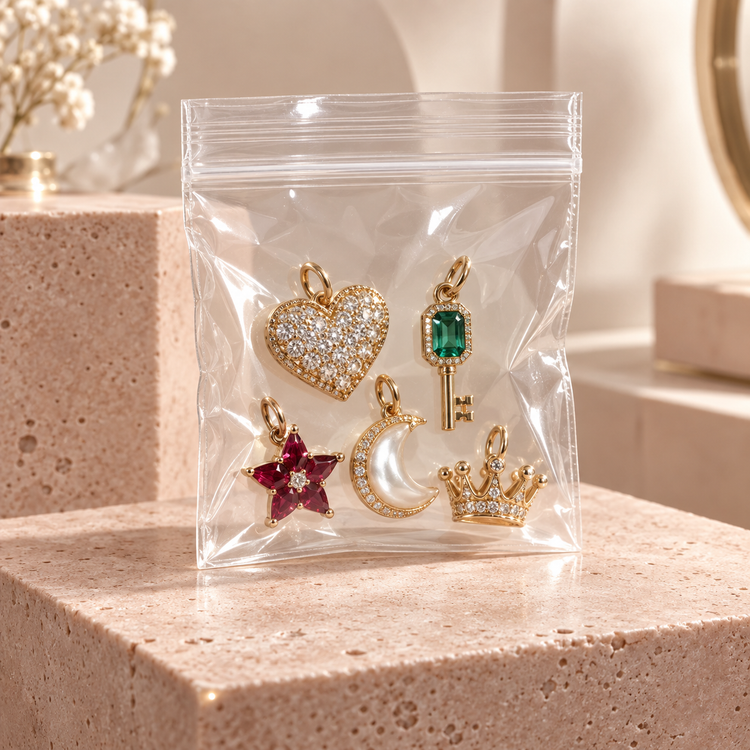
How to Choose Packaging Bags for Charms
Posted by AppleZipBags Team on Sep 15th 2026
Choosing the right packaging bags for charms requires more than measuring the decorative part of the charm and finding a bag with similar dimensions.
Charms can include:
-
Bails
-
Jump rings
-
Loops
-
Hooks
-
Wings
-
Pointed edges
-
Raised stones
-
Dangling components
-
Sculptural details
These features affect how a charm actually sits inside a bag.
A charm measuring one inch across its main body may need significantly more packaging space once its bail, jump ring or dangling components are included.
Apple Zip Bags offers jewelry bags for charms, jewelry components, beads and other small items.
For most charm sellers, the strongest process is:
identify the charm type → measure the entire charm → account for protrusions and thickness → determine quantity → leave zipper clearance → choose appropriate film thickness → decide between clear and colored → add SKU labels → test → standardize → buy proven sizes in bulk.
Quick Answer: How Do You Choose Packaging Bags for Charms?
Follow these steps:
-
Identify the charm type.
-
Measure the complete width and height.
-
Include bails, loops and jump rings.
-
Measure the charm's depth.
-
Look for sharp or projecting components.
-
Consider product weight.
-
Decide how many charms go into each bag.
-
Leave room around the product.
-
Leave clearance below the zipper.
-
Choose appropriate film thickness.
-
Decide between clear and colored packaging.
-
Confirm label space.
-
Test a smaller quantity.
-
Standardize successful sizes.
-
Move to bulk quantities once demand is predictable.
The goal is not:
the smallest bag the charm can physically enter.
The goal is:
the smallest bag that holds the complete charm comfortably and supports efficient packing, storage and handling.
Step 1: Identify the Type of Charm
Start by classifying the product.
Common charm types include:
-
Metal charms
-
Enamel charms
-
Rhinestone charms
-
Gemstone charms
-
Pendant charms
-
Letter charms
-
Zodiac charms
-
Birthstone charms
-
Holiday charms
-
Dangling charms
-
Vintage charms
-
Statement charms
Different designs create different packaging requirements.
Metal Charms
Metal charms can be:
small but relatively heavy.
A tiny bag may provide enough physical space while becoming overloaded if too many metal pieces are added.
Consider:
-
Size
-
Weight
-
Quantity
-
Edges
together.
Enamel Charms
Enamel charms are highly visual.
Clear packaging allows:
-
Design
-
Color
-
Shape
to remain visible.
Avoid excessively tight packaging that presses against decorative surfaces.
Rhinestone Charms
Rhinestone charms may include:
-
Raised stones
-
Prongs
-
Settings
These features increase:
depth
and may create pressure points.
Pendant Charms
Pendant-style charms are often:
longer
than ordinary bracelet charms.
Include the:
-
Bail
-
Jump ring
-
Attached loop
when measuring total height.
Dangling Charms
Dangling charms may contain several moving components.
Measure them in a:
natural packaged position.
Do not force the pieces into an unnatural shape merely to use a smaller bag.
Step 2: Measure the Complete Charm
This is the most important sizing step.
Do not measure only:
the decorative body.
Measure:
the entire assembled product.
That can include:
-
Bail
-
Loop
-
Jump ring
-
Chain
-
Hook
-
Hanging element
Apple Zip Bags' packaging bag size guide emphasizes measuring the actual product and allowing sufficient room before choosing packaging.
Measure the Widest Point
Suppose a wing charm has:
a narrow center
but:
wide wings.
Measure:
wingtip to wingtip.
The widest point determines minimum bag width.
Measure the Tallest Point
For pendant-style charms:
measure from:
the top of the bail to the bottom of the charm.
Do not ignore the attachment point.
Step 3: Measure Charm Depth
Length and width are not enough.
Some charms are:
almost flat.
Others may contain:
-
Raised stones
-
Sculptural designs
-
Domed surfaces
-
Multiple layers
Depth affects how much usable room remains inside the bag.
Example
Charm A:
1 × 1 inch
Almost flat
Charm B:
1 × 1 inch
Thick sculptural design
Although their face dimensions are identical:
Charm B may require a larger package.
Step 4: Account for Bails and Loops
Bails and loops are easy to overlook.
A charm body may measure:
0.75 inch
but the bail adds:
0.25 inch.
The actual package length becomes approximately:
1 inch before clearance is added.
Always measure:
the assembled product.
Step 5: Account for Jump Rings
If charms are sold with attached jump rings:
include them.
A jump ring can:
-
Increase total dimensions
-
Move during handling
-
Sit near the zipper
Leave enough room for it to move without interfering with closure.
Step 6: Account for Dangling Components
Some charms include:
-
Chains
-
Tassels
-
Multiple hanging pieces
-
Decorative drops
These components should not be aggressively folded or compressed just to fit smaller packaging.
Measure the product as it will actually be stored or sold.
Step 7: Check for Sharp Edges
Some charm designs create concentrated pressure points.
Examples include:
-
Stars
-
Arrows
-
Wings
-
Lightning bolts
-
Leaves
-
Geometric corners
A sharp edge pressed tightly against plastic can increase the chance of damage.
Allow more room when necessary.
Step 8: Check for Prongs
Rhinestone or gemstone charms may contain:
small metal prongs.
Do not force those areas against the bag.
Consider:
-
More clearance
-
Backing card
-
Additional inner protection
depending on the product.
Step 9: Consider Charm Weight
Small does not necessarily mean:
light.
Metal charms can be surprisingly dense.
A bag may physically accommodate:
20 metal charms
while handling much better with:
5 or 10.
Choose quantity based on:
weight + volume.
Step 10: Decide How Many Charms Go in One Bag
Charms may be sold:
-
Individually
-
In pairs
-
In sets
-
In bulk quantities
The package should be sized to:
the actual sellable unit.
Single Charms
For higher-value or unique charms:
one charm per bag may provide the cleanest inventory organization.
Charm Pairs
Some charms intended for:
earrings
may be sold in pairs.
Package the two pieces together if that matches the SKU.
Charm Sets
If the product listing contains:
5 matching charms,
size the bag for:
all five pieces.
Bulk Charm Packages
For:
25
50
or:
100 charms,
the packaging decision becomes increasingly dependent on:
-
Weight
-
Volume
-
Shape
Do not simply multiply dimensions.
Test the finished quantity.
Step 11: Decide Whether the Charm Is Loose or Carded
This changes bag size dramatically.
A charm may be:
tiny.
Its branded card may be:
several inches wide.
If the charm is mounted on a card:
size the bag to the carded assembly.
Loose vs. Carded Charms
| Format | Size According To |
|---|---|
| Single loose charm | Entire charm |
| Charm with jump ring | Charm + ring |
| Pendant | Pendant + bail |
| Charm set | Complete set |
| Carded charm | Entire card |
| Charm + findings | Complete packaged assembly |
Step 12: Choose the Smallest Comfortable Bag
The ideal package should provide:
-
Product clearance
-
Zipper clearance
-
Label room
-
Easy insertion
-
Easy removal
Avoid the temptation to choose the smallest theoretical size.
Why Overly Tight Charm Bags Cause Problems
They can make:
-
Packing slower
-
Removal difficult
-
Resealing harder
-
Sharp edges more problematic
-
Labels awkward
A little working room usually improves the package.
Step 13: Leave Clearance Below the Zipper
Do not position:
-
Bail
-
Jump ring
-
Pointed component
directly against the zipper.
Leave enough empty area so the closure can operate normally.
Step 14: Avoid Excessively Large Bags
More room is not always better.
An unnecessarily large bag can:
-
Waste storage space
-
Let the charm move excessively
-
Make presentation look less intentional
-
Require larger outer packaging
Choose:
comfortable, not oversized.
Step 15: Understand Film Thickness
Apple Zip Bags currently lists its jewelry bags at:
2.5 mil thickness.
One mil equals:
0.001 inch.
Therefore:
2.5 mil = 0.0025 inch.
Mil describes:
plastic film thickness.
It does not describe:
-
Bag width
-
Bag height
-
Capacity
Is 2.5 Mil Good for Charms?
For many everyday charm-storage and jewelry-making applications:
2.5 mil can provide a practical balance between:
-
Flexibility
-
Visibility
-
Compact storage
-
Handling
But thickness should be evaluated alongside:
-
Weight
-
Shape
-
Quantity
-
Sharpness
Step 16: Do Not Assume Thicker Is Always Better
A thicker bag is not automatically the right bag.
The correct order is:
size → shape → weight → thickness.
If a pointed charm is squeezed tightly into an undersized bag:
increasing film thickness does not correct the poor fit.
Step 17: Choose Clear or Colored Bags
For most charm businesses:
clear is the strongest default.
Why?
Charms are visual products.
Clear packaging lets staff and customers see:
-
Design
-
Shape
-
Finish
-
Color
without opening the package.
When Clear Bags Work Best
Choose clear when:
-
Product visibility matters
-
You carry many charm designs
-
Staff pick orders visually
-
Customers see packaged products
-
You need fast inventory checks
When Colored Bags Work Best
Colored bags can help with:
-
Category coding
-
Collection separation
-
Workflow status
-
Wholesale organization
For example:
Clear = standard retail
Blue = wholesale
Pink = seasonal collection
Green = inspected stock
Do Not Use Color Instead of Labels
A blue bag may identify:
wholesale
but it does not identify:
which charm is inside.
Color coding should supplement:
SKU labels.
Step 18: Make Sure the Label Fits
A charm package may need to display:
-
SKU
-
Product name
-
Size
-
Finish
-
Material
-
Quantity
Make sure the label:
fits without interfering with the zipper or hiding the entire product.
Step 19: Give Every Charm SKU a Unique Identifier
Shopify's SKU guidance explains that stock keeping units can be used to help organize products and support inventory and fulfillment workflows.
For example:
CH-HRT-GLD-01
Heart Charm
Gold-tone
Small
Another:
CH-MOON-SLV-01
Moon Charm
Silver-tone
Small
Step 20: Label Similar Designs Carefully
Charm collections may include:
several nearly identical products.
Examples:
Small heart
Medium heart
Large heart
or:
Gold heart
Silver heart
Rose-gold-tone heart
Clear packaging helps visually.
Labels provide:
exact confirmation.
Step 21: Include Size on the Label When Relevant
For example:
Moon Charm – 18 × 12 mm
This makes picking easier when the same design is offered in several sizes.
Step 22: Include Finish
If the same charm comes in:
-
Gold-tone
-
Silver-tone
-
Bronze-tone
-
Black
include the finish on the label.
Step 23: Include Quantity
If the package contains:
5 pieces
state:
5 PCS
or another clear quantity format.
Step 24: Use One SKU Per Bag
Unless you are intentionally selling a set:
avoid mixing different charm SKUs.
Separate bags improve:
-
Counting
-
Picking
-
Reordering
-
Quality checks
Step 25: Choose Bags for Tiny Charms
Tiny charms may fit into:
very small packaging.
However:
make sure the package is still easy to:
-
Open
-
Hold
-
Label
The absolute smallest bag may be inconvenient.
Step 26: Choose Bags for Large Charms
Large charms may require:
medium or larger jewelry bags.
Apple Zip Bags also offers larger bag options for products requiring more room.
Do not classify packaging purely according to the word:
“charm.”
Use actual dimensions.
Step 27: Choose Bags for Charm Sets
For sets:
arrange the complete product exactly as it will be sold.
Then test the bag.
Consider:
-
Number of pieces
-
Total weight
-
Total volume
-
Sharp edges
Step 28: Choose Bags for Charm Kits
A jewelry-making kit may contain:
-
Charms
-
Beads
-
Clasps
-
Jump rings
-
Cord
Separate small components where useful.
For example:
Bag 1 = charms
Bag 2 = beads
Bag 3 = findings
Then place them inside:
one larger kit.
Step 29: Standardize Core Bag Sizes
A charm business does not necessarily need:
a unique bag for every product.
A practical system might include:
Extra small = tiny flat charms
Small = everyday charms
Medium = pendants and larger charms
Large = carded charms or sets
Why Standardization Helps
It reduces:
-
Packaging SKUs
-
Purchasing complexity
-
Storage requirements
-
Packing mistakes
Step 30: Test Before Standardizing
Do not assume several charms will work in one size.
Test:
representative products.
For example:
-
Smallest charm
-
Largest charm
-
Thickest charm
-
Sharpest charm
If all intended products fit appropriately:
the size may be suitable for standardization.
Step 31: Start With 100 Bags When Testing
When a size is unproven:
start smaller.
Apple Zip Bags' 100-pack small jewelry bags can be used to test:
-
Fit
-
Label placement
-
Closure space
-
Staff workflow
before committing to bulk quantities.
Step 32: Move to 1,000 When the Size Is Proven
Once a bag works consistently:
larger quantities become more practical.
Apple Zip Bags' 1,000-pack small jewelry bags can suit sellers with recurring packaging demand across many charm SKUs.
100 vs. 1,000 Charm Bags
| Situation | Better Starting Point |
|---|---|
| New bag size | 100 |
| New charm collection | 100 |
| Testing labels | 100 |
| Testing colors | 100 |
| Low monthly demand | 100 |
| Proven bag size | 1,000 |
| Many charm SKUs | 1,000 |
| Wholesale demand | 1,000 |
| Frequent reordering | 1,000 |
The strongest sequence is:
test → validate → standardize → bulk buy.
Step 33: Calculate Monthly Charm Bag Usage
Do not calculate packaging demand from:
customer order count alone.
One customer may order:
8 different charms.
That order may require:
8 bags.
Use:
monthly orders × average individually packaged charm SKUs per order.
Example
150 orders per month
Average:
4 separately packaged charm SKUs
150 × 4 =
600 bags per month.
Then add:
-
Samples
-
Repair components
-
Craft kits
-
Safety stock
Step 34: Keep Safety Stock
Packaging is operational inventory.
Shopify's guide to safety stock explains the role of buffer inventory in reducing stockout risk when demand or replenishment changes unexpectedly.
The exact buffer depends on:
-
Monthly usage
-
Supplier lead time
-
Seasonal variation
-
Wholesale orders
Example
Expected monthly charm bag usage:
600
20% buffer:
120
Target:
720 bags.
Step 35: Plan for Seasonal Charm Demand
Charm sales can be seasonal.
Examples include:
-
Hearts around Valentine's Day
-
Bridal charms during wedding season
-
Graduation charms
-
Halloween charms
-
Holiday charms
Packaging demand should be forecast alongside product demand.
Step 36: Plan for Wholesale Orders
Wholesale orders can consume packaging quickly.
Example:
30 charm SKUs
× 10 packages each
=
300 bags
for one wholesale order.
Include wholesale demand in inventory planning.
Step 37: Consider Plain vs. Branded Bags
Plain packaging is flexible.
It can work across:
-
Different collections
-
New products
-
Seasonal lines
-
Branding updates
Brand identity can then be added using:
-
Labels
-
Stickers
-
Inserts
Apple Zip Bags' guide to custom-printed vs. plain jewelry bags discusses these tradeoffs.
Step 38: Treat Small Bags as Inner Packaging
Small charm bags are useful for:
-
Organization
-
Separation
-
Identification
-
Containment
But they are not automatically complete shipping protection.
Step 39: Protect Fragile Charms for Shipping
Charms containing:
-
Glass
-
Rhinestones
-
Gemstones
-
Delicate enamel
-
Fragile dangling pieces
may need additional protection.
FedEx provides jewelry shipping guidance that emphasizes appropriate inner packaging, cushioning and outer packaging.
Step 40: Avoid Unsupported Packaging Claims
Do not automatically describe a standard resealable bag as:
-
Waterproof
-
Hermetically sealed
-
Leakproof
-
Archival
-
Museum-grade
-
Anti-tarnish
unless those properties are specifically documented.
Common Mistakes When Choosing Packaging Bags for Charms
Measuring Only the Charm Body
Include:
bails, loops, rings and dangling components.
Ignoring Depth
Three-dimensional charms need additional room.
Choosing the Tightest Possible Bag
Choose a comfortable fit.
Ignoring Sharp Edges
Pointed designs can concentrate pressure against the film.
Ignoring Prongs
Raised settings may need more clearance.
Ignoring Weight
Small metal charms can be heavy.
Treating Loose and Carded Charms the Same
Size the package to the final assembly.
Filling to the Zipper
Leave closure clearance.
Choosing Color Before Fit
Size comes first.
Using Clear Bags Without Labels
Visibility does not replace SKU identification.
Using Color Instead of SKUs
Color coding should supplement labels.
Mixing Unrelated SKUs
Separate products unless intentionally sold as a set.
Carrying Too Many Bag Sizes
Standardize where practical.
Buying 1,000 Before Testing
Validate the packaging first.
Calculating Demand Only From Orders
One order may consume multiple bags.
Forgetting Safety Stock
Packaging shortages can interrupt fulfillment.
Treating a Small Bag as Complete Shipping Protection
Fragile charms may need cushioning and suitable outer packaging.
Charm Packaging Selection Checklist
Before ordering, ask:
-
What type of charm am I packaging?
-
What is its complete width?
-
What is its complete height?
-
What is its depth?
-
Does it have a bail?
-
Does it have a loop?
-
Does it have an attached jump ring?
-
Does it have dangling components?
-
Does it have sharp edges?
-
Does it contain prongs?
-
Is it heavy?
-
How many charms go into one package?
-
Is it sold individually?
-
Is it sold as a pair?
-
Is it sold as a set?
-
Is the charm loose?
-
Is it mounted on a card?
-
Is there enough working room?
-
Is there zipper clearance?
-
Is the film thickness suitable?
-
Should the bag be clear?
-
Would color coding provide a useful purpose?
-
Is there enough label space?
-
Is the SKU shown?
-
Is charm size shown?
-
Is finish shown?
-
Is quantity shown?
-
Can one bag size serve multiple SKUs?
-
Can packaging sizes be standardized?
-
Should I test 100 first?
-
Is the size already proven?
-
Would 1,000 make more sense?
-
How many bags are used monthly?
-
Is safety stock included?
-
Is seasonal demand included?
-
Is wholesale demand included?
-
Does the charm need additional shipping protection?
-
Have unsupported waterproof, archival and anti-tarnish claims been avoided?
Frequently Asked Questions
How do I choose packaging bags for charms?
Measure the:
entire assembled charm
including:
-
Bail
-
Loop
-
Jump ring
-
Dangling components
Then add enough room for:
comfortable handling and closure.
What size bag should I use for charms?
There is no universal charm bag size.
Choose according to:
-
Complete dimensions
-
Depth
-
Weight
-
Quantity
-
Packaging format
Should I choose the smallest bag that fits?
Not necessarily.
Choose:
the smallest comfortable bag
rather than the smallest technically possible bag.
Should I include the bail when measuring?
Yes.
Include all attached components in the measurement.
Should I include jump rings?
Yes.
Measure the product as it will actually be sold.
How should I package dangling charms?
Measure them in their natural packaged position and avoid excessive compression.
What about pointed charms?
Leave additional room around sharp or pointed components.
Additional protection may also be appropriate.
What about charms with rhinestones?
Consider the additional depth created by:
-
Stones
-
Settings
-
Prongs
Avoid forcing raised components against the bag.
Are clear bags good for charms?
Yes.
For most charm inventories:
clear packaging is the strongest default because the design remains visible.
When should I use colored charm bags?
Colored bags can be useful for:
-
Category coding
-
Collection separation
-
Wholesale organization
-
Workflow status
What thickness works for charm bags?
Apple Zip Bags currently lists its jewelry bags at:
2.5 mil.
This can be practical for many everyday charm-storage applications.
Does thicker mean better?
Not automatically.
The correct bag should first fit:
the product's dimensions, shape and weight.
What should I put on a charm bag label?
Depending on the product:
-
SKU
-
Product name
-
Size
-
Finish
-
Material
-
Quantity
may be useful.
Should every charm SKU have a separate bag?
For inventory organization:
generally yes.
Products intentionally sold as sets can be packaged together.
How should I package charms on cards?
Size the bag according to:
the complete carded product.
Should I buy 100 or 1,000 charm bags?
Start with:
100
when testing.
Move to:
1,000
when the size is proven and demand is predictable.
How do I calculate monthly charm bag demand?
Use:
monthly orders × average separately packaged charm SKUs per order.
Then add:
-
Samples
-
Kits
-
Repair components
-
Safety stock
Are small charm bags enough for shipping?
They are usually best treated as inner packaging.
Fragile charms may need:
-
Cushioning
-
Protective mailers
-
Boxes
-
Other suitable outer packaging
Are resealable charm bags waterproof?
Do not assume standard resealable bags are waterproof or hermetically sealed unless specifically documented.
Are standard charm bags anti-tarnish?
Not automatically.
Anti-tarnish performance requires packaging specifically designed and documented for that purpose.
Final Verdict: How to Choose Packaging Bags for Charms
Choosing the right packaging bags for charms begins with:
the complete charm—not just its decorative body.
Measure:
-
Width
-
Height
-
Depth
and include:
-
Bails
-
Loops
-
Jump rings
-
Hooks
-
Dangling pieces
Then evaluate:
shape and weight.
Pointed or heavy charms may require:
-
More room
-
Lower quantities per bag
-
Additional protection
For everyday charm inventory:
clear packaging is usually the strongest default
because employees and customers can immediately see:
-
Design
-
Shape
-
Color
-
Finish
Combine visibility with:
SKU labels
for exact identification.
For film thickness:
Apple Zip Bags currently lists its jewelry bags at:
2.5 mil, which can provide a practical option for many ordinary charm-storage applications.
For purchasing:
start with:
100 bags
when testing an unproven size.
Move to:
1,000
when:
-
The size works
-
Labels fit
-
Multiple charm SKUs use it
-
Monthly demand is predictable
The strongest selection process is:
identify charm type → measure the entire assembled product → account for depth, bails, rings and protrusions → evaluate weight and sharp edges → determine package quantity → choose bag size → leave zipper clearance → confirm film thickness → choose clear or colored → label by SKU → test → standardize → forecast usage → buy proven sizes in bulk.
That creates a charm packaging system that is easier to:
organize, store, identify, pick, sell and scale.