
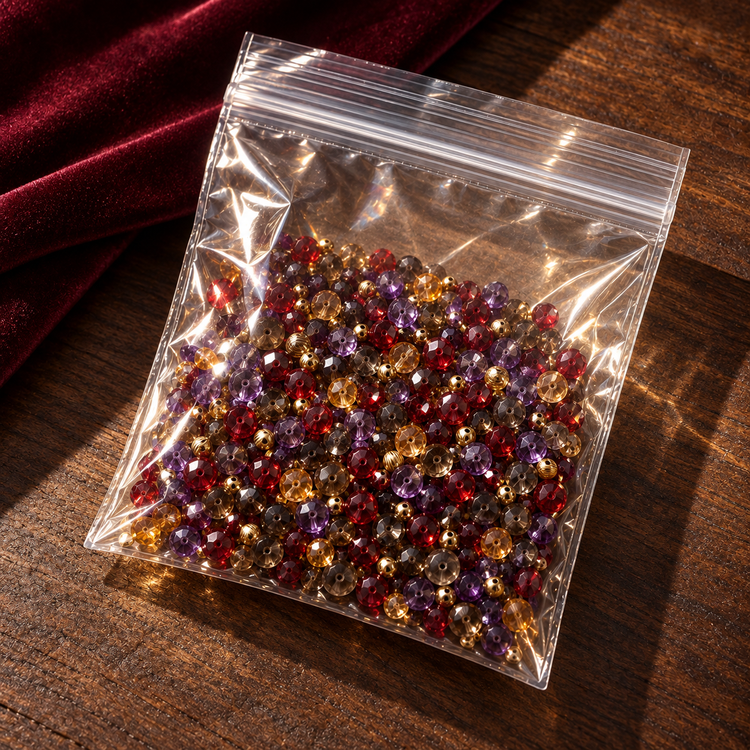
How to Choose Packaging Bags for Beads
Posted by AppleZipBags Team on Sep 13th 2026
Choosing the right packaging bags for beads starts with understanding what is actually going inside the bag.
A package of tiny seed beads has very different requirements from:
-
A strand of 12 mm gemstone beads
-
Large wooden beads
-
Heavy metal beads
-
Crystal bead mixes
-
Jewelry findings
The best bead bag therefore depends on more than simple dimensions.
You need to consider:
-
Bead size
-
Bead shape
-
Package quantity
-
Loose vs. stranded format
-
Product weight
-
Visibility
-
Label space
-
Storage method
-
Sales volume
Apple Zip Bags offers jewelry bags suitable for beads, charms, jewelry pieces and other small items.
Its jewelry bags are currently listed at:
2.5 mil thickness
and are available in different sizes and colors.
The strongest selection method is:
identify the bead type → decide how many beads go in each package → test the actual volume → leave closure clearance → select clear or colored packaging → label properly → test a small quantity → move into bulk once the size is proven.
Quick Answer: How Do You Choose Bags for Beads?
Use these steps:
-
Identify the bead type.
-
Determine whether beads are loose or stranded.
-
Decide how many beads belong in each package.
-
Test the actual physical volume.
-
Leave space below the zipper.
-
Consider bead weight and sharp edges.
-
Choose clear or colored film.
-
Confirm label space.
-
Test the packaging with a smaller pack.
-
Standardize successful sizes.
-
Calculate monthly bag demand.
-
Move into bulk quantities once usage is predictable.
The biggest mistake is choosing:
the smallest bag that technically holds the beads.
The better goal is:
a bag that holds the product comfortably and remains easy to fill, close, label, store and reopen.
Step 1: Identify the Bead Type
Start with the material.
Common bead categories include:
-
Seed beads
-
Gemstone beads
-
Glass beads
-
Crystal beads
-
Acrylic beads
-
Wooden beads
-
Metal beads
-
Pearl-style beads
-
Letter beads
-
Spacer beads
-
Mixed bead assortments
Different materials behave differently inside packaging.
Seed Beads
Seed beads are:
-
Small
-
Compact
-
Often sold in relatively high counts
They can fit into very small bags.
The most important features are usually:
-
Clear visibility
-
Secure closure
-
Easy pouring
-
Good label space
Gemstone Beads
Gemstone beads are usually:
-
Larger
-
Heavier
-
More variable in shape
They may need significantly more bag volume than seed beads.
Glass Beads
Glass beads can vary from:
-
Tiny rounds
-
Large decorative beads
-
Drops
-
Tubes
Large or fragile glass beads may also need additional shipping protection.
Crystal Beads
Crystal beads often benefit from clear packaging because customers and staff can see:
-
Color
-
Transparency
-
Finish
-
Shape
without opening the package.
Acrylic Beads
Acrylic beads can be:
-
Lightweight
-
Bulky
Weight alone may make them appear easy to package, but physical volume may require a larger bag.
Wooden Beads
Wood beads can also occupy considerable space while remaining relatively light.
Choose by:
volume rather than weight.
Metal Beads
Metal beads can be compact but heavy.
Avoid overfilling a small bag simply because the beads fit dimensionally.
Heavy contents can put more stress on:
-
Seams
-
Closure
-
Film
Step 2: Decide Whether the Beads Are Loose or Stranded
This dramatically changes packaging needs.
Loose beads can settle into a compact shape.
Stranded beads maintain a much larger footprint.
Loose Beads
Loose beads are usually easier to package.
They settle naturally inside the bag.
Choose according to:
-
Volume
-
Quantity
-
Weight
Bead Strands
A bead strand may need much more:
-
Width
-
Height
even when it contains the same total quantity as loose beads.
Measure the strand:
in the exact position in which it will be packaged.
Loose vs. Stranded Beads
| Bead Format | Main Packaging Consideration |
|---|---|
| Loose seed beads | Compact volume |
| Loose gemstone beads | Depth and weight |
| Short bead strand | Width and height |
| Full strand | Larger footprint |
| Mixed bead kit | Multiple inner bags may help |
Step 3: Decide How Many Beads Go in Each Bag
Before choosing dimensions:
decide the package quantity.
Beads may be sold by:
-
Count
-
Weight
-
Strand
-
Set
-
Mix
A bag intended for:
25 beads
does not need the same capacity as a bag intended for:
250 beads.
Bead Count Alone Is Not Enough
Twenty-five:
12 mm beads
occupy much more space than:
25 tiny seed beads.
Always combine bead count with:
physical volume.
Bead Weight Alone Is Not Enough Either
Ten grams of:
metal beads
may occupy less space than:
10 grams of large acrylic beads.
The bag should be chosen around:
how the product physically fills the package.
Step 4: Test the Actual Volume
Do not rely only on calculations.
Put the actual quantity of beads into the proposed bag.
Then ask:
-
Does it close easily?
-
Is the zipper area clear?
-
Is the bag bulging?
-
Can the beads be poured out easily?
-
Can the package be resealed?
If not:
move to the next larger size.
Apple Zip Bags' bag size guide emphasizes measuring the actual item and allowing enough space rather than choosing packaging that fits too precisely.
Step 5: Leave Space Below the Zipper
This is particularly important for tiny beads.
If beads fill the package all the way to the zipper:
they can interfere with closure.
Leave some empty space so the bag can be:
-
Closed
-
Reopened
-
Poured from
-
Resealed
without beads getting trapped near the seal.
How Much Empty Space Should You Leave?
There is no universal number.
The package should simply have:
enough working space for normal handling.
If the beads constantly reach the zipper:
the bag is probably too small or too full.
Step 6: Consider Bead Size
Bead diameter strongly affects bag volume.
For example:
-
2 mm beads
-
4 mm beads
-
6 mm beads
-
8 mm beads
-
10 mm beads
-
12 mm beads
all occupy increasingly larger amounts of space.
Fire Mountain Gems provides a useful seed bead size reference showing how much bead dimensions can vary.
Step 7: Consider Bead Shape
Shape affects how efficiently beads settle.
Round beads pack differently from:
-
Cubes
-
Chips
-
Nuggets
-
Tubes
-
Drops
-
Flowers
-
Stars
Irregular beads often leave more empty space between pieces.
That means:
a larger bag may be required even if bead count stays the same.
Step 8: Consider Bead Weight
Heavier beads place more stress on the package.
Examples include:
-
Metal beads
-
Large gemstone beads
-
Dense glass beads
Avoid creating a package that is technically large enough but overloaded.
Step 9: Consider Sharp or Irregular Components
Some bead packages may contain:
-
Pointed beads
-
Metal findings
-
Wire
-
Pins
-
Sharp edges
These can place concentrated pressure on plastic.
Consider using:
-
A larger bag
-
Backing card
-
Additional inner protection
when needed.
Step 10: Decide Between Clear and Colored Bags
For beads:
clear bags are usually the strongest default.
Visibility is particularly valuable because beads are frequently differentiated by:
-
Color
-
Size
-
Finish
-
Shape
-
Material
Choose Clear Bags When You Need:
-
Fast product identification
-
Color visibility
-
Inventory checks
-
Order picking
-
Quality control
-
Wholesale sorting
Clear packaging lets staff see the contents without opening the bag.
Choose Colored Bags When You Need:
-
Category coding
-
Collection separation
-
Internal organization
-
Privacy
For example:
Clear = beads
Blue = charms
Pink = findings
Green = repair parts
Keep the system simple.
Clear vs. Colored Bead Bags
| Goal | Clear Bags | Colored Bags |
|---|---|---|
| See bead color | Excellent | Limited |
| See bead shape | Excellent | Limited |
| Inventory checks | Excellent | Good |
| Category coding | Limited | Excellent |
| Wholesale sorting | Excellent | Excellent |
| SKU organization | Excellent | Excellent |
| Quick picking | Excellent | Good |
For most bead sellers:
clear wins because visibility is operationally useful.
Step 11: Understand Film Thickness
Apple Zip Bags currently lists its jewelry bags at:
2.5 mil thickness.
One mil equals:
0.001 inch.
Therefore:
2.5 mil = 0.0025 inch.
Mil refers to:
film thickness
not the bag dimensions.
Is 2.5 Mil Good for Beads?
For many everyday bead and jewelry-making applications:
yes.
A 2.5 mil bag can provide a useful balance between:
-
Flexibility
-
Visibility
-
Compact storage
-
Handling convenience
But the correct packaging still depends on:
-
Weight
-
Sharpness
-
Quantity
-
Frequency of handling
Is Thicker Always Better?
No.
More thickness may mean:
-
More material
-
More bulk
-
Less flexibility
The right choice should match the application.
Tiny seed beads may not need the same bag construction as heavy metal beads.
Step 12: Make Sure Labels Fit
Labels are extremely important for bead inventory.
A good bead package may include:
-
SKU
-
Bead type
-
Size
-
Color
-
Quantity
-
Material
-
Hole size
The bag needs enough visible area for the label without completely covering the product.
Step 13: Use One SKU Per Bag
Unless you are intentionally selling a bead mix:
keep one product SKU per package.
This makes inventory easier to:
-
Count
-
Pick
-
Reorder
-
Verify
Shopify's guide to SKUs explains how structured product codes can help businesses identify and organize inventory.
Example Bead SKU
Product:
8 mm rose quartz round beads
Possible internal SKU:
RQ-RND-8MM
The packaging label can then include:
RQ-RND-8MM
Rose Quartz
8 mm
25 pieces
Step 14: Label Bead Size Clearly
Bead sizes can look very similar.
For example:
6 mm
and:
8 mm
may be difficult to distinguish quickly.
Always label product size when it matters.
Step 15: Label Hole Size When Relevant
Jewelry makers may also care about:
-
Hole diameter
-
Cord compatibility
If hole size is an important product specification:
include it.
Step 16: Label Quantity Clearly
If beads are sold by count:
show the quantity.
Examples:
25 pcs
50 pcs
100 pcs
This makes fulfillment and customer identification easier.
Step 17: Label Weight When Sold by Weight
If the product is sold by weight:
clearly distinguish:
-
Product weight
-
Package quantity
Consistency matters.
Step 18: Choose Bags for Seed Beads
Seed bead packaging should prioritize:
-
Compact dimensions
-
Clear visibility
-
Easy closure
-
Labeling
Because seed beads are tiny:
leave enough empty space near the zipper to prevent interference.
Step 19: Choose Bags for Gemstone Beads
For gemstone beads:
focus on:
-
Bead diameter
-
Quantity
-
Weight
-
Package depth
Large gemstone beads may require more room than their count suggests.
Step 20: Choose Bags for Bead Strands
If beads are still on a strand:
measure:
the entire packaged strand.
Do not size the bag as though the beads were loose.
Step 21: Choose Bags for Bead Mixes
Mixed packages may contain beads of:
-
Different shapes
-
Different sizes
-
Different materials
Test the actual finished mixture.
Do not estimate based on one bead type.
Step 22: Choose Bags for Findings and Beads Together
If a kit includes:
-
Beads
-
Clasps
-
Jump rings
-
Cord
-
Charms
consider using:
separate inner bags
rather than mixing everything together.
This makes the kit easier to use.
Step 23: Use Small Bags for Craft Kits
A larger craft package may include:
Bag 1 = beads
Bag 2 = charms
Bag 3 = findings
Bag 4 = cord
Then all small bags can be placed into:
one larger outer package.
Step 24: Standardize Bag Sizes
Do not carry dozens of nearly identical sizes unless necessary.
A practical bead business may use:
three or four core bag sizes.
Example:
Extra small = seed beads
Small = standard loose beads
Medium = gemstone beads
Large = full strands or bulk packages
Why Standardization Helps
Standardization makes:
-
Purchasing
-
Storage
-
Employee training
-
Inventory management
simpler.
It also makes bulk purchasing more efficient.
Step 25: Test a Smaller Pack Before Buying Bulk
If a size is new:
test it first.
Apple Zip Bags' 100-pack small jewelry bags can be useful when evaluating:
-
Bead capacity
-
Label fit
-
Closure space
-
Storage efficiency
before committing to larger quantities.
Step 26: Move to 1,000 When the Size Is Proven
Once the packaging format works consistently:
bulk ordering becomes more practical.
Apple Zip Bags' 1,000-pack small jewelry bags can suit bead sellers who repeatedly use the same bag across multiple SKUs.
100 vs. 1,000 Bags for Beads
| Situation | Better Starting Point |
|---|---|
| New size | 100 |
| New bead category | 100 |
| Testing labels | 100 |
| Low sales volume | 100 |
| Proven bag size | 1,000 |
| Many bead SKUs | 1,000 |
| Wholesale business | 1,000 |
| Frequent packing | 1,000 |
The safest strategy is:
test → standardize → bulk buy.
Step 27: Calculate Monthly Bag Usage
Customer order count alone may underestimate bag demand.
Why?
Because one order can contain:
many bead SKUs.
A customer may order:
8 different bead products.
That single order may require:
8 separate bags.
Better Formula for Bead Businesses
Use:
monthly orders × average individually packaged SKUs per order = monthly bag demand.
Example:
120 orders per month
Average:
5 individually packaged bead SKUs per order
120 × 5 =
600 bags per month.
Add Other Packaging Uses
You may also use small bags for:
-
Samples
-
Replacement pieces
-
Findings
-
Spare beads
-
Repair kits
Include these in monthly demand.
Step 28: Keep Safety Stock
Do not order exactly the quantity you expect to use.
Packaging inventory should have some buffer.
Shopify's guide to safety stock and reorder points explains how buffer inventory helps businesses handle fluctuations in demand and replenishment delays.
Example Safety Stock
Expected monthly bag usage:
800 bags
20% buffer:
160 bags
Target availability:
960 bags.
At this volume:
a 1,000-pack may be very practical.
Step 29: Create a Reorder Point
Use:
average daily bag usage × lead time + safety stock.
Example:
Daily usage:
30 bags
Lead time:
7 days
Safety stock:
150 bags
30 × 7 = 210
210 + 150 =
360 bags.
Reorder when inventory approaches:
360 bags.
Step 30: Track Packaging Inventory
As the business grows:
track packaging supplies like other operational inventory.
Shopify's inventory management guide explains broader inventory-control principles that can also be applied to packaging supplies.
Create Internal Bag SKUs
Examples:
BEAD-BAG-XS-CLR
Extra-small clear bead bag
BEAD-BAG-SM-CLR
Small clear bead bag
BEAD-BAG-MED-CLR
Medium clear bead bag
This makes ordering easier.
Step 31: Organize Bag Storage
Tiny packaging sizes can look nearly identical.
Store them in separate bins labeled by:
-
Dimensions
-
Color
-
Internal SKU
-
Intended use
This reduces packing errors.
Step 32: Think About Wholesale Orders
Wholesale bead buyers may order:
large quantities of many SKUs.
Example:
20 bead styles
× 5 packages each
=
100 individual bags
for one wholesale order.
Wholesale operations often benefit from bulk packaging inventory.
Step 33: Think About Seasonal Demand
Craft sales may increase around:
-
Holidays
-
Wedding season
-
Craft-fair season
-
DIY gifting periods
Increase packaging stock before predictable demand spikes.
Step 34: Consider Photography and Listing Workflows
Beads often move through:
-
Receiving
-
Sorting
-
Photography
-
Listing
-
Storage
-
Fulfillment
Clear bags make these workflows easier because contents remain visible.
Step 35: Use Packaging for Project Organization
Jewelry makers can also use bags for:
individual projects.
Example:
one bag contains all components needed for:
one bracelet design.
That makes project preparation easier.
Step 36: Use Bags as Inner Packaging
Small resealable bags are usually best treated as:
inner organization.
They can then be placed inside:
-
Mailers
-
Boxes
-
Larger bags
-
Craft kits
depending on the shipment.
Step 37: Protect Fragile Beads During Shipping
Glass, crystal and some gemstone beads may require:
-
Padding
-
Separation
-
Protective outer packaging
A small plastic bag alone may not provide sufficient shipping protection.
UPS provides general packaging guidance for choosing suitable internal and outer protection.
Step 38: Do Not Assume Resealable Means Waterproof
A standard zipper closure should not automatically be described as:
-
Waterproof
-
Hermetically sealed
-
Leakproof
unless the specific product is documented that way.
Step 39: Do Not Assume Standard Bags Are Archival
Similarly:
standard jewelry bags should not automatically be called:
-
Archival
-
Museum-grade
unless specifically designed for that use.
Step 40: Check Whether Plain or Branded Packaging Makes More Sense
For bead sellers carrying hundreds of SKUs:
plain bags can offer flexibility.
Branding can then be added with:
-
Labels
-
Stickers
-
Inserts
Apple Zip Bags discusses these tradeoffs in its guide to custom-printed vs. plain jewelry bags.
Common Mistakes When Choosing Bead Packaging Bags
Choosing the Smallest Bag Possible
Leave working room.
Filling the Bag to the Zipper
Keep the closure area clear.
Choosing by Weight Alone
Volume matters.
Choosing by Count Alone
Large beads occupy more space.
Ignoring Bead Shape
Irregular beads pack differently.
Treating Loose and Stranded Beads the Same
They need different dimensions.
Ignoring Heavy Beads
Weight can stress the package.
Ignoring Sharp Components
Use additional protection when needed.
Choosing Colored Bags That Hide Important Product Details
Visibility matters for bead inventory.
Skipping Labels
Similar beads can be easily confused.
Forgetting Bead Size on Labels
6 mm and 8 mm products can look very similar.
Mixing SKUs
Keep separate products separate unless selling a mix.
Using Too Many Bag Sizes
Standardize where practical.
Buying 1,000 Before Testing
Validate the packaging first.
Calculating Demand Only From Order Count
One order may require several bags.
Forgetting Safety Stock
Packaging shortages interrupt fulfillment.
Treating Small Bags as Complete Shipping Protection
Use suitable outer packaging.
Bead Packaging Bag Checklist
Before ordering, ask:
-
What bead material am I packaging?
-
Are the beads loose or stranded?
-
What is the bead diameter?
-
What is the bead shape?
-
How many beads go in one package?
-
Is the product sold by count or weight?
-
What physical volume does the product occupy?
-
Does the bag close comfortably?
-
Is there room below the zipper?
-
Can the package be reopened easily?
-
Are the beads heavy?
-
Are any components sharp?
-
Should the bag be clear?
-
Would colored bags improve organization?
-
Does the bag provide label space?
-
Is the SKU visible?
-
Is bead size shown?
-
Is material shown?
-
Is quantity shown if relevant?
-
Is hole size important?
-
Is one SKU stored per bag?
-
Can this bag work across several bead SKUs?
-
Can bag sizes be standardized?
-
Should I test 100 first?
-
Is the size already proven?
-
Would 1,000 make more sense?
-
How many individual bead packages are prepared monthly?
-
Have multi-SKU orders been included?
-
Is safety stock included?
-
Is there a reorder point?
-
Are fragile beads protected for shipping?
-
Have unsupported waterproof or archival claims been avoided?
Frequently Asked Questions
How do I choose packaging bags for beads?
Start with:
-
Bead type
-
Size
-
Shape
-
Quantity
-
Loose vs. stranded format
Then test the actual beads inside the bag before purchasing in bulk.
What size bag should I use for beads?
There is no universal bead bag size.
Choose according to:
actual package volume.
Should bead bags be clear?
For most bead businesses:
clear is the strongest default because it makes:
-
Color
-
Shape
-
Finish
-
Size
easier to identify.
Are colored bags useful?
Yes.
They can help with:
-
Category coding
-
Collection organization
-
Internal sorting
What thickness works for bead bags?
Apple Zip Bags currently lists its jewelry bags at:
2.5 mil.
This can work well for many ordinary bead-packaging applications.
What does 2.5 mil mean?
It means:
0.0025 inch film thickness.
It does not refer to bag dimensions.
How full should a bead bag be?
Leave enough room below the zipper for:
-
Closing
-
Opening
-
Pouring
-
Resealing
Should seed beads use smaller bags?
Often yes.
Seed beads are compact and can usually use smaller packaging than large gemstone or wooden beads.
How should gemstone beads be packaged?
Consider:
-
Bead diameter
-
Weight
-
Quantity
-
Package depth
Avoid overfilling.
What about bead strands?
Measure the full strand in its packaged position.
Do not size the bag as though the beads were loose.
Should every bead SKU have its own bag?
For inventory control:
generally yes.
What should be printed on a bead label?
Depending on the product:
-
SKU
-
Material
-
Size
-
Color
-
Quantity
-
Hole size
may be useful.
Should I buy 100 or 1,000 bead bags?
Buy 100 when:
-
Testing a new size
-
Launching a category
-
Unsure of capacity
Buy 1,000 when:
-
The size is proven
-
Several SKUs use the same bag
-
Monthly demand is predictable
How do I calculate monthly bead bag demand?
Use:
monthly orders × average individually packaged bead SKUs per order.
Then add:
-
Samples
-
Findings
-
Replacement bags
-
Safety stock
Can bead bags be used for wholesale?
Yes.
Wholesale bead businesses often benefit from individually labeled clear bags.
Can I use bead bags for jewelry kits?
Yes.
Separate small bags can organize:
-
Beads
-
Findings
-
Charms
-
Cord
inside one larger kit.
Are resealable bead bags waterproof?
Do not assume a standard resealable bag is waterproof or hermetically sealed unless specifically documented.
Are standard bead bags archival?
Not automatically.
Archival performance requires packaging specifically designed and documented for that purpose.
Final Verdict: How to Choose Packaging Bags for Beads
The right packaging bags for beads should be selected according to:
the actual product volume and packaging workflow.
Start by identifying:
-
Bead type
-
Size
-
Shape
-
Loose or stranded format
-
Quantity per package
Then test the finished package.
The bag should:
-
Hold the beads comfortably
-
Leave room below the zipper
-
Close easily
-
Reopen easily
-
Provide enough label space
-
Avoid excessive unused room
For most bead businesses:
clear resealable bags are the strongest default
because they make it easy to identify:
-
Color
-
Shape
-
Size
-
Finish
without opening the package.
For packaging thickness:
Apple Zip Bags' current:
2.5 mil jewelry bags
provide a practical option for many everyday bead applications.
For inventory:
use:
one SKU per bag
where possible, and label products clearly.
For quantity:
start with:
100 bags
when testing a new size.
Move to:
1,000 bags
when:
-
The size is proven
-
Multiple SKUs use it
-
Monthly demand is predictable
The strongest bead-packaging process is:
identify bead type → determine loose or stranded format → determine package quantity → test actual volume → leave zipper clearance → select clear or colored → add labels → standardize core sizes → calculate monthly usage → maintain safety stock → bulk-buy proven packaging.
That creates a bead packaging system that is easier to:
sort, identify, store, sell and fulfill.