
Clear or Colored Bags for Coins: What Works Best?
Posted by AppleZipBags Team on Sep 30th 2026
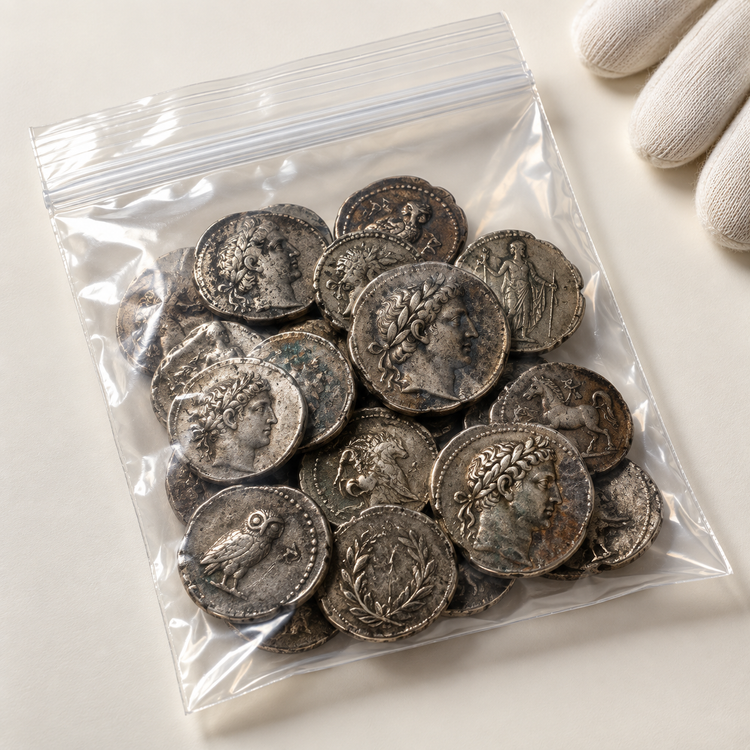
Clear bags are generally the best all-purpose choice for packaging and organizing coins because they allow the coin, holder and inventory label to remain visible.
Colored bags can also be useful, especially when a coin dealer or collector needs a simple visual system for separating:
-
Countries
-
Denominations
-
Inventory status
-
Consignments
-
Research queues
-
Coin-show stock
-
Sold merchandise
-
Photography assignments
For many coin businesses, the strongest solution is not choosing exclusively between clear and colored packaging. It is combining them:
clear resealable bag + colored inventory label
This approach preserves product visibility while adding fast visual organization.
However, color is only one part of the coin-packaging decision. The bag must also fit the complete coin holder, provide enough closure clearance and suit the intended handling conditions.
Most importantly, an ordinary resealable bag should not automatically be treated as an archival coin holder. Collectible coins should first be placed in a suitable PVC-free flip, capsule, cardboard holder, hard holder or certified slab. The resealable bag can then function as secondary packaging for organization, labeling or retail presentation.
This guide compares clear and colored bags for coins and explains when each option works best.
Quick Answer: Clear vs. Colored Coin Bags
| Packaging Need | Clear Bags | Colored Bags | Best Choice |
|---|---|---|---|
| Visual coin identification | Excellent | Depends on transparency | Clear |
| Viewing dates and mint marks | Easier | May be obstructed | Clear |
| Retail display | Strong | Useful for branding | Usually clear |
| Order picking | Strong | Strong with a color system | Clear or combined |
| Category coding | Requires colored labels | Excellent | Colored |
| Photography workflow | Easy to inspect contents | Useful for status coding | Combined |
| Coin-show organization | Strong visibility | Fast category recognition | Combined |
| Inventory counting | Easy to verify contents | Helpful for broad groups | Combined |
| Keeping slabs visible | Excellent | May hide certification details | Clear |
| Branding | Neutral | More visually distinctive | Colored |
| Long-term direct coin storage | Not automatically suitable | Not automatically suitable | Use a verified coin holder |
| General secondary packaging | Excellent | Useful for defined categories | Clear for most users |
The Best Overall Choice
For most coin dealers, collectors and resellers:
clear bags are the best general-purpose option.
They allow users to see:
-
Coin type
-
Denomination
-
Date
-
Mint mark
-
Holder
-
Grade information
-
Certification label
-
Inventory card
-
Package condition
without opening the bag.
Colored bags work best when the color has a specific operational purpose.
Examples include:
-
Red for sold inventory
-
Yellow for coins awaiting research
-
Blue for United States coins
-
Green for world coins
-
Purple for consignments
-
Orange for products awaiting photography
If the color does not communicate anything useful, clear packaging is usually simpler.
First, Understand the Bag’s Role
Before comparing colors, determine whether the bag is intended to be:
-
The primary holder
-
Secondary packaging
-
Retail presentation
-
Temporary sorting packaging
-
Order-fulfillment packaging
-
Shipping organization
-
Long-term storage
This distinction matters because ordinary resealable bags should not automatically replace purpose-made coin holders.
Primary Coin Protection
Primary packaging directly surrounds or contacts the coin.
Examples include:
-
PVC-free coin flips
-
Cardboard 2×2 holders
-
Coin capsules
-
Hard plastic holders
-
Coin tubes
-
Certified slabs
-
Numismatic envelopes
The material used for the primary holder matters because unstable plastic can damage coin surfaces.
The U.S. Mint’s coin-care guidance recommends acid-free cardboard and PVC-free plastic holders. It also recommends hard plastic holders for high-value coins.
Secondary Coin Packaging
Secondary packaging holds the protected coin and its identifying materials together.
A clear or colored resealable bag may be used to organize:
-
One coin in a flip
-
One coin in a capsule
-
One cardboard 2×2
-
One certified slab
-
A protected coin with an inventory card
-
Several individually protected coins belonging to one set
-
A holder and certificate of authenticity
This organizational role is where the choice between clear and colored bags becomes most useful.
Customers can explore different sizes and color options through the Apple Zip Bags jewelry-bag collection.
Advantages of Clear Bags for Coins
Clear bags are versatile because they support visual identification.
Coin inventory often depends on fine distinctions:
-
One year versus another
-
One mint mark versus another
-
Circulated versus uncirculated condition
-
Raw versus certified status
-
Different denominations with similar dimensions
-
Different varieties of the same coin
-
Different certification labels or grades
Clear packaging allows a user to compare the physical item with its label before opening the bag.
Faster Visual Identification
A clear bag makes it easier to verify:
-
Correct coin
-
Correct holder
-
Correct inventory label
-
Correct certificate
-
Correct customer order
This is useful for online order fulfillment.
An employee can check that the item matches the order without repeatedly opening and closing the package.
Fewer openings can also mean less unnecessary handling.
Better Visibility for Dates and Mint Marks
Dates and mint marks are central to coin identification.
If the coin is positioned correctly inside a clear holder and clear outer bag, the user may be able to see these details without removing the package.
Visibility depends on:
-
Holder design
-
Label position
-
Coin orientation
-
Lighting
-
Bag clarity
-
Whether the bag is wrinkled
-
Whether the coin is loose or protected
Clear packaging does not replace close inspection, but it can simplify routine inventory checks.
Stronger Retail Presentation
Clear packaging allows the product to remain the focus.
Customers can see:
-
Coin design
-
Metal color
-
Holder type
-
Certification information
-
Label
-
Overall presentation
This is valuable at:
-
Coin shops
-
Coin shows
-
Flea markets
-
Antique stores
-
Estate sales
-
Hobby conventions
-
Retail counters
Clear packaging can look clean and professional when the bag is properly sized and the label is neatly placed.
Easier Quality Control
Before an order is shipped, staff can inspect:
-
Whether the correct coin is inside
-
Whether the holder is cracked
-
Whether the label matches
-
Whether the package contains documentation
-
Whether the zipper is closed
-
Whether the bag is damaged
-
Whether the item appears to have shifted
This can reduce fulfillment errors.
Better for Certified Coins
Certified coins are already enclosed in rigid slabs.
The slab label may display:
-
Grading service
-
Coin description
-
Date
-
Mint mark
-
Grade
-
Certification number
-
Barcode
-
Security features
A clear outer bag keeps this information visible.
An opaque or heavily colored bag may require the slab to be removed before its certification details can be checked.
Repeated removal can slow fulfillment and increase handling.
Easier Barcode Scanning
A label placed on a clear bag may be easier to scan if it:
-
Lies flat
-
Has sufficient contrast
-
Is not positioned over a seam
-
Avoids glare
-
Is not distorted by an overfilled package
Always test the actual barcode through the complete packaging configuration.
Do not assume that a scanner will read every label through every clear film under every lighting condition.
Better for Mixed Inventory
Clear bags are particularly helpful when one operation manages:
-
United States coins
-
World coins
-
Tokens
-
Medals
-
Bullion
-
Proof coins
-
Circulated coins
-
Certified coins
-
Coin accessories
A single clear bag system can support many product categories without requiring a separate bag color for each one.
Exact identification can be handled through the SKU and label.
Disadvantages of Clear Bags for Coins
Clear bags are practical, but they are not perfect for every workflow.
Limited Privacy or Concealment
Clear packaging displays the contents.
That may be undesirable during:
-
Transportation
-
Temporary public handling
-
Order staging
-
High-value inventory movement
-
Situations where product visibility creates a security concern
Outer shipping packaging should remain discreet when appropriate.
Do not rely on a colored retail bag as the only security measure for valuable coins.
Visual Similarity Across Categories
If every package is clear, employees may need to read each label to distinguish workflow categories.
For example, clear bags alone may not immediately communicate:
-
Sold
-
Awaiting photography
-
Consignment
-
Customer hold
-
Research required
-
Ready to list
This is where colored labels or colored bags can improve efficiency.
Glare
Clear plastic can reflect overhead lighting.
Glare may interfere with:
-
Photography
-
Barcode scanning
-
Reading small labels
-
Viewing coin surfaces
-
Inspecting slab information
Test packaging under the lighting used in the shop, warehouse or photography area.
Clear Does Not Mean Archival
A bag’s transparency does not reveal whether it is chemically suitable for long-term coin contact.
A clear bag is not automatically:
-
PVC-free
-
Acid-free
-
Archival
-
Chemically inert
-
Anti-tarnish
-
Moisture-proof
For valuable coins, use a verified primary coin holder.
Advantages of Colored Bags for Coins
Colored bags are most useful when color has a defined purpose.
Their strongest advantage is rapid visual categorization.
An employee may not need to read every label to know that:
-
Red means sold
-
Yellow means research required
-
Green means listed online
-
Purple means consignment
-
Blue means ready for a coin show
Color can make physical inventory workflows easier to understand at a glance.
Faster Workflow Identification
Consider a coin dealer processing a newly purchased collection.
The coins may move through several stages:
-
Received
-
Identified
-
Researched
-
Photographed
-
Listed
-
Sold
-
Shipped
A color-coded system could assign one color to each stage.
For example:
| Bag or Label Color | Workflow Status |
|---|---|
| Clear | Newly received |
| Yellow | Research required |
| Orange | Ready for photography |
| Blue | Ready to list |
| Green | Listed for sale |
| Red | Sold |
| Purple | Consignment |
This system works only if:
-
The meanings are documented
-
Employees are trained
-
Colors remain consistent
-
Written labels are also used
-
Too many similar colors are avoided
Category Separation
Colored packaging can separate broad inventory groups.
Possible systems include:
By geographic region
-
Blue: United States
-
Green: Europe
-
Red: Asia
-
Yellow: Latin America
-
Purple: ancient coins
By product type
-
Clear: raw coins
-
Blue: certified coins
-
Green: bullion
-
Yellow: tokens
-
Purple: medals
By sales channel
-
Blue: website
-
Orange: marketplace
-
Green: physical store
-
Purple: coin show
-
Red: customer hold
By ownership
-
Clear: store-owned inventory
-
Purple: consignment
-
Blue: customer submission
-
Yellow: estate property
The correct system depends on the operation.
Useful for Coin Shows
Coin-show inventory often needs to be:
-
Transported
-
Displayed
-
Counted
-
Reorganized
-
Returned to storage
-
Separated by table or case
Color coding can help staff quickly identify:
-
Display case
-
Price range
-
Product category
-
Dealer ownership
-
Sales status
However, an opaque bag may hide the product. Transparent colored bags or clear bags with colored labels may provide a better balance.
Branding Opportunities
Colored bags can support a distinctive presentation.
A business might use a signature color to reinforce its:
-
Brand identity
-
Retail style
-
Packaging consistency
-
Customer experience
Branding should not make the coin difficult to inspect.
If a dark color obscures the product, reserve it for:
-
Outer presentation
-
Gift packaging
-
Nontransparent shipping layers
-
Category accents
Keep the coin itself visible through an appropriate holder whenever practical.
Reduced Visual Exposure
Colored or opaque packaging may make the contents less obvious.
This can be useful during internal movement, but it should not be treated as meaningful theft protection.
For valuable coins, rely on:
-
Controlled access
-
Secure storage
-
Inventory records
-
Appropriate insurance
-
Discreet shipping
-
Tracking
-
Signature confirmation
-
Secure transportation procedures
Bag color is not a security system.
Disadvantages of Colored Bags for Coins
Colored packaging introduces operational tradeoffs.
Reduced Coin Visibility
Depending on the color and opacity, the bag may obscure:
-
Date
-
Mint mark
-
Holder
-
Label
-
Certification number
-
Coin condition
-
Package contents
Employees may need to open the bag more often.
This reduces some of the efficiency gained through color coding.
More Packaging SKUs
If a business carries the same size in:
-
Clear
-
Blue
-
Red
-
Green
-
Yellow
-
Purple
it now has six packaging SKUs instead of one.
This increases:
-
Purchasing complexity
-
Storage requirements
-
Reorder tracking
-
Risk of stocking the wrong color
-
Risk of employees selecting the wrong category
-
Minimum inventory levels
A clear bag with colored labels may provide the same organizational benefit with fewer packaging SKUs.
Color Systems Can Become Confusing
A color system becomes difficult to use when:
-
Too many colors are assigned
-
Similar shades are used
-
Meanings change
-
Different departments create separate rules
-
Temporary exceptions become permanent
-
Labels do not include written status
-
New employees are not trained
Keep the system simple.
Four clearly differentiated colors are often easier to manage than ten subtle shades.
Accessibility Concerns
Color should never be the only means of identification.
Some people have difficulty distinguishing:
-
Red and green
-
Blue and purple
-
Similar pastel shades
-
Dark colors under low lighting
Combine color with:
-
Printed text
-
SKU
-
Barcode
-
Symbol
-
Number
-
Storage-location code
For example:
Yellow label + “RESEARCH”
is clearer than yellow alone.
Color May Affect Product Appearance
Colored film can alter how a coin’s surface appears.
It may affect the perceived color of:
-
Copper
-
Silver
-
Gold
-
Toning
-
Patina
-
Proof surfaces
Do not evaluate coin color or condition through colored packaging.
Remove only the secondary outer bag when necessary, while leaving the coin safely inside its primary holder.
Clear Bags With Colored Labels: The Best Hybrid System
For many coin operations, the hybrid system offers the best combination of visibility and organization.
Use:
one clear bag family + standardized colored labels
This allows the business to maintain:
-
Clear product visibility
-
Fewer bag SKUs
-
Easy barcode scanning
-
Category coding
-
Written identification
-
Flexible workflow changes
Apple Zip Bags offers 100-pack small 2.5 mil jewelry bags that can be used to test compact secondary-packaging formats before committing to larger quantities.
Why Labels Are More Flexible Than Bag Colors
Suppose a business changes its workflow.
The previous system used:
-
Yellow bags for research
-
Green bags for listed products
The new system needs:
-
Yellow for customer holds
-
Green for wholesale inventory
Changing the meaning of existing bag colors can create confusion.
With clear bags, the business can simply redesign the labels.
Labels can also carry:
-
Written status
-
SKU
-
Barcode
-
Price
-
Date
-
Initials
-
Location code
This provides more information than color alone.
Example Hybrid System
| Label Color | Printed Status | Purpose |
|---|---|---|
| White | ACTIVE | Standard inventory |
| Yellow | RESEARCH | Identification or pricing needed |
| Orange | PHOTO | Ready for photography |
| Blue | LIST | Ready for website listing |
| Green | LIVE | Listed and available |
| Red | SOLD | Awaiting shipment |
| Purple | CONSIGN | Consigned inventory |
The clear bag continues to display the coin and holder while the label communicates workflow status.
How Bag Color Affects Different Coin Formats
The best choice may depend on how the coin is already packaged.
Loose Common Coins
For temporary sorting of low-value circulated coins, clear bags make it easier to verify:
-
Denomination
-
Country
-
Quantity
-
General type
Colored bags may separate:
-
Counted versus uncounted
-
Domestic versus foreign
-
Sorted versus unsorted
-
Customer-owned versus store-owned
For collectible coins, avoid relying on an ordinary bag as the primary long-term holder.
Coins in Cardboard 2×2 Holders
Cardboard holders already provide space for written information.
A clear outer bag preserves visibility of:
-
Coin window
-
Handwritten notes
-
Date
-
Mint mark
-
Grade estimate
-
Inventory number
A colored outer bag may make the information harder to read.
For this format, clear bags with colored status labels are usually the better choice.
Coins in Flips
Coin flips often contain:
-
Coin in one pocket
-
Information insert in the other
A clear outer bag allows both elements to remain visible.
The primary flip should be made from a suitable material.
The American Numismatic Association’s storage guidance recommends acid-free envelopes or PVC-free Mylar flips for long-term numismatic storage.
Do not assume the outer bag corrects a material problem with the inner flip.
Coins in Capsules
Clear bags work well around capsules because they preserve visibility while keeping:
-
Capsule
-
Label
-
Inventory card
together.
Colored labels can classify capsules by:
-
Coin series
-
Metal
-
Sales channel
-
Inventory status
Avoid colored bags that distort the apparent color of the coin.
Certified Coins in Slabs
Clear bags are generally the stronger option for certified coins.
They keep visible:
-
Certification service
-
Grade
-
Certification number
-
Barcode
-
Coin description
-
Security features
If category coding is required, place a colored label on an area that does not obscure the slab information.
Coin Sets
Color can help distinguish sets, but clear packaging allows the buyer or employee to verify the contents.
For example:
-
Blue label: annual set
-
Gold label: proof set
-
Green label: world coin set
-
Purple label: themed set
Every collectible coin should still be individually protected or held in an appropriate set holder.
Choose Fit Before Color
Color should never be the first packaging decision.
A perfectly colored bag is still the wrong bag if:
-
The coin holder does not fit
-
The slab catches in the opening
-
The capsule presses against the closure
-
The label curls
-
The contents overload the seams
-
The bag is unnecessarily large
Follow this order:
-
Select the primary coin holder.
-
Assemble the complete package.
-
Measure width, height and depth.
-
Leave room below the closure.
-
Select an appropriate film thickness.
-
Choose clear or colored packaging.
-
Apply the actual label.
-
Test a smaller quantity.
-
Standardize the successful format.
The Apple Zip Bags sizing guide explains the general importance of measuring the complete packaged item and allowing practical working space.
Measure the Complete Holder
Include:
-
Flip
-
Capsule
-
Cardboard 2×2
-
Slab
-
Label
-
Inventory card
-
Certificate
-
Insert
Do not choose the bag according to the loose coin diameter if the coin will be placed in a larger holder.
Check Depth
Capsules and slabs create substantial depth compared with a loose coin.
A bag can appear large enough from the front but become tight after a thick holder is inserted.
Leave Closure Clearance
The holder should remain fully below the zipper track.
If the holder repeatedly catches in the closure, select a larger bag.
Avoid Oversizing
An oversized bag can:
-
Allow excessive movement
-
Fold around the holder
-
Waste storage space
-
Reduce presentation quality
-
Make labels difficult to align
Choose the smallest comfortable fit—not the tightest possible fit.
Does Film Thickness Affect the Color Decision?
Thickness and color are separate characteristics.
A clear bag may be thin or thick.
A colored bag may also be thin or thick.
Do not assume:
-
Colored film is thicker
-
Clear film is weaker
-
Dark film provides archival protection
-
Thicker film is chemically safer
For many secondary coin-packaging applications, 2–2.5 mil can provide a practical starting point.
Apple Zip Bags offers 1,000-pack small 2.5 mil bags for businesses that have already tested and standardized a higher-volume packaging format.
What 2.5 Mil Means
One mil equals 0.001 inch.
Therefore:
2.5 mil = 0.0025 inch
This specification describes film thickness.
It does not establish that a bag is:
-
PVC-free
-
Archival
-
Anti-tarnish
-
Airtight
-
Waterproof
-
Chemically inert
Thicker Is Not Automatically Better
A heavier film may be helpful when the package receives more physical handling.
However, additional thickness can also add:
-
Cost
-
Bulk
-
Material
-
Storage volume
-
Reduced flexibility
Choose thickness according to actual handling needs.
Coin Safety: Color Does Not Determine Material Suitability
Neither clear nor colored packaging is automatically safe for long-term direct coin contact.
Material composition matters.
The PCGS handling and storage guide warns collectors about soft plastic flips containing PVC because the material can break down and damage coin surfaces.
NGC’s information about PVC coin holders likewise explains the risk that PVC-containing materials can pose to coins.
For collectible coins:
-
Use verified PVC-free primary holders
-
Use acid-free materials where appropriate
-
Retain suitable original packaging
-
Use hard holders for valuable coins
-
Avoid unverified direct-contact plastic
-
Inspect stored coins periodically
A colored bag does not provide additional chemical protection simply because it blocks some light.
A clear bag does not become archival merely because the coin remains visible.
Inventory Systems for Clear and Colored Bags
The packaging system should support the complete inventory workflow.
System 1: All Clear Bags
Best for:
-
Small collections
-
Retail visibility
-
Simple SKU systems
-
Certified coins
-
Online order fulfillment
-
Operations with limited packaging storage
Identification relies on:
-
Printed labels
-
Barcodes
-
Shelf locations
-
Inventory software
System 2: Clear Bags With Colored Labels
Best for:
-
Growing coin businesses
-
Multi-stage workflows
-
Coin-show preparation
-
Consignment inventory
-
Online listing operations
-
Teams with several employees
This system provides flexibility without requiring many bag colors.
System 3: Multiple Colored Bags
Best for:
-
Simple, stable category systems
-
Clearly separated departments
-
Broad product classes
-
Workflows where quick visual sorting matters more than product visibility
Use written labels as well.
System 4: Clear Inner Bag and Colored Outer Packaging
Best for:
-
Gift presentation
-
Brand packaging
-
Discreet handling
-
Premium retail orders
-
Separating presentation from inventory protection
The protected coin remains visible in its clear organizational layer, while the outer package adds branding or discretion.
Packaging Coins for Retail Display
Retail packaging needs to balance:
-
Visibility
-
Information
-
Security
-
Presentation
-
Ease of handling
Clear bags generally provide the strongest product visibility.
Keep the Label Organized
A retail label may include:
-
Country
-
Denomination
-
Year
-
Mint mark
-
Condition
-
Price
-
SKU
-
Barcode
Do not obscure the coin unnecessarily.
Use Color as an Accent
Instead of placing the entire coin in an opaque colored bag, consider:
-
Colored label
-
Colored header card
-
Colored sticker
-
Colored display tray
-
Colored storage divider
This keeps the coin visible while adding visual distinction.
Test Under Retail Lighting
Lighting can change how colored packaging appears.
Test whether the package creates:
-
Glare
-
Color distortion
-
Shadows
-
Reduced barcode readability
-
Difficulty seeing the coin
A package that looks good in an office may behave differently beneath bright display lighting.
Packaging Coins for Online Fulfillment
Clear bags can simplify order verification.
Before sealing the shipping package, an employee can confirm:
-
Coin matches the listing
-
Date is correct
-
Mint mark is correct
-
Certification number is correct
-
Label matches the SKU
-
Holder is not visibly damaged
-
Documentation is included
A colored workflow label may indicate:
-
Picked
-
Checked
-
Packed
-
Ready to ship
This creates a two-part verification system:
clear visibility + color-coded status
Do Not Treat the Bag as Shipping Protection
A resealable inventory bag does not replace:
-
Cushioning
-
Rigid support
-
Padded mailer
-
Shipping box
-
Immobilization
-
Tracking
-
Insurance
-
Signature confirmation
The inventory bag organizes the product.
The shipping package protects it during transportation.
Packaging Coins for Shows and Events
Coin shows create fast-moving inventory conditions.
Products may be:
-
Removed from cases
-
Handled by staff
-
Shown to customers
-
Returned to storage
-
Sold
-
Recounted
-
Transported
Color coding can help distinguish:
-
Display case
-
Dealer
-
Consignment source
-
Price category
-
Sold merchandise
-
Hold items
Recommended Coin-Show System
A practical system is:
-
Clear bag for every protected coin
-
Colored label for the display case or status
-
Printed SKU for exact identification
-
Barcode when inventory software is used
-
Secure rigid transport container
This maintains visibility without requiring the coin to be removed repeatedly.
How Many Clear and Colored Bags Should You Buy?
Test the complete system before purchasing in bulk.
Start With Approximately 100 Bags When:
-
Comparing clear and colored options
-
Testing a new size
-
Testing a new holder
-
Designing a color-coding system
-
Changing label dimensions
-
Preparing a limited collection
-
Launching a new workflow
Smaller packs let you validate the specification before committing to more inventory.
Consider 1,000 Bags When:
-
Size has been proven
-
Film thickness is appropriate
-
Label placement works
-
Color meanings are standardized
-
Monthly usage is stable
-
Several coin categories use the same bag
-
Employees have tested the process
-
Storage space is available
If larger dimensions are needed for slabs, presentation cards or grouped holders, a 100-pack large 2.5 mil bag option can help test the format before a larger purchase.
Avoid Buying Too Many Colors
Every color creates another packaging SKU.
Before adding one, ask:
-
Does this color communicate something important?
-
Could a colored label accomplish the same result?
-
Will employees understand the meaning?
-
Will the color remain useful next year?
-
Is monthly usage high enough to justify stocking it?
-
Can customers still see the product?
If the answer is unclear, stay with a clear bag and use labels.
Storage Environment Still Matters
Bag color cannot compensate for poor coin-storage conditions.
Store protected coins in an environment that is:
-
Cool
-
Dry
-
Stable
-
Clean
-
Away from direct sunlight
-
Away from chemical fumes
-
Protected from rapid temperature changes
The PCGS guide to proper coin storage emphasizes the risks associated with PVC, heat, humidity and unstable storage locations.
The Library of Congress preservation guidance also identifies proper storage environment and careful handling as central preventive-preservation measures.
Avoid storing valuable coins in:
-
Hot attics
-
Damp basements
-
Garages
-
Vehicles
-
Areas near household chemicals
-
Direct sunlight
-
Locations with frequent condensation
A colored bag may reduce visible light reaching the holder, but it does not provide complete environmental control.
Common Mistakes When Choosing Bag Color for Coins
Choosing Color Before Fit
The holder must fit correctly before color is considered.
Assuming Colored Means Protective
Color does not prove archival, PVC-free or anti-tarnish performance.
Assuming Clear Means Safe
Transparency does not prove chemical stability.
Using Opaque Bags for Products That Require Visual Verification
Certified coins and retail inventory often benefit from clear packaging.
Creating Too Many Color Categories
An overly complicated system slows employees down.
Using Color Without Written Identification
Always include an exact SKU or description.
Changing Color Meanings Frequently
Document the system and keep meanings consistent.
Ignoring Accessibility
Use text, symbols or numbers in addition to color.
Covering the Coin With a Large Label
Keep the product visible when visibility supports the workflow.
Covering Slab Information
Do not obscure certification numbers, grades or security elements.
Evaluating Coin Color Through Colored Film
Colored packaging can alter the perceived appearance of metal and toning.
Buying Bulk Before Testing
Test the actual holder, label, storage bin and fulfillment process first.
Treating the Bag as the Primary Long-Term Holder
Use suitable numismatic holders for collectible coins.
Clear or Colored Coin Bags Checklist
Before ordering, confirm:
-
The coin already has suitable primary protection
-
Direct-contact materials are appropriate
-
The finished holder has been measured
-
Width has been checked
-
Height has been checked
-
Depth has been checked
-
There is room below the closure
-
The bag is not excessively large
-
Clear packaging supports visual identification
-
Colored packaging has a defined purpose
-
The color system is documented
-
Written labels are still used
-
Accessibility has been considered
-
The coin remains visible when necessary
-
Certification details are unobstructed
-
The label fits
-
Barcodes scan correctly
-
Glare has been tested
-
Coin color is not distorted during evaluation
-
Packaging fits storage bins
-
The workflow has been tested
-
Approximately 100 bags should be tested before 1,000
-
Separate shipping protection has been planned
-
The storage environment is stable
-
Stored coins will be inspected periodically
Frequently Asked Questions
Are clear or colored bags better for coins?
Clear bags are generally better for most coin-packaging applications because they allow the coin, holder and label to remain visible.
Colored bags are useful when they support a specific category or workflow system.
What is the best bag color for coin dealers?
Clear is the most versatile choice.
Coin dealers can add colored labels to identify:
-
Inventory status
-
Coin category
-
Consignment
-
Sales channel
-
Photography status
This preserves visibility while supporting fast organization.
Are colored bags safe for coins?
Color does not determine whether a bag is safe for direct or long-term coin contact.
For collectible coins, use a verified PVC-free holder as the primary enclosure. Treat the colored bag as secondary organizational packaging unless its suitability is specifically established.
Are clear bags safe for coins?
Clear bags are not automatically archival or suitable for long-term direct coin contact.
Transparency is a visual characteristic, not proof of chemical stability.
Can I store loose coins in colored bags?
Common circulated coins may be placed in bags for temporary sorting, provided the package can support the weight.
Collectible coins should first be placed inside suitable individual holders.
Do colored bags protect coins from sunlight?
Colored or opaque bags may reduce some light exposure, but they should not be relied upon as complete protection from sunlight or environmental damage.
Store coins away from direct sunlight in a cool, dry and stable location.
What color-coding system works for coins?
Use a simple system with clearly different colors.
For example:
-
White: active inventory
-
Yellow: research
-
Orange: photography
-
Green: listed
-
Red: sold
-
Purple: consignment
Print the status on the label so color is not the only identifier.
Should certified coins be stored in clear bags?
A clear outer bag can be useful for certified coins because it keeps the slab label, grade and certification number visible.
Choose a bag that fits the complete slab without force.
Are clear bags better for coin shows?
Clear bags are usually helpful at coin shows because staff and customers can see the protected coin.
Colored labels can be added to identify display cases, dealers, price categories or sales status.
What thickness should coin bags be?
For secondary organization, approximately 2–2.5 mil may provide a practical starting point.
The correct thickness depends on holder edges, contents’ weight and handling frequency. Thickness does not determine archival suitability.
Is a colored label better than a colored bag?
For many businesses, yes.
A colored label offers category coding while allowing the business to use one clear bag family. It can also include written status, SKU and barcode information.
How many bag colors should I use?
Use the fewest colors necessary to communicate meaningful categories.
A simple four- or five-color system is often easier to manage than a complex system with many similar shades.
Should I buy 100 or 1,000 coin bags?
Start with approximately 100 when testing a size, color or label format.
Consider 1,000 when the specification is proven and monthly usage is predictable.
Final Verdict: Clear or Colored Bags for Coins?
For most applications, clear bags work best.
They offer:
-
Better coin visibility
-
Easier inventory verification
-
Stronger retail presentation
-
Faster order checking
-
Clearer access to slab information
-
Greater flexibility across coin categories
Colored bags work best when the color communicates a specific operational category.
The most flexible overall system is:
verified coin holder + clear resealable outer bag + colored written label
This arrangement separates three functions:
-
The primary holder protects the coin
-
The clear bag organizes the complete inventory unit
-
The colored label communicates category or status
Before ordering in bulk, test the actual coin holder, label, closure and storage workflow.
Customers can begin comparing available packaging formats through the Apple Zip Bags homepage.
The best decision process is:
protect → measure → choose clear or colored → label → test → standardize → buy the appropriate quantity