
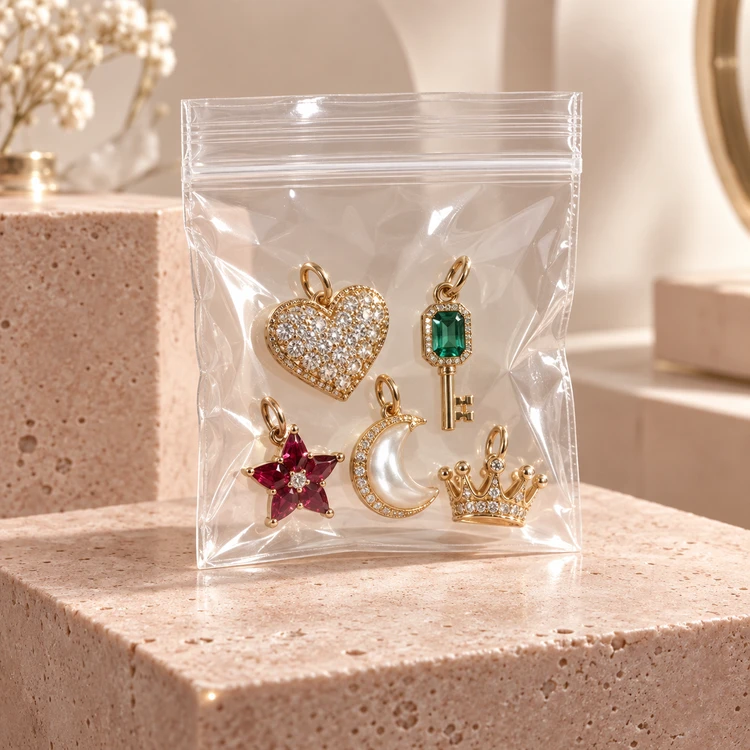
Charms Packaging Guide: Size, Thickness and Quantity
Posted by AppleZipBags Team on Sep 15th 2026
Packaging charms becomes much easier when the decision is divided into three variables:
size → thickness → quantity.
First, determine how much physical space the complete charm requires.
Second, choose a film thickness appropriate for its weight, shape and normal handling.
Third, calculate how many bags your business actually needs.
This matters because charms are not uniform.
A tiny flat heart charm and a large three-dimensional pendant may both be called “charms,” but their packaging requirements can be completely different.
Charms may also contain:
-
Bails
-
Jump rings
-
Loops
-
Pointed edges
-
Raised stones
-
Prongs
-
Dangling components
-
Sculptural surfaces
Apple Zip Bags offers jewelry bags in 2.5 mil material for charms and other small jewelry components.
For most charm sellers, the strongest packaging process is:
measure the complete charm → allow working room → choose appropriate thickness → test the package → standardize successful sizes → calculate monthly consumption → buy the appropriate quantity.
Quick Charms Packaging Guide
| Charm Type | Size Priority | Thickness Consideration | Quantity Strategy |
|---|---|---|---|
| Tiny flat charms | Compact dimensions | Lightweight everyday handling | Test, then standardize |
| Metal charms | Complete size + weight | Avoid overloading | Bulk once proven |
| Enamel charms | Full shape | Protect decorative surface | Forecast by SKU volume |
| Rhinestone charms | Depth + prongs | Avoid tight pressure | Test actual product |
| Pendant charms | Body + bail | Weight and length | Standardize common sizes |
| Dangling charms | Full natural length | Moving components | Test before bulk |
| Pointed charms | Maximum dimensions | Sharp pressure points | Allow extra room |
| Charm sets | Total set volume | Combined weight | Forecast by set sales |
| Carded charms | Complete card | Card + charm depth | Size to finished package |
| Wholesale charms | Quantity + weight | Handling frequency | Bulk often practical |
Part 1: Choosing the Right Charm Bag Size
Size should always come before:
-
Thickness
-
Color
-
Quantity
-
Price
A 4 mil bag is still the wrong bag if the charm does not fit comfortably.
Measure the Complete Charm
Do not measure only the decorative centerpiece.
Include everything attached to the sellable product:
-
Bail
-
Loop
-
Jump ring
-
Hook
-
Chain
-
Tassel
-
Hanging piece
Apple Zip Bags' packaging bag size guide provides additional guidance on measuring products and leaving appropriate room instead of choosing an exact fit.
Measure Maximum Width
Measure the widest point.
This matters for charms such as:
-
Wings
-
Bows
-
Stars
-
Flowers
-
Nameplates
-
Horizontal bars
A narrow center does not determine bag width.
The widest point does.
Measure Maximum Height
Measure from the highest attached component to the lowest point.
For a pendant charm:
bail + charm body = total height.
If a jump ring is attached above the bail:
include that too.
Measure Depth
Depth is frequently overlooked.
Two charms may both measure:
1 × 1 inch
from the front.
But one may be:
almost flat,
while the other contains:
-
Raised rhinestones
-
Domed enamel
-
Sculptural details
-
Multiple layers
The three-dimensional charm may require significantly more packaging room.
Measure the Final Packaged Product
If the charm will be attached to:
-
Display card
-
Branded card
-
Backing card
-
Foam insert
measure:
the entire finished assembly.
Do not size the bag to the loose charm and then discover that the display card will not fit.
Loose Charm vs. Carded Charm
| Format | Measure |
|---|---|
| Loose flat charm | Full charm dimensions |
| Charm with jump ring | Charm + ring |
| Pendant | Body + bail |
| Dangling charm | Full natural length |
| Charm set | Complete set volume |
| Carded charm | Entire card + product depth |
Leave Working Room
The ideal package is not:
the smallest bag the charm can physically enter.
It is:
the smallest bag that accommodates the charm comfortably.
There should be enough room to:
-
Insert the product
-
Position it
-
Close the zipper
-
Open the package
-
Remove the charm
-
Reseal the bag
Leave Zipper Clearance
This is particularly important for charms with:
-
Bails
-
Jump rings
-
Hooks
-
Points
Do not position those components directly inside the closure area.
Leave clear space below the zipper.
Do Not Oversize Excessively
Extra space is not automatically beneficial.
An excessively large bag can:
-
Increase product movement
-
Use unnecessary storage space
-
Look poorly proportioned
-
Require larger outer packaging
Aim for:
comfortable fit rather than maximum room.
Bag Size for Tiny Charms
Tiny charms may include:
-
Initials
-
Mini hearts
-
Small stars
-
Tiny symbols
-
Miniature birthstones
These can often use compact packaging.
However, the bag still needs enough space for:
-
Fingers to handle it
-
Labels
-
Zipper operation
Bag Size for Metal Charms
Metal charms require attention to:
size + weight.
A package may have enough physical volume for:
20 charms,
but the combined weight may make a small bag awkward.
Test the actual selling quantity.
Bag Size for Enamel Charms
Enamel charms may be:
-
Flat
-
Domed
-
Layered
-
Irregular
Measure the complete outline and depth.
Avoid forcing decorative surfaces tightly against the bag.
Bag Size for Rhinestone Charms
Rhinestone charms may include:
-
Raised stones
-
Prongs
-
Metal settings
These increase the three-dimensional profile.
Allow additional clearance.
Bag Size for Pendant Charms
Pendant-style charms may require more vertical room.
Always include:
body + bail + attached ring.
Bag Size for Dangling Charms
Dangling designs may contain several connected components.
Arrange them naturally.
Then measure the resulting:
-
Width
-
Height
-
Depth
Avoid folding delicate components unnecessarily.
Bag Size for Pointed Charms
Examples include:
-
Stars
-
Arrows
-
Lightning bolts
-
Wings
-
Leaves
-
Geometric charms
Sharp corners can create concentrated pressure against plastic.
Avoid an excessively tight fit.
Bag Size for Charm Sets
Suppose a product contains:
5 charms.
Do not size the package using:
one charm × five.
Arrange the actual five-piece set and measure:
its real packaged volume.
Pieces may overlap and settle differently.
Bag Size for Wholesale Charm Packages
Wholesale quantities require consideration of:
-
Number of charms
-
Weight
-
Volume
-
Shape
For large quantities:
several smaller packages may sometimes be easier to handle than one heavily loaded bag.
Standardize Core Charm Bag Sizes
Many businesses do not need a different bag for every charm.
A practical system might include:
| Bag Category | Typical Use |
|---|---|
| Extra small | Tiny flat charms |
| Small | Everyday charms |
| Medium | Pendants and larger charms |
| Large | Carded charms and sets |
The exact dimensions depend on your product catalog.
Why Standardization Matters
Standardizing sizes can reduce:
-
Purchasing complexity
-
Storage requirements
-
Packing mistakes
-
Employee confusion
-
Reordering errors
It also makes bulk purchasing easier.
Test the Extremes Before Standardizing
Suppose you want:
40 charm SKUs
to share one bag size.
Test at least:
-
Widest charm
-
Tallest charm
-
Thickest charm
-
Sharpest charm
-
Heaviest charm
If those products work appropriately:
the size may be a strong candidate for standardization.
Part 2: Choosing Charm Bag Thickness
After size is established:
evaluate film thickness.
Size answers:
Will the charm fit?
Thickness answers:
How substantial should the packaging material be?
These are separate decisions.
Understanding Mil Thickness
A mil equals:
0.001 inch.
Therefore:
| Thickness | Inches |
|---|---|
| 1 mil | 0.001" |
| 2 mil | 0.002" |
| 2.5 mil | 0.0025" |
| 4 mil | 0.004" |
Apple Zip Bags currently lists its jewelry bags at:
2.5 mil.
2 Mil Bags for Charms
Lighter film may be suitable for some:
-
Tiny charms
-
Lightweight flat charms
-
Limited handling
-
Internal organization
The product's actual requirements should determine suitability.
2.5 Mil Bags for Charms
For many everyday charm applications:
2.5 mil is a practical middle ground.
It can provide a useful balance of:
-
Flexibility
-
Visibility
-
Compact storage
-
Everyday handling
Apple Zip Bags' 1,000-pack small jewelry bags use 2.5 mil material and are intended for jewelry, charms, beads and other small items.
When Heavier Film May Make Sense
More substantial packaging may be considered when charms are:
-
Heavy
-
Sharp
-
Frequently handled
-
Packed in larger quantities
But:
thicker does not automatically mean better.
The application needs to justify the extra material.
Size Comes Before Thickness
Suppose a pointed pendant barely fits into a small bag.
Moving from:
2.5 mil
to:
4 mil
while keeping the exact same dimensions does not solve the underlying fit problem.
The better solution may be:
a larger bag.
Charm Weight and Thickness
Metal charms may be small but dense.
When several are packaged together:
combined weight increases.
Evaluate:
-
Film
-
Bag dimensions
-
Number of pieces
together.
Charm Shape and Thickness
A smooth round charm behaves differently from:
a star with five pointed edges.
Sharp geometry can create localized pressure.
Film thickness is only one part of the solution.
Proper sizing remains essential.
Rhinestones, Prongs and Settings
Raised settings can press against packaging.
Avoid:
-
Overfilling
-
Excessively tight bags
-
Compressing raised components
Additional backing or cushioning may be appropriate for delicate products.
Thickness Does Not Equal Anti-Tarnish Protection
Do not assume:
thicker = anti-tarnish.
Film thickness alone does not establish:
-
Anti-tarnish properties
-
Archival performance
-
UV resistance
-
Hermetic sealing
-
Waterproofness
Those are separate specifications.
Thickness Does Not Equal Scratch Protection
Likewise:
a plastic bag should not automatically be described as:
scratch-proof.
If a charm has a delicate finish:
additional separation or protective material may be appropriate.
Part 3: Clear vs. Colored Charm Bags
After size and thickness:
consider visibility.
For most charm businesses:
clear is the strongest everyday default.
Why Clear Bags Work Well for Charms
Charms are highly visual.
Employees can immediately see:
-
Design
-
Shape
-
Finish
-
Color
without opening the package.
Clear Bags for Inventory Picking
Imagine an order containing:
-
Moon charm
-
Star charm
-
Heart charm
-
Butterfly charm
Clear packaging provides:
visual verification
before shipment.
Clear Bags for Similar Charm Designs
Suppose your inventory includes:
Small heart
Medium heart
Large heart
or:
Gold-tone star
Silver-tone star
Black star
Clear packaging helps employees visually narrow the choice.
Labels provide exact identification.
When Colored Charm Bags Work Well
Colored bags can be useful for:
-
Category coding
-
Wholesale separation
-
Collection coding
-
Workflow status
Example:
Clear = retail
Blue = wholesale
Pink = seasonal collection
Green = inspected inventory
Do Not Use Color Instead of SKUs
Color should support:
inventory organization.
It should not replace:
precise product identification.
Part 4: Labels and Charm Inventory
Every charm bag should make it easy to determine:
what is inside.
For businesses with many SKUs:
labels become essential.
What to Put on a Charm Label
Depending on the product:
-
SKU
-
Charm name
-
Dimensions
-
Finish
-
Material
-
Quantity
may be useful.
Example
CH-MOON-SLV-18
Moon Charm
Silver-tone
18 mm
1 Piece
One SKU Per Bag
Unless several charms intentionally form one product set:
keep different SKUs separated.
This simplifies:
-
Counting
-
Picking
-
Reordering
-
Quality control
Charm Sets Are Different
If the SKU is:
5-Piece Celestial Charm Set
then all five pieces can belong in:
one package.
The bag should be sized to the:
complete sellable unit.
Part 5: How Many Charm Bags Should You Buy?
Once:
-
Size
-
Thickness
-
Color
-
Label
are proven,
determine quantity.
The most common purchasing decision is:
100 vs. 1,000.
When 100 Charm Bags Make Sense
Choose a smaller quantity when:
-
Testing a new size
-
Launching a charm collection
-
Testing card dimensions
-
Comparing colors
-
Testing labels
-
Monthly volume is low
Apple Zip Bags' 100-pack small jewelry bags can be useful when validating a packaging format before committing to larger quantities.
Why Testing First Matters
Suppose you buy:
1,000 bags.
Then discover:
the most popular charm's bail catches against the zipper.
A low unit price does not compensate for:
1,000 poorly fitting bags.
The safer sequence is:
test → confirm → standardize → bulk buy.
When 1,000 Charm Bags Make Sense
Bulk quantities become more practical when:
-
Bag size is proven
-
Labels fit
-
Many SKUs use the same bag
-
Monthly demand is stable
-
Wholesale orders are frequent
-
You repeatedly reorder smaller packs
100 vs. 1,000 Charm Bags
| Situation | 100 | 1,000 |
|---|---|---|
| Testing a new size | Best | Avoid initially |
| New collection | Strong | Wait for validation |
| Low monthly usage | Strong | Possibly excessive |
| Proven size | Good | Strong |
| Many SKUs | Limited | Strong |
| Wholesale | Limited | Strong |
| Frequent reordering | Inefficient | Strong |
| Predictable demand | Good | Strong |
Part 6: Calculate Monthly Charm Bag Usage
Do not simply count:
customer orders.
One customer order may contain:
8 individually packaged charm SKUs.
That could require:
8 bags.
Use:
monthly orders × average separately packaged charm SKUs per order = monthly bag demand.
Example
Monthly orders:
150
Average separately packaged charm SKUs:
4
150 × 4 =
600 bags per month.
Add Other Packaging Uses
Include bags used for:
-
Samples
-
Replacement charms
-
Repair components
-
Craft kits
-
Photography
-
Internal organization
Example
Customer orders:
600 bags
Samples:
40 bags
Replacement components:
20 bags
Craft kits:
100 bags
Actual monthly consumption:
760 bags.
Part 7: Calculate Annual Charm Bag Demand
If monthly usage is:
760 bags,
annual usage is:
760 × 12 =
9,120 bags.
At that volume:
repeated 100-pack purchases may become operationally inefficient.
Part 8: Keep Safety Stock
Packaging is inventory.
If you run out of bags:
you may be unable to package orders even when every charm is in stock.
Shopify describes safety stock as buffer inventory used to reduce stockout risk when demand increases or replenishment takes longer than expected.
Example Safety Stock
Expected monthly consumption:
800 bags
20% operational buffer:
160 bags
Target availability:
960 bags.
The correct buffer depends on:
-
Demand variability
-
Lead time
-
Supplier reliability
-
Wholesale activity
-
Seasonality
Part 9: Establish a Reorder Point
A practical replenishment formula is:
lead-time demand + safety stock = reorder point.
Shopify's inventory forecasting guide explains how lead-time demand, safety stock and reorder points can be used together when planning replenishment.
Example
Average daily usage:
25 bags
Supplier lead time:
8 days
Lead-time demand:
25 × 8 =
200 bags
Safety stock:
200 bags
Reorder point:
200 + 200 =
400 bags
When inventory reaches approximately:
400 bags,
it is time to replenish under this example.
Part 10: Seasonal Charm Packaging Demand
Charm sales can be highly seasonal.
Examples include:
Valentine's Day:
-
Hearts
-
Love symbols
Wedding season:
-
Bridal charms
-
Initials
-
Sentimental symbols
Graduation:
-
Graduation caps
-
Years
-
Initials
Halloween:
-
Bats
-
Pumpkins
-
Ghosts
Holiday season:
-
Snowflakes
-
Trees
-
Stars
Packaging inventory should be increased before:
product demand increases.
Part 11: Wholesale Charm Packaging
Wholesale can consume bags extremely quickly.
Example:
A wholesale buyer orders:
30 charm SKUs
with:
10 individually packaged units each.
30 × 10 =
300 bags.
Four similar wholesale orders:
300 × 4 =
1,200 bags.
A 100-pack would not be practical.
Part 12: Charm Packaging for Etsy Sellers
Suppose an Etsy seller processes:
50 monthly orders
with:
3 separately packaged charm SKUs per order.
50 × 3 =
150 bags per month.
A 100-pack lasts less than one month.
A 1,000-pack lasts approximately:
6.7 months.
The right choice depends on:
-
Storage space
-
Cash flow
-
Confidence in the bag size
-
Expected growth
Part 13: Charm Packaging for Growing Stores
Suppose:
200 orders
× 5 charm packages per order
=
1,000 bags per month.
At this volume:
1,000 bags represent approximately:
one month of normal consumption.
Bulk purchasing becomes significantly more practical.
Part 14: Charm Packaging for Craft Kits
One jewelry-making kit might contain:
Bag 1 = charms
Bag 2 = beads
Bag 3 = clasps
Bag 4 = jump rings
Bag 5 = cord
If you prepare:
200 kits,
and each kit uses:
5 bags,
total consumption is:
1,000 bags.
Part 15: Charm Packaging for Jewelry-Making Classes
Classes can also consume substantial packaging.
Example:
30 students
Each receives:
4 individually packaged components
30 × 4 =
120 bags per class.
Four monthly classes:
120 × 4 =
480 bags.
Part 16: Plain vs. Branded Charm Packaging
Plain bags provide flexibility.
One bag can work across:
-
Hearts
-
Stars
-
Letters
-
Zodiac charms
-
Seasonal collections
Brand identity can be added through:
-
Labels
-
Stickers
-
Inserts
-
Cards
Apple Zip Bags' guide to custom-printed vs. plain jewelry bags discusses the tradeoffs between customization, cost and packaging flexibility.
Why Plain Packaging Can Reduce Risk
Charm collections can change quickly.
A seller may discontinue:
one collection
and launch:
another.
Plain bags can continue to be used.
Customized inventory may be more difficult to repurpose.
Part 17: Packaging Heavy Charms
Metal charms deserve special attention.
Suppose:
10 charms fit comfortably by volume.
The package may still become:
too heavy for convenient handling.
Test the:
actual finished package.
Consider reducing the quantity per bag if necessary.
Part 18: Packaging Pointed Charms
For:
-
Stars
-
Arrows
-
Wings
-
Lightning bolts
avoid pressing points tightly against the bag.
A larger bag may provide better positioning.
Additional backing or cushioning may also be useful depending on the product.
Part 19: Packaging Delicate Charms
Charms containing:
-
Rhinestones
-
Glass
-
Gemstones
-
Delicate enamel
-
Fragile dangling components
may require more than simple containment.
The resealable bag should generally be treated as:
inner packaging.
Part 20: Shipping Charm Orders
Small resealable bags help organize individual SKUs.
They do not automatically replace:
-
Cushioning
-
Mailers
-
Boxes
-
Appropriate outer packaging
UPS provides general packaging guidance for protecting products during transportation.
Prevent Excessive Movement
For delicate charms:
reduce unnecessary movement within the shipping package.
The correct solution depends on:
-
Product fragility
-
Shipment size
-
Weight
-
Outer container
Part 21: Do Not Assume Resealable Means Waterproof
A standard resealable charm bag should not automatically be described as:
-
Waterproof
-
Hermetically sealed
-
Leakproof
unless those properties are specifically documented.
Part 22: Do Not Assume Thickness Means Anti-Tarnish
Likewise:
2.5 mil
or:
4 mil
does not automatically establish:
-
Anti-tarnish performance
-
Archival performance
-
Museum-grade storage
These are separate material properties.
Part 23: Calculate Cost Per Charm Bag
Use:
pack price ÷ number of bags = cost per bag.
Example:
100 bags cost $8.
$8 ÷ 100 =
$0.08 per bag.
If:
1,000 bags cost $10,
$10 ÷ 1,000 =
$0.01 per bag.
Always use current pricing when making a real purchasing decision.
Part 24: Lower Cost Per Bag Is Not Everything
Imagine:
1,000 bags provide a lower unit cost.
But:
the charm's bail does not fit properly.
Those bags are not economical.
The correct purchasing order is:
fit → thickness → workflow → quantity → cost.
Part 25: Calculate Packaging Cost Per Charm
Packaging may include:
-
Small resealable bag
-
Label
-
Backing card
-
Insert
-
Outer mailer
Example:
Bag = $0.02
Label = $0.03
Card = $0.08
Total inner packaging:
$0.13 per charm.
Understanding this number can support:
-
Product pricing
-
Margin calculations
-
Wholesale quotes
Part 26: Store Charm Bags by Size
If several bag sizes look similar:
use clearly labeled storage bins.
Example:
XS – Tiny Charms
S – Everyday Charms
M – Pendants
L – Carded Charms
This reduces packing mistakes.
Part 27: Give Packaging Its Own SKU
For example:
CHARM-BAG-XS-CLR
Extra-small clear charm bag
CHARM-BAG-SM-CLR
Small clear charm bag
CHARM-BAG-MED-CLR
Medium clear charm bag
This makes packaging inventory easier to track.
Part 28: Avoid Too Many Packaging SKUs
Suppose you stock:
5 sizes
× 6 colors
=
30 packaging SKUs.
That may create unnecessary complexity.
If most charms can use:
3 clear sizes
plus:
a few specialty colored bags,
the system becomes easier to manage.
Part 29: Review Packaging as the Business Grows
The best packaging system for:
50 monthly orders
may not be the best system for:
500 monthly orders.
Periodically review:
-
Bag usage
-
Size standardization
-
Reorder frequency
-
Wholesale demand
-
Seasonal demand
-
Packaging cost
Part 30: Charm Packaging Size, Thickness and Quantity Checklist
Before ordering charm bags, confirm:
-
What type of charm is being packaged?
-
What is its maximum width?
-
What is its maximum height?
-
What is its depth?
-
Does it have a bail?
-
Does it have a loop?
-
Does it have a jump ring?
-
Does it have dangling components?
-
Does it have sharp edges?
-
Does it have prongs?
-
Is the charm heavy?
-
How many pieces go into one package?
-
Is it sold individually?
-
Is it sold as a set?
-
Is it mounted on a card?
-
Is there enough working room?
-
Is there zipper clearance?
-
Is the bag excessively large?
-
Is film thickness suitable?
-
Is 2.5 mil appropriate for the application?
-
Does the product need heavier material?
-
Should the bag be clear?
-
Would color coding help?
-
Is there enough label space?
-
Is the SKU visible?
-
Is charm size shown?
-
Is finish shown?
-
Is quantity shown?
-
Can several SKUs share one bag size?
-
Can the packaging system be standardized?
-
Has the bag been tested?
-
Should 100 be purchased first?
-
Is the size proven enough for 1,000?
-
What is monthly bag consumption?
-
What is annual consumption?
-
Are samples included?
-
Are craft kits included?
-
Is wholesale demand included?
-
Is seasonal demand included?
-
Is safety stock included?
-
Is a reorder point established?
-
Is storage space available?
-
Does the charm need additional shipping protection?
-
Have unsupported waterproof claims been avoided?
-
Have unsupported anti-tarnish claims been avoided?
Frequently Asked Questions
What size bag should I use for charms?
Choose according to:
-
Maximum width
-
Maximum height
-
Depth
-
Bail
-
Jump ring
-
Dangling components
Measure the complete product.
Should I use the smallest possible bag?
No.
Use:
the smallest comfortable bag.
Leave room for handling and closure.
Should I include the charm bail when measuring?
Yes.
Include every component attached to the sellable product.
Should I include jump rings?
Yes.
If the jump ring is sold with the charm:
include it when measuring.
What about dangling charms?
Measure them in their natural packaged position.
Avoid unnecessary compression.
What thickness is good for charm bags?
For many everyday applications:
2–2.5 mil
can provide a practical starting range.
Apple Zip Bags currently lists its jewelry bags at:
2.5 mil.
What does 2.5 mil mean?
It means:
0.0025 inch film thickness.
It does not refer to bag dimensions.
Is 4 mil always better than 2.5 mil?
No.
More thickness is not automatically better.
Choose according to:
-
Weight
-
Shape
-
Handling
-
Packaging requirements
Are clear bags best for charms?
For most inventory systems:
clear bags are a strong default because the charm remains visible.
When should I use colored charm bags?
Colored bags may help with:
-
Category coding
-
Wholesale organization
-
Workflow status
-
Collections
Should each charm have its own bag?
For individual SKUs:
often yes.
Intentional charm sets can be packaged together.
How should I package charm sets?
Arrange the entire set and size the bag according to:
the complete packaged volume.
How should I package carded charms?
Measure:
the entire card + charm assembly.
Should I buy 100 or 1,000 charm bags?
Choose:
100
when testing.
Choose:
1,000
when the bag is proven and usage is predictable.
How do I calculate monthly charm bag usage?
Use:
monthly orders × average separately packaged charm SKUs per order.
Then add:
-
Samples
-
Kits
-
Replacement components
-
Safety stock
How much safety stock should I keep?
The correct amount depends on:
-
Demand variability
-
Lead time
-
Wholesale activity
-
Seasonal sales
Use actual business data rather than relying on one universal percentage.
How do I calculate a reorder point?
A basic method is:
lead-time demand + safety stock.
Are charm bags enough for shipping?
They are generally best treated as:
inner packaging.
Fragile charms may require additional protection.
Are resealable charm bags waterproof?
Do not assume so unless the specific product is documented as waterproof.
Are 2.5 mil bags anti-tarnish?
Film thickness alone does not establish anti-tarnish performance.
Final Verdict: Charm Packaging Size, Thickness and Quantity
A strong charm-packaging system gets three things right:
size, thickness and quantity.
Start with:
size.
Measure the complete charm, including:
-
Bail
-
Loop
-
Jump ring
-
Dangling components
-
Raised settings
Allow enough room for:
comfortable insertion, removal and zipper operation.
Next choose:
thickness.
For many everyday charm applications:
2.5 mil
provides a practical middle ground between flexibility and substantial everyday handling.
But thicker does not automatically mean better.
A poorly sized bag remains poorly sized regardless of film thickness.
Finally determine:
quantity.
Start with:
100 bags
when:
-
Testing a new size
-
Launching a collection
-
Evaluating labels
-
Comparing packaging formats
Move to:
1,000 bags
when:
-
Fit is proven
-
Multiple charm SKUs use the same size
-
Monthly demand is predictable
-
Wholesale or higher-volume sales justify bulk purchasing
Calculate packaging demand according to:
individual packaged charm SKUs—not simply customer orders.
Then add:
-
Samples
-
Kits
-
Seasonal demand
-
Wholesale demand
-
Safety stock
The strongest process is:
measure → size → choose thickness → confirm visibility → label → test → standardize → calculate monthly usage → add safety stock → establish a reorder point → bulk-buy proven formats.
That creates a charm packaging system designed for:
better organization, faster fulfillment, simpler inventory management and scalable purchasing.