
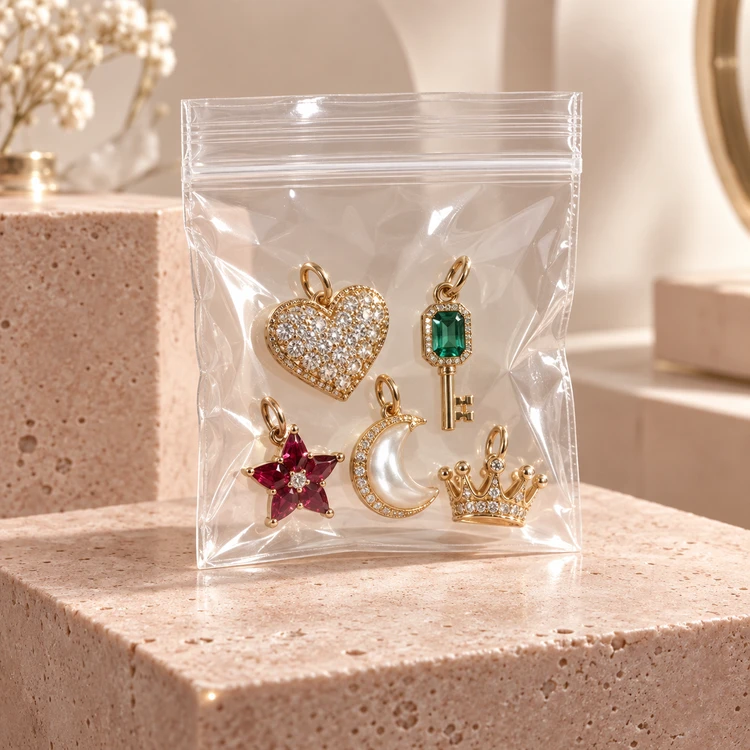
Bulk Bags for Charms: When to Buy 100 vs 1,000
Posted by AppleZipBags Team on Sep 15th 2026
Should you buy 100 or 1,000 bags for charms?
The answer depends primarily on whether your packaging format is still being tested or has already become a predictable part of your operation.
If you are still determining:
-
Bag size
-
Charm fit
-
Zipper clearance
-
Label placement
-
Clear vs. colored packaging
-
Number of charms per bag
a 100-pack usually provides more flexibility.
Once the packaging format is proven and your business consistently uses hundreds of bags:
1,000-pack quantities can make significantly more operational sense.
Apple Zip Bags offers jewelry bags for charms and other small jewelry components.
The simplest rule is:
Buy 100 when you are testing. Buy 1,000 when the bag is proven and consumption is predictable.
Quick Answer: Should You Buy 100 or 1,000 Charm Bags?
| Situation | Better Starting Point |
|---|---|
| Testing a new bag size | 100 |
| Launching a new charm collection | 100 |
| Testing label placement | 100 |
| Comparing clear vs. colored bags | 100 |
| Low monthly sales | 100 |
| New display cards | 100 |
| Proven bag size | 1,000 |
| Many SKUs use one size | 1,000 |
| High monthly usage | 1,000 |
| Wholesale charm business | 1,000 |
| Frequent reordering | 1,000 |
| Predictable demand | 1,000 |
| Recurring craft kits | 1,000 |
| Subscription-box production | 1,000 |
Bulk purchasing should happen after:
fit → testing → standardization → demand calculation.
Not before.
When Should You Buy 100 Bags for Charms?
A 100-pack is especially useful when:
uncertainty still exists.
The goal is to validate your packaging without creating hundreds of unused bags.
Buy 100 When Testing a New Bag Size
This is the strongest reason to start with a smaller quantity.
Charm dimensions can be deceptive.
A charm may measure:
1 inch
but also include:
-
Bail
-
Jump ring
-
Raised design
-
Pointed edge
The actual packaging footprint may therefore be larger.
Apple Zip Bags' bag size guide provides guidance on measuring products and allowing sufficient room rather than selecting packaging that fits too tightly.
Buy 100 When Launching a New Charm Collection
Suppose you normally sell:
small flat charms.
You introduce:
large pendant charms.
Do not assume your existing bag works.
Test first.
Buy 100 When Testing Metal Charms
Metal charms can be:
small but relatively heavy.
A bag may hold:
20 pieces by volume
while handling better with:
5 or 10.
Test the actual selling quantity.
Buy 100 When Testing Enamel Charms
Enamel charms may have:
-
Irregular outlines
-
Raised surfaces
-
Decorative edges
Test the complete product before standardizing packaging.
Buy 100 When Testing Rhinestone Charms
Rhinestone charms may include:
-
Raised stones
-
Settings
-
Prongs
An overly tight bag can place unnecessary pressure against these areas.
Test first.
Buy 100 When Testing Pendant Charms
Pendant charms frequently include:
-
Bail
-
Jump ring
-
Longer body
Measure the complete assembled product.
Then test.
Buy 100 When Testing Dangling Charms
Dangling components can behave differently inside a package than expected.
Test:
-
Natural positioning
-
Zipper clearance
-
Product removal
before purchasing bulk quantities.
Buy 100 When Testing Charm Cards
A tiny charm may be attached to:
a much larger display card.
Once carded:
the packaging requirement changes completely.
Test the final:
charm + card assembly.
Buy 100 When Testing Labels
A label needs enough space without:
-
Blocking the zipper
-
Covering the entire charm
-
Folding awkwardly
-
Becoming difficult to scan
Test the actual label.
Buy 100 When Testing Colored Bags
Clear packaging is highly versatile.
Colored bags can be useful for:
-
Categories
-
Collections
-
Wholesale
-
Workflow status
But test whether the color system actually improves operations before buying 1,000.
Buy 100 When Monthly Usage Is Low
Suppose you use:
25 charm bags per month.
A 100-pack lasts:
approximately four months.
A 1,000-pack would represent:
approximately 40 months of inventory.
Unless demand is expected to increase substantially:
that may be excessive.
When Should You Buy 1,000 Bags for Charms?
A 1,000-pack becomes much more attractive once:
the uncertainty is gone.
You know:
-
The charm fits
-
The zipper closes comfortably
-
The label fits
-
Staff can pack efficiently
-
The bag works across multiple SKUs
-
Monthly consumption is predictable
At that point:
bulk purchasing becomes an inventory-management decision.
Buy 1,000 When the Bag Size Is Proven
Before buying bulk:
test actual charm inventory.
Do not rely solely on:
dimensions listed in a spreadsheet.
Physically test representative products.
Buy 1,000 When One Bag Works Across Many Charm SKUs
This is one of the strongest arguments for bulk purchasing.
Suppose one clear bag works for:
100 charm SKUs.
Even if each SKU sells slowly:
combined packaging consumption may be substantial.
Example
100 charm SKUs
Average:
6 individually packaged units per SKU each month
100 × 6 =
600 bags per month.
A 1,000-pack lasts:
approximately 1.7 months.
Buy 1,000 When You Keep Reordering 100-Packs
Suppose you use:
500 bags per month.
A 100-pack lasts:
approximately six days.
That creates repeated:
-
Ordering
-
Receiving
-
Restocking
-
Inventory monitoring
A 1,000-pack lasts approximately:
two months.
That is operationally simpler.
Buy 1,000 for Wholesale Charm Businesses
Wholesale orders can consume bags extremely quickly.
Suppose one retailer orders:
25 charm SKUs
with:
10 individually packaged units per SKU.
25 × 10 =
250 bags.
Four similar wholesale orders:
250 × 4 =
1,000 bags.
A 100-pack is no longer practical.
Buy 1,000 for Large Etsy Charm Stores
Suppose an Etsy store processes:
150 orders per month
with an average of:
4 separately packaged charm SKUs.
150 × 4 =
600 bags per month.
A 1,000-pack lasts less than:
two months.
Buy 1,000 for Subscription Kits
Suppose each jewelry-making subscription box contains:
5 individually packaged components.
200 boxes require:
5 × 200 =
1,000 bags.
Bulk quantities become essential.
Buy 1,000 for Jewelry-Making Classes
Suppose:
40 students
receive:
5 individually packaged components.
40 × 5 =
200 bags per class.
Five classes:
1,000 bags.
Buy 1,000 Before Predictable Busy Periods
Charm demand may increase around:
-
Valentine's Day
-
Mother's Day
-
Wedding season
-
Graduation
-
Halloween
-
Christmas
Use previous sales patterns when forecasting packaging requirements.
Shopify's inventory forecasting guide discusses using demand data to estimate future inventory needs.
100 vs. 1,000 Charm Bags: Complete Comparison
| Factor | 100 Bags | 1,000 Bags |
|---|---|---|
| Testing size | Excellent | Poor |
| New charm collection | Excellent | Moderate |
| Testing labels | Excellent | Poor |
| Testing color coding | Excellent | Poor |
| Low volume | Excellent | Limited |
| High volume | Limited | Excellent |
| Proven packaging | Good | Excellent |
| Many charm SKUs | Limited | Excellent |
| Wholesale | Limited | Excellent |
| Subscription kits | Limited | Excellent |
| Seasonal testing | Excellent | Moderate |
| Frequent reordering | Poor | Excellent |
| Storage required | Low | Higher |
| Inventory commitment | Low | Higher |
| Risk if size is wrong | Low | High |
Calculate Your Monthly Charm Bag Usage
Do not calculate bag demand using:
customer orders alone.
One order may contain:
10 separately packaged charms.
Therefore:
one order can consume:
10 bags.
Use This Formula
Monthly customer orders × average individually packaged charm SKUs per order = monthly charm bag demand.
Example: Small Charm Business
50 monthly orders
Average:
2 separately packaged charm SKUs
50 × 2 =
100 bags per month.
A 100-pack lasts:
approximately one month.
A 1,000-pack lasts:
approximately ten months.
Example: Growing Charm Business
100 monthly orders
Average:
4 separately packaged charm SKUs
100 × 4 =
400 bags per month.
A 100-pack lasts:
approximately one week.
A 1,000-pack lasts:
approximately 2.5 months.
Example: Established Charm Business
250 monthly orders
Average:
5 separately packaged charm SKUs
250 × 5 =
1,250 bags per month.
A 1,000-pack does not cover:
one complete month.
Example: High-Volume Charm Business
500 monthly orders
Average:
6 individually packaged charm SKUs
500 × 6 =
3,000 bags per month.
This business may require:
multiple 1,000-packs every month.
Include Charm Samples
Do you send:
free samples?
Include them.
Example:
Normal packaging:
700 bags
Samples:
50
Actual usage:
750 bags.
Include Replacement Components
Some charm businesses send:
-
Spare charms
-
Jump rings
-
Clasps
-
Replacement components
These packages consume bags too.
Include Craft Kits
One craft kit may require:
Bag 1 = charms
Bag 2 = beads
Bag 3 = jump rings
Bag 4 = clasps
Bag 5 = cord
One kit consumes:
five bags.
200 kits consume:
1,000 bags.
Calculate Annual Charm Bag Usage
Monthly consumption:
800 bags
Annual consumption:
800 × 12 =
9,600 bags.
At this level:
repeatedly purchasing only 100 at a time creates unnecessary replenishment work.
Add Safety Stock
Do not plan inventory so precisely that:
the last bag is used immediately before the next shipment arrives.
Packaging needs a buffer.
Shopify's guide to safety stock discusses keeping additional inventory to reduce the risk of stockouts caused by changing demand or replenishment conditions.
Example
Expected monthly usage:
1,000 bags
20% operational buffer:
200
Target:
1,200 bags.
The correct buffer depends on the business.
Factors That Affect Charm Bag Safety Stock
Consider:
-
Supplier lead time
-
Sales volatility
-
Wholesale orders
-
Seasonal demand
-
Promotions
-
Subscription-box production
A business with unpredictable wholesale orders may need:
more buffer.
Calculate Your Charm Bag Reorder Point
Use:
average daily bag usage × supplier lead time + safety stock.
Example
Average daily usage:
30 bags
Lead time:
7 days
Safety stock:
200
30 × 7 =
210
210 + 200 =
410 bags.
Reorder when inventory approaches:
410 bags.
Why Reorder Points Matter
Without a defined reorder point:
packaging is often reordered when someone says:
“We're almost out.”
That is not a reliable inventory system.
Track Charm Bags as Inventory
Once a business uses significant packaging volume:
bags should be treated as operational inventory.
Shopify's inventory management guide discusses broader approaches to inventory tracking and replenishment.
Track:
-
Bag size
-
Color
-
Quantity on hand
-
Monthly consumption
-
Safety stock
-
Reorder point
Give Charm Bags Packaging SKUs
For example:
CH-BAG-XS-CLR
Extra-small clear charm bag
CH-BAG-SM-CLR
Small clear charm bag
CH-BAG-MED-CLR
Medium clear charm bag
This makes internal purchasing easier.
Standardize Charm Bag Sizes Before Buying Bulk
Bulk purchasing works best when:
fewer packaging sizes cover more products.
A charm business might standardize:
Extra small = tiny charms
Small = everyday charms
Medium = pendants
Large = carded charms and sets
Apple Zip Bags also offers larger bags for charm packages requiring additional space.
Why Standardization Makes 1,000-Packs More Practical
Suppose:
40 SKUs use Size A.
60 SKUs use Size B.
25 SKUs use Size C.
Instead of buying dozens of specialized packaging formats:
you replenish three core sizes according to total consumption.
Do Not Standardize at the Expense of Fit
A tiny heart charm and:
large wing pendant
may not belong in the same bag.
Standardization should simplify packaging without creating poor fit.
Clear Bags Are Often Easier to Buy in Bulk
Clear bags can work across:
-
Charm colors
-
Finishes
-
Themes
-
Collections
-
Seasons
That versatility can make them easier to standardize.
Be More Careful With Bulk Colored Bags
Suppose monthly usage is:
1,000 bags.
Distribution:
85% clear
10% blue
5% pink
Demand becomes:
Clear = 850
Blue = 100
Pink = 50
Buying:
1,000 of every color
would create excessive colored inventory.
Forecast Charm Bag Demand by Color
Track each packaging format separately.
For example:
Clear small = 800/month
Clear medium = 250/month
Blue small = 100/month
Pink small = 50/month
Then order according to:
actual consumption.
Seasonal Colored Bags Need Extra Planning
Suppose:
pink bags
are used only for Valentine's collections.
Do not automatically purchase:
1,000
unless projected seasonal demand justifies that quantity.
Plain Bags Can Reduce Bulk-Purchasing Risk
Plain packaging works across:
multiple charm collections.
Brand identity can then be added with:
-
Stickers
-
Labels
-
Cards
-
Inserts
Apple Zip Bags' guide to custom-printed vs. plain jewelry bags discusses the flexibility and branding considerations involved in these packaging choices.
Custom Charm Packaging Requires More Careful Forecasting
Customized packaging may become obsolete if:
-
Logo changes
-
Branding changes
-
Collection ends
-
Product information changes
Forecast carefully before committing to large quantities.
Storage Space Matters
One 1,000-pack may be easy to store.
But suppose you carry:
5 sizes
× 6 colors
× 1,000 bags.
That equals:
30,000 bags.
Packaging inventory can grow rapidly.
Standardization helps.
Calculate Cost Per Charm Bag
Use:
pack price ÷ bag quantity = cost per bag.
Example:
100 bags cost:
$8
$8 ÷ 100 =
$0.08 per bag.
Suppose:
1,000 bags cost:
$10.
$10 ÷ 1,000 =
$0.01 per bag.
Always use current supplier pricing for actual purchasing calculations.
Lower Cost Per Bag Does Not Automatically Mean Better Value
Imagine:
1,000 bags offer a much lower unit cost.
But after receiving them:
you discover the pendant bail catches against the zipper.
Those unused bags are not:
a saving.
The correct sequence is:
fit → test → standardize → forecast → bulk buy.
Consider Inventory Carrying Costs
Packaging inventory consumes:
-
Cash
-
Storage space
-
Employee time
-
Organizational resources
Shopify's discussion of inventory costs explains that inventory creates costs beyond simply purchasing the goods.
That is why:
more inventory
is not automatically:
better inventory management.
Buy 100 When Cash Flow Matters More Than Unit Cost
A smaller business may prefer:
lower immediate inventory commitment
even if:
the per-bag cost is higher.
That can be rational when:
cash is better used for products, marketing or other operating needs.
Buy 1,000 When Reordering Costs More Than Holding Inventory
At higher volume:
repeated purchasing creates its own costs.
Employees spend time:
-
Checking quantities
-
Ordering
-
Receiving
-
Restocking
Bulk quantities can reduce those repeated tasks.
Bulk Charm Bags for Etsy Sellers
Suppose:
75 monthly orders
× 3 separately packaged charms
=
225 bags per month.
A 100-pack lasts less than:
two weeks.
A 1,000-pack lasts approximately:
4.4 months.
If the size is proven:
bulk may be practical.
Bulk Charm Bags for Wholesale Sellers
Wholesale can rapidly change consumption.
Example:
50 SKUs
× 10 packages
=
500 bags
for one wholesale order.
Two similar orders:
1,000 bags.
Bulk Charm Bags for Jewelry Supply Stores
A supply store may carry:
hundreds or thousands of charm SKUs.
One standardized bag size may serve:
many products.
Combined consumption can make:
1,000-pack purchasing highly practical.
Bulk Charm Bags for Craft Shows
Suppose normal monthly consumption is:
500 bags.
Craft-show preparation requires:
Safety stock:
Total requirement:
1,000 bags.
Plan event packaging before production begins.
Bulk Charm Bags for Subscription Boxes
Suppose each box contains:
4 individually packaged charm components.
250 boxes:
4 × 250 =
1,000 bags.
Bulk Charm Bags for Jewelry Classes
Suppose:
25 students
receive:
6 component bags.
25 × 6 =
150 bags per class.
Eight classes require:
1,200 bags.
Bulk Bags for Seasonal Charm Collections
Consider:
Valentine's collection:
500 packages
Wedding collection:
700 packages
Halloween collection:
400 packages
Holiday collection:
900 packages
Seasonal demand can add:
thousands of bags annually.
Don't Forget Packaging Waste
Some bags may be:
-
Damaged
-
Mislabelled
-
Used for samples
-
Used for photography
-
Used internally
A modest operational buffer helps account for normal waste.
Should You Buy More Than 1,000 Charm Bags?
At sufficiently high volume:
yes.
Suppose monthly consumption is:
4,000 bags.
A 1,000-pack represents only:
one week of demand.
The same inventory principles apply regardless of order size.
Use:
forecast demand + safety stock − usable inventory = replenishment requirement.
Should You Buy 1,000 of Every Charm Bag Size?
No.
Order according to:
actual usage.
Example:
Extra small = 1,000/month
Small = 700/month
Medium = 250/month
Large = 75/month
Those sizes should not receive:
identical purchasing quantities.
Should You Buy 1,000 of Every Color?
No.
Forecast:
each color separately.
Clear packaging may represent:
the majority of consumption.
When to Move From 100 to 1,000
The transition becomes increasingly logical when:
-
Bag size has been tested
-
Charm fits comfortably
-
Bail clears the zipper
-
Label fits
-
Staff can pack efficiently
-
Multiple SKUs use the size
-
Monthly demand is predictable
-
You repeatedly reorder 100-packs
-
Storage space is available
The more of these statements are true:
the stronger the argument for bulk purchasing.
Charm Bags Are Usually Inner Packaging
Whether you purchase:
100
or:
1,000,
small resealable bags are generally best treated as:
inner packaging.
They can help with:
-
Separation
-
Identification
-
Organization
-
Containment
They do not automatically replace appropriate shipping protection.
UPS provides general packaging guidance for protecting products during transportation.
Fragile Charms May Need Additional Protection
This can be especially important for charms containing:
-
Rhinestones
-
Glass
-
Gemstones
-
Delicate enamel
-
Fragile dangling components
Depending on the item, additional:
-
Cushioning
-
Wrapping
-
Mailers
-
Boxes
may be appropriate.
Heavy Charms Need Additional Consideration
A bag that comfortably holds:
10 lightweight enamel charms
may not be appropriate for:
10 heavy metal charms.
Evaluate actual:
finished package weight.
Pointed Charms Need Additional Consideration
Stars, arrows, wings and similar designs can create:
pressure points.
Avoid excessively tight packaging.
Do Not Assume Resealable Means Waterproof
Standard charm bags should not automatically be described as:
-
Waterproof
-
Hermetically sealed
-
Leakproof
unless those properties are specifically documented.
Do Not Assume Charm Bags Are Anti-Tarnish
Likewise:
standard plastic packaging should not automatically be described as:
-
Anti-tarnish
-
Archival
-
Museum-grade
unless designed and documented for those applications.
Common Mistakes When Buying Charm Bags in Bulk
Buying 1,000 Before Testing
Test first.
Choosing Quantity Based Only on Unit Price
Fit matters first.
Measuring Only the Charm Body
Include:
bail, jump ring and dangling components.
Ignoring Charm Depth
Raised designs need room.
Ignoring Charm Weight
Small metal charms can become heavy in quantity.
Ignoring Sharp Edges
Pointed components may require additional clearance.
Calculating Demand From Orders Alone
One order may use:
many bags.
Forgetting Samples
Samples consume packaging.
Forgetting Craft Kits
One kit may use:
several bags.
Forgetting Wholesale
One wholesale order can consume:
hundreds.
Ignoring Seasonality
Plan packaging before demand peaks.
Waiting Until Inventory Reaches Zero
Establish a reorder point.
Buying Equal Quantities of Every Size
Order according to consumption.
Buying Equal Quantities of Every Color
Forecast colors separately.
Carrying Too Many Similar Sizes
Standardize where practical.
Buying Custom Packaging Too Early
Branding and collections can change.
Ignoring Storage Space
Bulk packaging still requires organized storage.
Assuming the Lowest Unit Cost Is Always Best
Unused packaging is:
not a saving.
Bulk Charm Bag Buying Checklist
Before choosing between 100 and 1,000, ask:
-
Has this bag size been physically tested?
-
Does the complete charm fit?
-
Is the bail included?
-
Is the jump ring included?
-
Are dangling components included?
-
Has charm depth been considered?
-
Are sharp edges comfortable inside the package?
-
Is combined charm weight appropriate?
-
Is there room below the zipper?
-
Can staff insert the charm easily?
-
Can customers remove it easily?
-
Does the label fit?
-
Is the SKU readable?
-
Is quantity clearly marked?
-
Is the bag clear or colored?
-
Does the color have a defined purpose?
-
How many charm SKUs use this size?
-
How many orders are processed monthly?
-
How many charm packages are used per average order?
-
How many bags are actually consumed monthly?
-
Are samples included?
-
Are replacement components included?
-
Are craft kits included?
-
Are subscription boxes included?
-
Are wholesale orders included?
-
Is seasonal demand included?
-
What is annual bag consumption?
-
How much safety stock is needed?
-
What is the supplier lead time?
-
What is the reorder point?
-
Is storage space available?
-
Can bag sizes be standardized?
-
Should 100 be purchased for testing?
-
Is the format proven enough for 1,000?
-
What is the current cost per bag?
-
Are inventory carrying costs reasonable?
-
Is the packaging plain or customized?
-
Could branding change?
-
Does the charm need additional shipping protection?
-
Have unsupported waterproof and anti-tarnish claims been avoided?
Frequently Asked Questions
Should I buy 100 or 1,000 charm bags?
Choose:
100
when testing a:
-
New size
-
New collection
-
New label
-
New color
-
New packaging workflow
Choose:
1,000
when the packaging is proven and usage is predictable.
When should I switch from 100 to 1,000?
Consider moving to bulk when:
-
You repeatedly reorder 100-packs
-
One bag size works across many charm SKUs
-
Monthly consumption is stable
-
The packaging has already been tested
How many charm bags do I need per month?
Use:
monthly orders × average separately packaged charm SKUs per order.
Then add:
-
Samples
-
Kits
-
Replacement components
-
Safety stock
Why shouldn't I calculate bags using customer orders alone?
Because one customer order may contain:
10 separately packaged charm SKUs.
That one order could require:
10 bags.
Is 1,000 too many for a small charm business?
Not necessarily.
If a small business uses:
400 bags per month,
1,000 lasts:
approximately 2.5 months.
Is 100 enough when starting a charm business?
A 100-pack can be useful for:
testing and validating packaging sizes.
Should I buy clear charm bags in bulk?
Clear bags can be particularly versatile because they work across:
many charm designs, colors and collections.
Should I buy colored charm bags in bulk?
Only when:
the color has a stable purpose
and:
usage is predictable.
Should I buy 1,000 of every size?
No.
Order according to:
actual usage by size.
Should I buy 1,000 of every color?
No.
Forecast:
actual usage by color.
How much safety stock should I keep?
There is no universal percentage.
Base the buffer on:
-
Demand variability
-
Supplier lead time
-
Wholesale demand
-
Seasonality
How do I calculate a reorder point?
A simple formula is:
average daily bag usage × supplier lead time + safety stock.
Should packaging bags have inventory SKUs?
At meaningful volume:
yes.
Packaging SKUs can make purchasing and replenishment easier.
Can charm bags be used for wholesale orders?
Yes.
Individual labeled bags can help:
-
Organize
-
Count
-
Pick
-
Fulfill
wholesale charm orders.
Are small charm bags enough for shipping?
They are generally better treated as:
inner packaging.
Fragile products may require additional shipping protection.
Are resealable charm bags waterproof?
Do not assume they are waterproof or hermetically sealed unless specifically documented.
Are standard charm bags anti-tarnish?
Not automatically.
Anti-tarnish performance requires appropriate materials specifically designed and documented for that purpose.
Final Verdict: When to Buy 100 vs. 1,000 Bulk Bags for Charms
Choose:
100 charm bags
when your packaging system is still being tested.
That includes testing:
-
Bag dimensions
-
Charm fit
-
Bail clearance
-
Jump-ring clearance
-
Labels
-
Clear vs. colored packaging
-
Charm cards
-
New collections
A smaller quantity reduces the risk of being left with:
hundreds of bags that do not fit your products or workflow.
Choose:
1,000 charm bags
once:
-
Size is proven
-
Labels fit
-
Staff can pack efficiently
-
Multiple charm SKUs use the same bag
-
Monthly consumption is predictable
Calculate demand according to:
individual charm packages—not customer orders.
For example:
150 orders
× 4 separately packaged charm SKUs
=
600 bags per month.
Then include:
-
Samples
-
Replacement components
-
Craft kits
-
Subscription boxes
-
Wholesale demand
-
Seasonal demand
-
Safety stock
The strongest bulk-buying process is:
test 100 → confirm charm fit → verify bail and zipper clearance → confirm labels → standardize core sizes → calculate monthly usage → forecast wholesale and seasonal demand → add safety stock → establish a reorder point → move to 1,000 when consumption justifies it.
Do not buy 1,000 bags merely because:
the unit price looks lower.
Buy 1,000 when:
the packaging format is proven and the business will actually use it.