
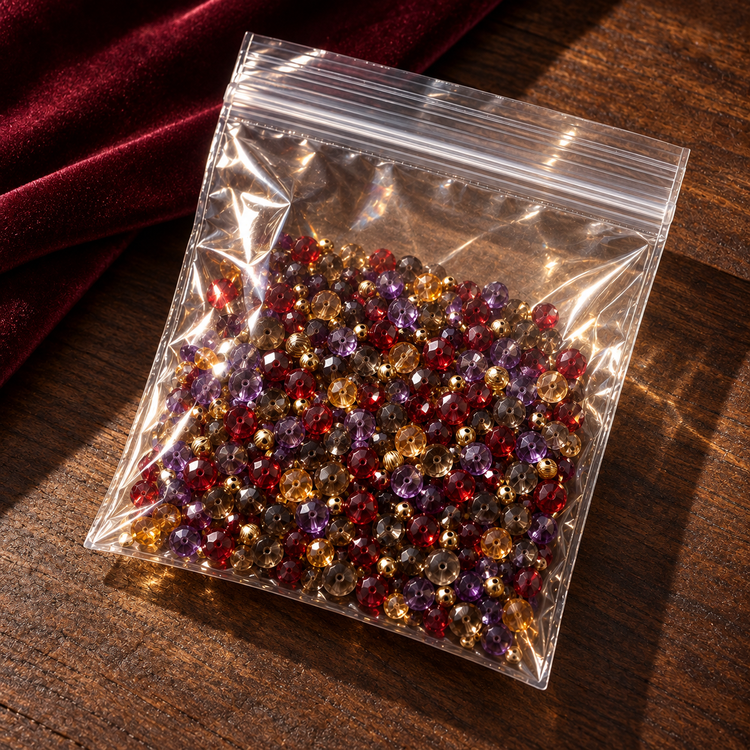
Bulk Bags for Beads: When to Buy 100 vs 1,000
Posted by AppleZipBags Team on Sep 14th 2026
When should you buy 100 bead bags, and when does it make more sense to buy 1,000?
The answer depends less on the size of your business than on whether your packaging system is already proven.
If you are still testing:
-
Bag dimensions
-
Bead capacity
-
Label placement
-
Clear vs. colored packaging
-
Loose vs. stranded bead packaging
a smaller quantity reduces risk.
Once you know a specific bag works across dozens or hundreds of bead SKUs, buying in bulk can reduce:
-
Reordering frequency
-
Packaging interruptions
-
Cost per bag
-
Administrative work
Apple Zip Bags offers jewelry bags for beads, jewelry, charms and other small items.
The simplest rule is:
Buy 100 when you are testing. Buy 1,000 when the packaging format is proven and usage is predictable.
Quick Answer: Should You Buy 100 or 1,000 Bead Bags?
| Situation | Better Choice |
|---|---|
| Testing a new bag size | 100 |
| Launching a new bead category | 100 |
| Testing label placement | 100 |
| Comparing clear vs. colored | 100 |
| Low monthly usage | 100 |
| Unsure about bead capacity | 100 |
| Proven bag size | 1,000 |
| Many SKUs use one bag | 1,000 |
| High monthly usage | 1,000 |
| Wholesale bead business | 1,000 |
| Frequent reordering | 1,000 |
| Predictable recurring demand | 1,000 |
The goal is not simply to buy more because the unit price may be lower.
The goal is to buy:
the right quantity of a bag you already know works.
When 100 Bead Bags Make More Sense
A 100-pack is primarily useful for:
flexibility and testing.
It lets you evaluate a packaging format without committing to hundreds of unused bags.
Buy 100 When Testing a New Bag Size
This is the most important reason to start small.
A bag may look correct based on dimensions but behave differently once filled.
The beads may:
-
Crowd the zipper
-
Bulge excessively
-
Leave too much empty space
-
Be difficult to pour
-
Hide behind a large label
Test the actual beads first.
Apple Zip Bags' bag size guide emphasizes evaluating actual product dimensions and allowing sufficient room rather than choosing packaging that fits too tightly.
Buy 100 When Launching a New Bead Category
Suppose your business normally sells:
seed beads
but is adding:
large gemstone beads.
Your existing packaging may not work.
Start with a smaller quantity while determining the right format.
Buy 100 When Testing Seed Bead Packaging
Seed beads can fit into surprisingly compact bags.
However, you still need enough room for:
-
Pouring
-
Closing
-
Opening
-
Resealing
-
Labeling
A test pack lets you determine how much empty space is necessary.
Buy 100 When Testing Gemstone Bead Packaging
Gemstone beads introduce different variables:
-
Diameter
-
Weight
-
Shape
-
Quantity
A bag that works for:
6 mm beads
may not work well for:
12 mm beads.
Buy 100 When Testing Full Bead Strands
Loose beads and full strands have very different packaging footprints.
A strand needs enough:
-
Width
-
Height
to sit comfortably inside the bag.
Test before ordering bulk quantities.
Buy 100 When Testing Labels
The bag must accommodate both:
product + label.
A label should not:
-
Cover the entire product
-
Block the zipper
-
Fold awkwardly
-
Make the package difficult to read
Buy 100 When Comparing Clear and Colored Bags
Clear bags usually provide the strongest visibility for beads.
Colored bags can be useful for:
-
Category coding
-
Collections
-
Internal organization
Test the workflow before buying a large quantity of a specific color.
Buy 100 When Sales Volume Is Low
Suppose you use:
25 bead bags per month.
A 100-pack lasts approximately:
four months.
A 1,000-pack would represent:
40 months
at the same usage rate.
Unless you expect significant growth, that may be unnecessary.
When 1,000 Bead Bags Make More Sense
A 1,000-pack becomes attractive once:
uncertainty has been removed.
You already know:
-
The size works
-
The beads fit
-
Labels fit
-
Staff can fill the bags efficiently
-
The bag works across multiple products
-
Monthly consumption is predictable
At that point:
bulk purchasing becomes an operational decision rather than an experiment.
Buy 1,000 When the Bag Size Is Proven
Before moving into bulk:
confirm that the bag works with the actual products.
Test:
-
Seed beads
-
Gemstone beads
-
Glass beads
-
Crystal beads
-
Metal beads
that are intended to use the same format.
Buy 1,000 When One Bag Works Across Many SKUs
This is one of the strongest reasons to buy bulk.
Suppose one small clear bag works for:
75 different bead SKUs.
Even if each individual SKU sells slowly:
combined bag consumption may be high.
Example
Suppose:
75 SKUs
each average:
8 packages per month.
75 × 8 =
600 bags per month.
A 1,000-pack would last only about:
1.7 months.
Bulk purchasing clearly makes more sense than repeatedly buying 100.
Buy 1,000 When You Keep Reordering 100-Packs
If staff constantly need to:
-
Monitor packaging
-
Place orders
-
Receive new packs
-
Restock bins
the smaller quantity may create unnecessary work.
At:
500 bags per month,
a 100-pack lasts only:
about six days.
A 1,000-pack lasts approximately:
two months.
Buy 1,000 for Wholesale Bead Operations
Wholesale bead businesses can consume bags extremely quickly.
One wholesale buyer might purchase:
30 bead SKUs
with:
10 packages of each.
That equals:
30 × 10 =
300 bags
for one order.
Three similar orders:
900 bags.
At that volume, 100-packs become impractical.
Buy 1,000 Before Predictable Busy Periods
Packaging demand may increase around:
-
Holiday crafting
-
Jewelry-making seasons
-
Craft shows
-
Wholesale buying periods
-
Promotional campaigns
Use historical demand to prepare.
Shopify's inventory forecasting guide explains how previous demand and expected changes can be used when estimating future inventory requirements.
100 vs. 1,000 Bead Bags: Full Comparison
| Factor | 100 Bags | 1,000 Bags |
|---|---|---|
| Testing new sizes | Excellent | Poor |
| New bead category | Excellent | Moderate |
| Low monthly volume | Excellent | Poor |
| High monthly volume | Poor | Excellent |
| Wholesale | Limited | Excellent |
| Flexibility | Excellent | Moderate |
| Inventory commitment | Low | Higher |
| Storage required | Low | Higher |
| Reordering frequency | High | Lower |
| Risk if size is wrong | Low | High |
| Established packaging | Good | Excellent |
| Many SKUs using same size | Moderate | Excellent |
Calculate Actual Monthly Bead Bag Usage
Bead businesses need to calculate packaging differently from businesses selling one packaged item per order.
One customer order may require:
10 separate bead bags.
Therefore:
customer orders ≠ bead bag usage.
Use This Formula
Monthly customer orders × average individually packaged bead SKUs per order = monthly bead bag demand.
Example:
150 monthly orders
Average:
6 bead SKUs per order
150 × 6 =
900 bags per month.
At that level:
1,000 bags represent only slightly more than one month of normal usage.
Example: 50 Orders Per Month
Average:
2 individually packaged SKUs per order.
50 × 2 =
100 bags per month.
A 100-pack lasts:
approximately one month.
A 1,000-pack lasts:
approximately ten months.
Depending on growth and storage space:
either quantity may be reasonable.
Example: 100 Orders Per Month
Average:
4 packaged SKUs.
100 × 4 =
400 bags per month.
A 100-pack lasts:
roughly one week.
A 1,000-pack lasts:
approximately 2.5 months.
Bulk becomes much more practical.
Example: 200 Orders Per Month
Average:
5 packaged SKUs.
200 × 5 =
1,000 bags per month.
At this volume:
one 1,000-pack represents approximately:
one month of packaging.
Example: 500 Orders Per Month
Average:
6 packaged SKUs.
500 × 6 =
3,000 bags per month.
A business at this volume may need:
multiple 1,000-packs every month.
Include Samples
Do you send bead samples?
Those use bags too.
Example:
Normal product packaging:
800 bags
Samples:
100 bags
Actual monthly usage:
900 bags.
Include Findings
Small bags may also be used for:
-
Clasps
-
Jump rings
-
Bead caps
-
Spacers
-
Charms
Include those quantities.
Include Replacement Beads
Some businesses provide:
-
Spare beads
-
Repair components
-
Replacement pieces
These packages also consume inventory.
Include Craft Kits
One craft kit may use several bags.
Example:
Bag 1 = seed beads
Bag 2 = gemstone beads
Bag 3 = charms
Bag 4 = findings
Bag 5 = cord
One kit consumes:
five bags.
If you sell:
200 kits,
that equals:
1,000 bags.
Calculate Annual Usage
Monthly usage:
800 bags
Annual usage:
800 × 12 =
9,600 bags.
At that level:
repeatedly purchasing only 100 at a time would create unnecessary replenishment work.
Add Safety Stock
Do not plan inventory so precisely that the final bag is used before the replacement shipment arrives.
Maintain a buffer.
Shopify's guide to safety stock and reorder points explains how buffer inventory can help account for demand fluctuations and replenishment delays.
Example Safety Stock Calculation
Expected monthly usage:
1,000 bags
20% buffer:
200 bags
Target inventory:
1,200 bags.
In this scenario:
keeping more than one 1,000-pack available at certain points may be reasonable.
How Much Safety Stock Should You Keep?
There is no universal percentage.
A simple operational starting point might be:
10–25% above expected usage
depending on:
-
Demand variability
-
Supplier lead time
-
Seasonal spikes
-
Wholesale orders
Businesses with unpredictable wholesale demand may need more buffer than businesses with stable retail sales.
Calculate Your Reorder Point
Use:
average daily bag usage × lead time + safety stock.
Example:
Daily usage:
40 bags
Lead time:
7 days
Safety stock:
200 bags
40 × 7 = 280
280 + 200 =
480 bags.
Reorder when inventory approaches:
480 bags.
Why Reorder Points Matter
Without a reorder point:
packaging is often reordered only when someone notices:
“we're almost out.”
That can create unnecessary fulfillment risk.
Track Bags as Inventory
Once packaging usage becomes significant:
bags should be tracked as operational inventory.
Shopify's inventory management guide discusses broader principles for monitoring stock and maintaining appropriate inventory levels.
Track:
-
Bag size
-
Color
-
Quantity
-
Monthly usage
-
Reorder point
Give Packaging Its Own SKU
Example:
BEAD-BAG-XS-CLR
could represent:
extra-small clear bead bag.
Another:
BEAD-BAG-SM-CLR
could represent:
small clear bead bag.
This makes purchasing easier.
Separate Similar Bag Sizes
Small plastic bags can look nearly identical.
Store them in labeled bins.
For example:
XS – Seed Beads
S – Loose Beads
M – Gemstone Beads
L – Strands
This reduces packing errors.
Standardize Bead Bag Sizes Before Buying Bulk
Bulk purchasing works best when:
fewer bag sizes cover more products.
Instead of carrying:
10 nearly identical sizes,
you may be able to standardize:
3–4 core formats.
Example Standardized System
Extra small:
seed beads
Small:
regular loose beads
Medium:
larger gemstone and glass beads
Large:
full strands and larger quantities
The exact sizes depend on the inventory.
Why Standardization Makes Bulk Buying Easier
Suppose:
30 SKUs use one bag.
Another:
40 SKUs use a second.
Another:
50 SKUs use a third.
Combined consumption becomes predictable.
That makes 1,000-pack purchasing much easier to justify.
Do Not Standardize at the Expense of Fit
A bag that is convenient for purchasing but poor for the product is not efficient.
Do not force:
large gemstone beads
into a package designed for:
tiny seed beads.
Clear Bags Are Often Safer for Bulk Buying
Clear packaging is versatile.
One clear bag can work across:
-
Red beads
-
Blue beads
-
Gold beads
-
Gemstone beads
-
Seed beads
-
Seasonal collections
That reduces the risk of obsolete packaging.
Be More Selective With Bulk Colored Bags
Colored packaging may serve a specific:
-
Collection
-
Category
-
Workflow
Suppose only:
10% of your packaging
uses pink bags.
Buying the same number of:
pink and clear
bags would create excess inventory.
Calculate Demand by Bag Color
Monthly total:
1,000 bags
Usage:
80% clear
15% blue
5% pink
Monthly demand:
Clear = 800
Blue = 150
Pink = 50
Order quantities should reflect actual usage.
Consider Seasonal Colors Carefully
If a colored bag is used only for:
Valentine's Day
or:
holiday kits,
do not automatically buy the same bulk quantity as your everyday clear packaging.
Plain Bags Can Reduce Bulk-Buying Risk
Plain packaging can be used across:
-
Collections
-
Seasons
-
Product launches
-
Branding changes
Brand identity can then be added through:
-
Stickers
-
Labels
-
Inserts
Apple Zip Bags discusses these considerations in its guide to custom-printed vs. plain jewelry bags.
When Custom Packaging Requires More Careful Forecasting
Customized bags can become obsolete if:
-
Logo changes
-
Branding changes
-
Product information changes
-
A collection ends
That makes accurate demand forecasting even more important.
Storage Space Matters
A single 1,000-pack may be easy to store.
But imagine:
4 sizes
× 6 colors
× 1,000 bags
=
24,000 bags.
Packaging inventory can grow quickly.
Standardize where practical.
Calculate Cost Per Bag
Use:
pack price ÷ number of bags = cost per bag.
Example:
100 bags cost $8.
$8 ÷ 100 =
$0.08 per bag.
If:
1,000 bags cost $10,
$10 ÷ 1,000 =
$0.01 per bag.
Use current supplier pricing when making the real purchasing decision.
Lower Cost Per Bag Does Not Automatically Mean Better Value
Suppose you save:
several cents per bag
by purchasing 1,000.
But then discover:
the package is too small.
The unused inventory eliminates the savings.
That is why the correct sequence is:
fit → test → standardize → forecast → bulk buy.
Think About Inventory Carrying Cost
Packaging takes:
-
Cash
-
Storage space
-
Organizational effort
Buying more than you can reasonably use can create unnecessary inventory.
Shopify's discussion of inventory costs explains how holding inventory creates costs beyond the initial purchase price.
100 Bags for Small Etsy Sellers
Suppose an Etsy bead seller processes:
30 orders per month
with:
2 individually packaged SKUs per order.
30 × 2 =
60 bags per month.
A 100-pack lasts approximately:
1.7 months.
Testing with 100 may make sense.
1,000 Bags for Growing Etsy Sellers
Suppose the same store grows to:
100 monthly orders
with:
4 packaged SKUs per order.
100 × 4 =
400 bags per month.
A 1,000-pack lasts:
approximately 2.5 months.
Bulk purchasing becomes much more practical.
1,000 Bags for Established Bead Stores
Suppose:
250 orders
× 6 individually packaged SKUs
=
1,500 bags per month.
At that point:
a 1,000-pack does not even cover one month of normal demand.
Bulk Bags for Wholesale Bead Sellers
Wholesale dramatically changes packaging consumption.
One buyer may order:
hundreds of separately packaged products.
A wholesale business should forecast packaging based on:
-
Average order size
-
Number of SKUs
-
Packages per SKU
-
Expected wholesale accounts
Example Wholesale Order
40 bead SKUs
× 5 units each
=
200 bags
for one buyer.
Five similar orders:
1,000 bags.
Bulk Bags for Craft Shows
Before a craft show:
calculate:
normal online demand
plus:
event inventory.
Example:
Normal monthly usage:
500
Craft-show preparation:
350
Safety stock:
150
Total:
1,000 bags.
Bulk Bags for Subscription Boxes
Suppose one jewelry-making subscription box uses:
6 individual bead/component bags.
You prepare:
200 boxes.
6 × 200 =
1,200 bags.
Bulk purchasing becomes essential.
Bulk Bags for Jewelry-Making Classes
Classes may also use pre-portioned bead packages.
Example:
30 students
× 4 component bags
=
120 bags
for one class.
Recurring classes can quickly increase demand.
Do Not Forget Damaged or Wasted Bags
Not every bag will necessarily reach a customer.
Some may be:
-
Damaged
-
Mislabelled
-
Used for samples
-
Used during photography
-
Used internally
A small operational buffer accounts for normal waste.
Should You Buy More Than 1,000?
If monthly usage is:
several thousand bags,
then:
1,000
may itself become a relatively small purchase.
The same principles still apply:
forecast demand + safety stock − current usable inventory = replenishment requirement.
Should You Buy 1,000 of Every Size?
No.
Buy according to actual usage.
Example:
Extra small:
1,200/month
Small:
700/month
Medium:
200/month
Large:
50/month
These sizes should not receive identical order quantities.
Should You Buy 1,000 of Every Color?
No.
Again:
forecast actual demand.
Clear packaging may account for most usage while specialty colors account for much less.
When to Move From 100 to 1,000
A practical transition point occurs when several conditions are true:
-
Size is proven
-
Labels fit
-
Product fits comfortably
-
Closure works properly
-
Multiple SKUs use the bag
-
Monthly demand is stable
-
You repeatedly reorder 100-packs
-
Storage space is available
You do not need every condition.
But the more that apply:
the stronger the case for bulk purchasing.
Bead Bags Are Usually Inner Packaging
Whether you buy:
100
or:
1,000,
small resealable bags are generally best treated as:
inner packaging and organization.
Fragile bead products may still need:
-
Padding
-
Protective mailers
-
Boxes
-
Separation
during shipping.
FedEx provides guidance for shipping jewelry, including the importance of appropriate inner and outer packaging.
Fragile Beads Need Additional Protection
This is particularly relevant for:
-
Glass beads
-
Crystal beads
-
Fragile gemstone pieces
Buying a thicker or larger quantity of bags does not eliminate the need for appropriate shipping protection.
Do Not Assume Resealable Means Waterproof
Standard bead bags should not automatically be described as:
-
Waterproof
-
Hermetically sealed
-
Leakproof
unless those properties are specifically documented.
Do Not Assume Standard Bags Are Archival
Likewise:
ordinary bead bags should not automatically be described as:
-
Archival
-
Museum-grade
-
Anti-tarnish
unless specifically designed and documented for those applications.
Common Mistakes When Buying Bead Bags in Bulk
Buying 1,000 Before Testing
Test the actual beads first.
Choosing Quantity Based Only on Price
Fit matters more than unit cost.
Calculating Demand From Customer Orders
Count individual packaged SKUs instead.
Forgetting Samples
Samples consume bags.
Forgetting Findings
Small components consume bags too.
Forgetting Craft Kits
One kit may use several bags.
Ignoring Wholesale Demand
A single wholesale order may use hundreds.
Ignoring Seasonal Demand
Prepare before predictable spikes.
Not Keeping Safety Stock
Packaging shortages can stop fulfillment.
Waiting Until Inventory Reaches Zero
Use a reorder point.
Buying 1,000 of Every Size
Order according to actual consumption.
Buying Equal Quantities of Every Color
Forecast demand by color.
Carrying Too Many Similar Sizes
Standardize where practical.
Buying Custom Bags Too Early
Branding can change.
Ignoring Storage Space
Bulk packaging still needs organized storage.
Assuming Lower Unit Cost Always Means Savings
Unused packaging is not a saving.
Bulk Bead Bag Buying Checklist
Before deciding between 100 and 1,000, ask:
-
Has this bag size been tested?
-
Do the beads fit comfortably?
-
Is there room below the zipper?
-
Does the label fit?
-
Can the bag be filled quickly?
-
Is the product loose or stranded?
-
Is the bag suitable for the bead weight?
-
Are any components sharp?
-
Is this clear or colored packaging?
-
Does the color have a stable purpose?
-
How many SKUs use this bag?
-
How many orders are processed monthly?
-
How many bead SKUs are packaged per average order?
-
How many bags are actually consumed monthly?
-
Are samples included?
-
Are findings included?
-
Are replacement components included?
-
Are craft kits included?
-
Are subscription boxes included?
-
Are wholesale orders included?
-
Are craft shows included?
-
Is seasonal demand included?
-
What is annual usage?
-
How much safety stock is required?
-
What is the reorder point?
-
How long is supplier lead time?
-
Is storage space available?
-
Can bag sizes be standardized?
-
Is 100 enough for testing?
-
Is 1,000 likely to be consumed within a reasonable period?
-
What is the cost per bag?
-
Are inventory carrying costs reasonable?
-
Is the packaging plain or customized?
-
Could branding change?
-
Is additional shipping protection required?
Frequently Asked Questions
Should I buy 100 or 1,000 bead bags?
Buy:
100
when testing a new:
-
Size
-
Color
-
Label
-
Bead category
Buy:
1,000
when the packaging format is proven and usage is predictable.
When should I switch from 100 to 1,000?
Consider switching when:
-
You repeatedly reorder 100-packs
-
One size works across many SKUs
-
Monthly demand is stable
-
The bag has already been tested
How many bead bags do I need per month?
Use:
monthly orders × average individually packaged bead SKUs per order.
Then add:
-
Samples
-
Findings
-
Kits
-
Safety stock
Why shouldn't I calculate bags by customer orders?
Because one order may contain:
10 separately packaged bead SKUs.
One order can therefore use:
10 bags.
Is 1,000 too many for a small bead business?
Not necessarily.
If a small business uses:
400 bags per month,
1,000 lasts only:
2.5 months.
Is 100 enough for a new business?
It can be a good starting point when testing packaging.
Should I buy 1,000 clear bead bags?
Clear bags can be easier to buy in bulk because they work across many:
-
Colors
-
Materials
-
Collections
Should I buy 1,000 colored bead bags?
Only when the color has an established purpose and predictable usage.
Should I buy the same quantity of every bag size?
No.
Order according to consumption by size.
Should I buy the same quantity of every color?
No.
Forecast demand separately.
How much safety stock should I keep?
A starting point might be:
10–25% above expected demand,
depending on variability and lead time.
How do I calculate a reorder point?
A simple formula is:
average daily usage × lead time + safety stock.
Should bead bags be tracked as inventory?
At meaningful volume:
yes.
Tracking packaging can prevent fulfillment interruptions.
Are 1,000-packs automatically cheaper?
They may provide a lower unit cost, but bulk purchasing only creates value when the bags are actually used.
Can I use bulk bead bags for wholesale?
Yes.
Wholesale operations may consume hundreds of individual bags in a single order.
Can I use bead bags for craft kits?
Yes.
Several individually packaged components can be organized inside one larger kit.
Are bead bags enough for shipping?
They are generally better treated as inner packaging.
Fragile products may require additional shipping protection.
Are standard resealable bead bags waterproof?
Do not assume they are waterproof or hermetically sealed unless specifically documented.
Final Verdict: When to Buy 100 vs. 1,000 Bulk Bags for Beads
Choose:
100 bead bags
when you are still learning.
That includes testing:
-
Bag dimensions
-
Bead capacity
-
Labels
-
Clear vs. colored packaging
-
New bead categories
-
Loose vs. stranded products
A smaller pack reduces the risk of being left with hundreds of bags that do not fit your workflow.
Choose:
1,000 bead bags
when the system is proven.
Bulk purchasing becomes particularly attractive when:
-
One size works across many SKUs
-
You use hundreds of bags every month
-
Wholesale orders are common
-
Craft kits consume multiple bags
-
You repeatedly reorder smaller packs
-
Demand is predictable
Most importantly:
calculate bag demand from individually packaged products—not customer order count.
If:
150 orders per month
contain an average of:
6 separately packaged bead SKUs,
your real demand is:
900 bags per month.
Then add:
-
Samples
-
Findings
-
Kits
-
Seasonal demand
-
Safety stock
The strongest bulk-buying process is:
test 100 → confirm bead fit → confirm labels → standardize sizes → calculate monthly usage → forecast seasonal and wholesale demand → add safety stock → establish a reorder point → move to 1,000 when consumption justifies it.
Do not buy 1,000 bags simply because the price per bag looks better.
Buy 1,000 when you already know:
the bag works and the business will use it.