
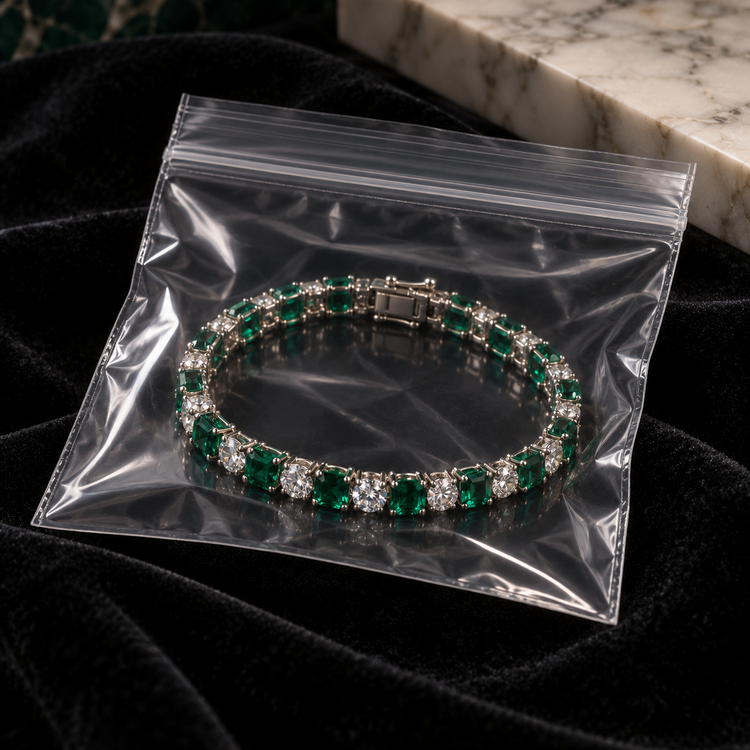
Bracelets Packaging Guide: Size, Thickness and Quantity
Posted by AppleZipBags Team on Sep 13th 2026
Bracelet packaging looks simple until you try to fit several different bracelet styles into the same bag.
A delicate chain bracelet, rigid bangle, thick gemstone bracelet and oversized charm bracelet may all require completely different packaging dimensions.
That is why a practical bracelets packaging guide should focus on three specifications first:
size, thickness and quantity.
Size determines whether the bracelet fits comfortably.
Film thickness affects flexibility and handling.
Quantity determines whether you should test a smaller pack or purchase in bulk.
Apple Zip Bags offers jewelry bags designed for jewelry, beads, charms and other small items, with its standard jewelry bags currently listed at:
2.5 mil thickness.
For most businesses, the best packaging strategy is:
measure the complete bracelet package → choose enough clearance → select an appropriate film thickness → test the size → buy larger quantities only after the format is proven.
Quick Bracelet Packaging Guide
Use this table as a starting point.
| Bracelet Type | Bag Sizing Priority | Main Thickness Concern | Quantity Strategy |
|---|---|---|---|
| Chain bracelet | Compact fit | Flexibility | Test small, then bulk |
| Tennis bracelet | Avoid sharp folding | Smooth flexible film | Test fit carefully |
| Stretch bracelet | Natural relaxed shape | Avoid compression | Standardize once proven |
| Beaded bracelet | Account for bead depth | Room around beads | Bulk if size is consistent |
| Gemstone bracelet | Diameter + thickness | Avoid tight pressure | Test before bulk |
| Charm bracelet | Extra clearance | Avoid charm pressure | Size by largest charm |
| Bangle | Full rigid diameter | Bag must fit shape | Usually larger size |
| Cuff | Width + rigid shape | Needs extra room | Test individual styles |
| Leather bracelet | Thickness + width | Avoid forced closure | Standardize if possible |
Why Size Matters Most
If the bag is incorrectly sized, thickness and quantity become secondary.
A bag that is too small can:
-
Bend jewelry cards
-
Compress beads
-
Catch charms
-
Stress the zipper
-
Slow packing
A bag that is too large can:
-
Allow movement
-
Encourage tangling
-
Take up extra storage space
-
Create unnecessary material around the bracelet
The goal is:
comfortable clearance without excessive empty space.
Apple Zip Bags' bag size guide emphasizes measuring the item and allowing room rather than choosing a bag whose dimensions exactly match the product.
Measure the Packaged Bracelet, Not Just the Bracelet
This distinction is important.
Suppose a bracelet is:
7 inches long.
That does not necessarily mean it needs a:
7-inch-long bag.
If it is mounted on a:
3 × 4 inch bracelet card,
the bag should be selected around:
the carded bracelet.
For rigid jewelry:
measure the item's actual physical shape.
For flexible jewelry:
measure the final packaging configuration.
Measure Width, Height and Thickness
For every bracelet package, measure:
width × height × depth.
Depth is especially important for:
-
Gemstone bracelets
-
Large beads
-
Charms
-
Leather cuffs
-
Layered bracelets
A bag may look large enough from the front but still be too tight once product thickness is considered.
Bracelet Bag Size by Jewelry Type
There is no single universal bracelet bag size.
The most practical approach is to classify bracelets by how they behave physically.
Chain Bracelets
Chain bracelets are flexible.
They may be:
-
Laid flat
-
Loosely folded
-
Mounted on a card
They usually need relatively compact packaging.
The card, if used, often determines the bag dimensions.
Tennis Bracelets
Tennis bracelets should not be aggressively folded to fit a smaller package.
Choose enough room for the bracelet to remain:
-
Flat
-
Gently curved
-
Properly supported
Stretch Bracelets
Stretch bracelets should remain in their natural shape.
Do not stretch elastic jewelry simply to fit a narrow bag.
Beaded Bracelets
Beaded bracelets require attention to:
-
Bead diameter
-
Bracelet diameter
-
Added charms
-
Product depth
A bracelet made with:
4 mm beads
and one made with:
12 mm beads
may need very different packaging even if both fit the same wrist size.
Gemstone Bracelets
Gemstone bracelets can be heavier and bulkier than simple chain jewelry.
Large stones increase:
-
Thickness
-
Weight
-
Pressure against the bag
Give the bracelet enough room to sit naturally.
Charm Bracelets
Charm bracelets need additional clearance because charms can:
-
Project outward
-
Move independently
-
Catch near the zipper
-
Create irregular thickness
Size the bag around:
the widest and thickest packaged point.
Bangles
Rigid bangles cannot be folded.
The bag must accommodate their:
full physical diameter.
Do not try to fit a large bangle into a bag intended for flexible chain bracelets.
Cuff Bracelets
Cuffs can vary greatly in:
-
Width
-
Diameter
-
Metal thickness
-
Ornamentation
Measure the actual cuff rather than relying on a general bracelet size.
Leather Bracelets
Leather bracelets may be:
-
Wide
-
Braided
-
Layered
-
Thick
Avoid forcing them into a narrow bag that compresses the material.
How Much Extra Room Should a Bracelet Bag Have?
There is no single correct clearance for every bracelet.
Instead, use a practical fit test.
The bracelet should:
-
Slide in easily
-
Sit naturally
-
Allow the closure to seal
-
Be removable without snagging
If the product has to be forced inside:
the bag is too small.
If the product floats around with significant unused space:
the bag may be too large.
Bracelet Cards and Bag Size
Jewelry cards can simplify packaging considerably.
A bracelet card can:
-
Hold the bracelet in position
-
Reduce tangling
-
Display branding
-
Carry SKU information
-
Support barcodes
When a card is used:
size the bag to the complete carded bracelet.
Example
Bracelet card:
3 × 4 inches
Bracelet:
10 mm beads
Do not select a bag based only on:
3 × 4 inches.
The beads add thickness.
The actual package requires slightly more room.
What Does 2.5 Mil Mean?
Apple Zip Bags currently lists its jewelry bags at:
2.5 mil thickness.
One mil equals:
0.001 inch.
Therefore:
2.5 mil = 0.0025 inch.
This measurement refers to:
film thickness
not the dimensions of the bag.
Is 2.5 Mil Good for Bracelet Packaging?
For many everyday bracelet applications:
yes.
A 2.5 mil flexible bag can provide a practical balance between:
-
Flexibility
-
Visibility
-
Compact storage
-
Easy handling
-
Resealable convenience
It is suitable for many:
-
Chain bracelets
-
Beaded bracelets
-
Charms
-
Jewelry cards
-
Small accessories
The appropriate bag still depends on the specific bracelet.
2 Mil vs. 2.5 Mil vs. 4 Mil for Bracelets
A simplified comparison:
| Thickness | Typical Characteristic | Bracelet Application |
|---|---|---|
| 2 mil | Lightweight and flexible | Light jewelry and organization |
| 2.5 mil | Flexible but substantial | Strong everyday jewelry choice |
| 4 mil | Heavier film | May suit heavier or more demanding handling |
More thickness is not automatically better.
The right thickness depends on:
-
Bracelet weight
-
Sharp components
-
Handling frequency
-
Storage requirements
When Thicker Packaging May Help
A heavier bag may be useful when jewelry has:
-
Substantial metal components
-
Large beads
-
Sharp edges
-
Frequent handling
However, thicker film should not replace appropriate:
-
Backing cards
-
Padding
-
Inserts
when a bracelet contains sharp components.
Sharp Charms Need Special Attention
Some bracelets include:
-
Pointed charms
-
Wire ends
-
Metal corners
-
Prongs
These can place concentrated pressure on plastic.
Consider adding:
-
Card backing
-
Tissue
-
Small protective insert
-
Additional cushioning
rather than simply choosing a dramatically thicker bag.
More Thickness Does Not Mean Archival
A thicker standard resealable bag should not automatically be described as:
-
Archival
-
Museum-grade
-
Anti-tarnish
unless the product is specifically designed and documented for those properties.
Film thickness and archival performance are different issues.
Clear vs. Colored Bracelet Bags
Bag color is another practical variable.
Choose Clear When You Need:
-
Product visibility
-
Fast picking
-
SKU verification
-
Quality checks
-
Wholesale sorting
Clear packaging is especially useful for high-volume online jewelry operations.
Choose Colored When You Need:
-
Collection coding
-
Seasonal sorting
-
Channel separation
-
Privacy
-
Visual differentiation
Keep color systems simple.
Example Bracelet Bag Color System
Clear:
Regular retail inventory
Blue:
Wholesale
Pink:
Seasonal collection
This can work well when paired with proper:
-
SKU labels
-
Product names
-
Inventory records
Color should supplement identification, not replace it.
How Many Bracelet Bags Should You Buy?
After determining:
size and thickness,
decide quantity.
Common pack choices include:
-
100 bags
-
1,000 bags
The right quantity depends on:
-
Sales volume
-
Packaging certainty
-
Number of bracelet styles
-
Storage capacity
-
Seasonal demand
When to Buy 100 Bracelet Bags
Choose a smaller pack when:
-
Testing a new size
-
Launching a new bracelet
-
Trying a new card
-
Comparing colors
-
Packaging low volumes
Apple Zip Bags' 100-pack small jewelry bags can be useful for validating a packaging setup before making a larger commitment.
When to Buy 1,000 Bracelet Bags
Buy larger quantities when:
-
Size is proven
-
Card fit is proven
-
Monthly use is predictable
-
Packing staff are comfortable with the format
-
The same bag works across several bracelet SKUs
Apple Zip Bags' 1,000-pack small jewelry bags are better suited to established, repeat-use packaging needs.
100 Bags vs. 1,000 Bags
| Factor | 100-Pack | 1,000-Pack |
|---|---|---|
| New packaging test | Excellent | Poor |
| Small seller | Excellent | Moderate |
| High-volume store | Limited | Excellent |
| Storage requirement | Low | Higher |
| Risk of wrong size | Low | Higher |
| Reorder frequency | Higher | Lower |
| Proven bag size | Good | Excellent |
The best sequence is:
test → validate → bulk order.
Calculate Monthly Bracelet Bag Usage
Use:
bracelets packaged per month × bags per bracelet = monthly bag demand.
Example:
300 bracelets per month
× 1 bag each
=
300 bags per month.
Include Component Bags
Bracelet sellers may also use bags for:
-
Extra charms
-
Clasps
-
Repair pieces
-
Extenders
-
Replacement components
Example:
300 bracelet bags
50 component bags
Total:
350 bags per month.
Calculate Annual Demand
If monthly use is:
350 bags,
annual demand is:
350 × 12 =
4,200 bags.
That makes larger pack purchasing easier to evaluate.
Account for Growth
Do not assume next year's volume will equal today's volume.
If monthly sales are growing:
increase packaging forecasts accordingly.
For example:
Current use:
500 bags/month
Expected growth:
20%
Projected demand:
600 bags/month.
Seasonal Bracelet Packaging Demand
Bracelet sales may rise around:
-
Valentine's Day
-
Mother's Day
-
Graduation
-
Wedding season
-
Holiday gifting
Packaging demand should be forecast alongside product demand.
Shopify's inventory forecasting guide provides broader guidance on using historical demand and expected changes to plan stock needs.
Keep Safety Stock
Do not plan to use every final bag before reordering.
Packaging is operational inventory.
Shopify's guide to safety stock and reorder points explains how buffer inventory can protect against demand spikes and replenishment delays.
A simple starting buffer may be:
10–25% above expected normal usage,
depending on demand stability.
Example Safety Stock Calculation
Expected monthly use:
500 bags
20% buffer:
500 × 0.20 =
100 bags
Target availability:
600 bags.
Calculate a Reorder Point
Use:
average daily use × lead time + safety stock.
Example:
Daily use:
15 bags
Lead time:
7 days
Safety stock:
100 bags
Calculation:
15 × 7 = 105
105 + 100 =
205 bags.
Place the next order when inventory approaches:
205 bags.
Quantity Planning for Wholesale Bracelet Sellers
Wholesale orders can consume packaging quickly.
Example:
One retail partner orders:
250 bracelets.
If each is individually packaged:
250 bags
may be used in one shipment.
Businesses serving wholesale accounts should maintain more packaging buffer than businesses shipping only small consumer orders.
Quantity Planning for Etsy Sellers
Suppose an Etsy seller ships:
50 bracelets per month.
A 100-pack represents approximately:
two months of normal packaging.
That may be more practical than immediately purchasing 1,000.
Quantity Planning for Growing Online Stores
Suppose an online store ships:
400 bracelets per month.
A 1,000-pack represents around:
2.5 months of usage
before considering safety stock and other packaging needs.
At that point, bulk purchasing becomes much more practical.
Standardize Bracelet Bag Sizes
Using many nearly identical sizes creates:
-
Purchasing complexity
-
Storage clutter
-
Packing errors
Where possible, standardize around a smaller number of bag sizes.
Many jewelry businesses can work with:
three to five core packaging sizes.
For example:
Small:
Rings and tiny earrings
Medium:
Bracelets
Large:
Necklaces
Actual dimensions should be based on the catalog.
Why Standardization Matters
Standardization simplifies:
-
Inventory counting
-
Reordering
-
Employee training
-
Storage
-
Fulfillment
It also allows larger pack quantities to be used more efficiently.
One Bracelet Per Bag
For most retail inventory:
one bracelet per bag is the simplest approach.
Benefits include:
-
Less tangling
-
Better SKU control
-
Faster counting
-
Easier fulfillment
Putting several bracelets together may increase:
-
Scratching
-
Tangling
-
Product confusion
Packaging Bracelet Sets
Bracelet sets are different.
You may choose:
one larger shared bag
or:
individual inner bags + one outer package.
The right choice depends on:
-
Materials
-
Product presentation
-
Scratch risk
-
SKU structure
Cost Per Bag
Do not evaluate packaging only by total pack price.
Calculate:
pack price ÷ bag quantity = cost per bag.
Example:
100-pack costs $8.
$8 ÷ 100 =
$0.08 per bag.
A 1,000-pack costing $10 would equal:
$10 ÷ 1,000 =
$0.01 per bag.
Use current pricing when making actual purchasing decisions because pricing can change.
Unit Cost Is Not Everything
A larger pack may offer a lower unit cost.
But if:
-
The size is wrong
-
The bag does not fit the card
-
Employees dislike the workflow
then the low unit price creates little value.
Fit comes first.
Calculate Packaging Cost Per Bracelet
Packaging may include:
-
Resealable bag
-
Bracelet card
-
Sticker
-
Pouch
-
Gift box
-
Shipping mailer
Example:
Bag = $0.02
Card = $0.12
Label = $0.03
Inner packaging:
$0.17 per bracelet.
Knowing this figure helps with:
-
Pricing
-
Margin analysis
-
Fulfillment planning
Packaging for Different Sales Channels
A business selling through:
-
Website
-
Marketplace
-
Wholesale
-
Craft shows
-
Retail stores
may use different packaging systems.
Standardizing across channels can simplify inventory.
If separate packaging is necessary:
forecast each type separately.
Bracelet Packaging for Wholesale
Wholesale buyers often value:
-
Consistent presentation
-
Clear identification
-
Individual separation
Resealable bracelet bags can simplify large assortments.
Bracelet Packaging for Craft Shows
At craft shows:
bags can be used for:
-
Back stock
-
Sold items
-
Customer pickup
-
SKU separation
Add expected event demand to normal monthly bag usage.
Bracelet Packaging for Online Fulfillment
Clear bags can help employees verify:
-
Bracelet color
-
Metal tone
-
Charm
-
Bead style
-
SKU
before shipping.
This becomes increasingly useful as SKU count grows.
Shopify's inventory management guide provides broader guidance on organizing and tracking inventory as operations scale.
Bracelet Packaging as Inner Packaging
A resealable bag does not have to be the final presentation.
It may sit inside:
-
Pouch
-
Gift box
-
Branded box
-
Shipping container
The bag can provide:
organization and separation
while the outer package creates the customer-facing presentation.
Shipping Bracelets Safely
A resealable bag should not automatically be treated as the complete shipping package.
FedEx provides guidance for shipping jewelry that emphasizes suitable internal packaging and secure outer packaging.
Depending on the product, additional protection may include:
-
Padding
-
Box
-
Pouch
-
Insert
-
Outer mailer
Bracelets With Sharp Components
Bracelets containing:
-
Prongs
-
Sharp charms
-
Wire ends
-
Pointed decorative elements
may need additional internal protection.
A plastic bag alone should not be expected to handle repeated contact with a sharp component.
Standard Resealable Bags Are Not Automatically Waterproof
Do not assume a resealable closure means the package is:
-
Waterproof
-
Hermetically sealed
-
Leakproof
Those characteristics require specific product support.
Standard Resealable Bags Are Not Automatically Anti-Tarnish
Likewise, ordinary jewelry bags should not automatically be described as:
-
Anti-tarnish
-
Archival
-
Museum-grade
unless those properties are specifically documented.
Common Bracelet Packaging Mistakes
Choosing by Wrist Size
Measure the actual packaged bracelet.
Forgetting Thickness
Width and height alone may not be enough.
Choosing an Exact-Fit Bag
Leave clearance.
Choosing Bags That Are Too Large
Excess room encourages movement.
Ignoring Bracelet Cards
The card can determine minimum dimensions.
Ignoring Charm Size
Charms increase width and depth.
Compressing Large Beads
Choose more space instead.
Stretching Elastic Jewelry
Keep stretch bracelets relaxed.
Folding Tennis Bracelets Too Sharply
Allow a natural shape.
Trying to Fit Bangles Into Flexible-Bracelet Bags
Rigid jewelry must be measured differently.
Assuming More Mil Is Always Better
Choose thickness for the application.
Assuming Thicker Bags Are Anti-Tarnish
Film thickness does not establish anti-tarnish performance.
Buying 1,000 Before Testing
Confirm size first.
Buying Only by Cost Per Bag
Usability matters.
Forgetting Safety Stock
Packaging shortages can interrupt fulfillment.
Ignoring Wholesale Orders
A single large order can consume hundreds of bags.
Using Too Many Sizes
Standardize where practical.
Treating a Small Bag as Complete Shipping Protection
Use suitable outer packaging.
Bracelet Packaging Buying Checklist
Before placing an order, ask:
-
What style of bracelet am I packaging?
-
Is it flexible or rigid?
-
Will it be mounted on a card?
-
What is the packaged width?
-
What is the packaged height?
-
What is the packaged thickness?
-
Are the beads large?
-
Are there charms?
-
Are there sharp components?
-
Does the bag provide comfortable clearance?
-
Can the zipper close easily?
-
Is there excessive empty room?
-
Does the bracelet remain naturally positioned?
-
Should the bag be clear?
-
Would colored bags improve organization?
-
Is 2.5 mil suitable for the workflow?
-
Is heavier material actually necessary?
-
Do I need backing or padding?
-
Will the bag be used as inner packaging?
-
Is additional shipping protection required?
-
Is this a new bag size?
-
Should I test a 100-pack?
-
Is the size already proven?
-
Would a 1,000-pack make sense?
-
How many bracelets are packaged monthly?
-
Are component bags included in the forecast?
-
Is seasonal demand included?
-
Is wholesale demand included?
-
How much safety stock should I hold?
-
What is the reorder point?
-
Can this size be standardized across several SKUs?
-
Have unsupported waterproof or anti-tarnish claims been avoided?
Frequently Asked Questions
What size bag should I use for bracelets?
Measure:
the bracelet in its final packaging configuration.
If a card is used:
measure the carded bracelet.
Allow additional clearance.
What thickness is good for bracelet bags?
For many everyday jewelry applications:
2–2.5 mil
is a practical range.
Apple Zip Bags currently lists its jewelry bags at:
2.5 mil.
What does 2.5 mil mean?
It means:
0.0025 inch film thickness.
It does not refer to bag width or length.
Is 4 mil better than 2.5 mil?
Not automatically.
Choose thickness according to:
-
Jewelry weight
-
Sharpness
-
Handling
-
Storage
rather than assuming thicker is always better.
Should bracelet bags fit tightly?
No.
Allow enough room for:
-
Product thickness
-
Insertion
-
Closure
Can a bag be too large?
Yes.
Excess space can allow the bracelet to:
-
Move
-
Tangle
-
Shift
Should I size the bag to the bracelet card?
If a card is used:
yes.
Measure the complete carded bracelet.
What bag works for a bangle?
Choose a bag large enough for the bangle's full rigid diameter.
What bag works for gemstone bracelets?
Select a bag with enough:
-
Width
-
Height
-
Depth
for the bracelet's full bead size and natural shape.
What bag works for charm bracelets?
Allow additional room for the largest charms and irregular product thickness.
Are clear bags best for bracelets?
Clear bags are highly practical when:
-
Product visibility
-
Inventory checks
-
Picking speed
matter.
When should I use colored bags?
Colored bags can support:
-
Collection coding
-
Sales-channel separation
-
Seasonal organization
Should I buy 100 or 1,000 bracelet bags?
Buy 100 when testing.
Buy 1,000 when:
-
Size is proven
-
Usage is predictable
-
Storage is available
How do I calculate monthly bracelet bag demand?
Use:
bracelets packaged monthly × bags per bracelet.
Then add:
-
Component bags
-
Seasonal demand
-
Safety stock
How much safety stock should I keep?
A practical starting point may be:
10–25% above normal usage,
depending on demand variability and supplier lead time.
Can several bracelets go in one bag?
They can, but individual bags often provide better:
-
Separation
-
SKU control
-
Tangling prevention
Can resealable bags be used for premium bracelets?
Yes.
They can function as inner packaging inside:
-
Pouches
-
Boxes
-
Branded packaging
Are 2.5 mil bags waterproof?
Film thickness alone does not make a bag waterproof.
Do not automatically describe standard resealable bags as waterproof.
Are 2.5 mil bags anti-tarnish?
Not necessarily.
Use specific anti-tarnish packaging when that property is required.
Can I ship a bracelet using only a small bag?
A resealable bag is generally better treated as:
inner packaging.
Use additional outer protection appropriate to the bracelet and shipping method.
Final Verdict: Bracelet Packaging Size, Thickness and Quantity
The best bracelet packaging system starts with:
size.
Measure the complete product exactly as it will be packaged.
That may mean measuring:
-
A folded chain bracelet
-
A carded bracelet
-
A rigid bangle
-
A thick gemstone bracelet
-
A charm bracelet with irregular projections
Then allow enough clearance for:
easy insertion + product thickness + zipper closure.
Do not choose a package that is:
too tight
or:
unnecessarily oversized.
Next, evaluate:
film thickness.
For many everyday bracelet applications:
2.5 mil resealable jewelry bags
provide a practical balance of:
-
Flexibility
-
Visibility
-
Compact storage
-
Handling convenience
But thicker material should not be viewed as automatically superior.
Finally, choose:
quantity.
Use smaller packs when:
-
Testing dimensions
-
Testing bracelet cards
-
Launching new products
Move into:
1,000-pack or other bulk purchasing
after the packaging format has been validated and usage is predictable.
The most reliable bracelet packaging sequence is:
identify bracelet style → determine packaged shape → measure width, height and depth → allow clearance → choose film thickness → select clear or colored → test the format → calculate monthly demand → add safety stock → order bulk once proven.
That creates a bracelet packaging system based on actual product dimensions and operational demand rather than guesswork.