
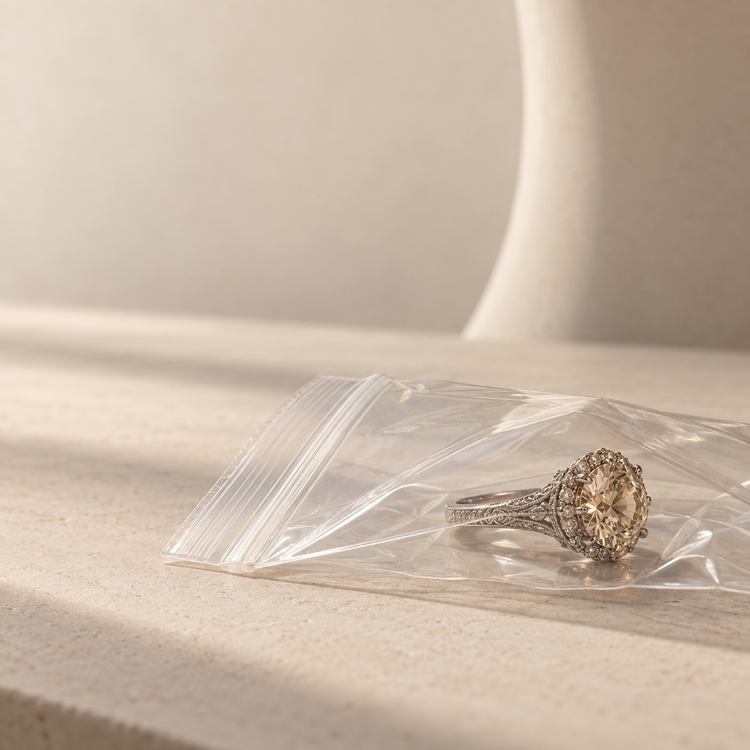
Best Small Resealable Bags for Rings
Posted by AppleZipBags Team on Sep 9th 2026
The best small resealable bags for rings are compact enough to keep inventory organized while providing enough room for the complete ring, label, holder or card without forcing the jewelry against the zipper.
Rings appear simple to package because they are small.
But their three-dimensional construction makes ring packaging more complicated than packaging many flat jewelry items.
A plain metal band may need very little room.
A gemstone ring can have:
-
A tall setting
-
Raised prongs
-
A large center stone
-
Side stones
-
A wide shank
A statement ring may be several times larger than a simple band even if both are the same ring size.
For many everyday inventory and retail applications, small resealable bags around 2–2.5 mil provide a practical starting point.
Apple Zip Bags offers small resealable jewelry bags in 2.5 mil material for jewelry and other compact products. Current product listings include both clear and colored options.
The best overall approach is:
identify the ring → measure the complete package → account for height and prongs → choose the smallest comfortable bag → test → standardize.
Quick Answer: What Are the Best Small Bags for Rings?
For many ring businesses, a strong general-purpose choice is:
a small clear 2.5 mil resealable bag sized to the complete ring or ring holder.
Use this framework:
| Ring Type | Packaging Approach | Main Concern |
|---|---|---|
| Thin band | Extra-small bag | Diameter |
| Wedding band | Extra-small–small | Width/thickness |
| Stackable ring | Extra-small | Keeping SKU separate |
| Signet ring | Small | Face width and height |
| Gemstone ring | Small | Raised setting |
| Engagement ring | Small | Prongs and center stone |
| Cluster ring | Small | Width + setting height |
| Cocktail ring | Small–medium | Large decorative top |
| Statement ring | Small–medium | Width + depth |
| Ring on display card | Size to card | Complete assembly |
For inventory:
clear bags are generally the most versatile.
For purchasing quantity:
use 100 to test an unproven size and 1,000 once the packaging specification is stable and regularly consumed.
Why Small Resealable Bags Work Well for Rings
Rings are easy to lose when stored loosely.
Individual resealable bags can keep:
ring + SKU + size information
together.
That makes them useful for:
-
Jewelry stores
-
Ecommerce brands
-
Etsy sellers
-
Wholesale suppliers
-
Repair departments
-
Estate jewelry sellers
-
Vintage dealers
-
Craft sellers
Individual ring packaging can also reduce direct contact between separate jewelry pieces.
GIA recommends avoiding tossing jewelry together because contact can contribute to scratches and damage.
Ring Size Is Not Bag Size
This distinction is critical.
Ring sizes such as:
-
5
-
6
-
7
-
8
-
9
describe how the ring fits a finger.
They do not tell you what packaging dimensions you need.
Two size-7 rings can have completely different external dimensions.
For example:
Ring A
Thin plain band.
Ring B
Large oval gemstone with a raised cathedral setting.
Both fit the same finger.
But Ring B needs significantly more packaging space.
Measure the Complete Ring
When selecting a bag, measure the ring's:
outside width + overall height + thickness/depth.
For gemstone rings, also measure the:
-
Setting
-
Stone
-
Prongs
-
Decorative shoulders
Do not measure only the inner diameter.
Measure the Ring at Its Widest Point
The bag has to accommodate the entire object.
For a plain band, the widest point may simply be the outer diameter.
For a signet ring, it may be the face.
For a cocktail ring, it may be the decorative top.
For an irregular statement ring, measure whichever section extends farthest.
Measure Setting Height
Gemstone rings create an additional packaging dimension:
vertical height.
This can include:
-
Center stone
-
Halo
-
Basket
-
Cathedral shoulders
-
Prongs
A bag that looks generous when the ring is viewed from above may become tight once the three-dimensional setting is considered.
Account for Ring Holders and Cards
If the ring is attached to:
-
Ring card
-
Foam insert
-
Display holder
-
Inventory tag
size the bag to the complete packaged assembly.
Do not size only to the ring.
Apple Zip Bags' packaging bag size guide emphasizes measuring the finished packaged item and allowing enough room for sealing and handling.
Leave Room for the Resealable Closure
A ring should sit completely below the zipper track.
If the ring:
-
Presses into the seal
-
Prevents easy closing
-
Must be forced downward
the bag is too small.
Leave enough clearance for normal:
-
Insertion
-
Closing
-
Reopening
-
Inventory handling
Choose the Smallest Comfortable Size
Smaller is not automatically better.
The ideal ring bag is:
compact without being tight.
Too small can create:
-
Difficult packing
-
Pressure against prongs
-
Stress against the closure
Too large can create:
-
Excess movement
-
More storage space
-
Less polished organization
The goal is the smallest size that works comfortably.
Best Bags for Plain Bands
Plain bands are among the easiest rings to package.
Examples include:
-
Wedding bands
-
Stackable bands
-
Simple fashion rings
These typically need less depth because they have no large raised setting.
An extra-small resealable bag may work well if it provides:
-
Easy insertion
-
Label room
-
Closure clearance
Best Bags for Wide Bands
A wide band takes up more space than a thin stacking ring.
Measure:
-
Outside diameter
-
Band width
-
Overall thickness
Wide men's bands or chunky fashion bands may need a slightly larger bag even without gemstones.
Best Bags for Stackable Rings
Stacking rings are frequently sold:
-
Individually
-
In sets
If each ring is an individual SKU:
one ring per labeled bag
can simplify inventory.
If multiple rings are intentionally sold as one set, they can potentially share a package if the combined arrangement fits comfortably.
Best Bags for Signet Rings
Signet rings often have:
-
Wider faces
-
Thicker shoulders
-
Greater overall mass
Measure the face at its widest point.
Do not assume a signet ring fits the same bag as a thin band just because the finger size is identical.
Best Bags for Gemstone Rings
Gemstone rings require additional care because the top of the ring may be:
-
Raised
-
Pointed
-
Irregular
The bag should allow the ring to rest without forcing the setting directly against the closure.
If the gemstone or setting is delicate, additional protective material may also be appropriate.
Best Bags for Engagement Rings
Engagement rings commonly have raised settings.
These may include:
-
Solitaire
-
Halo
-
Three-stone
-
Pavé
-
Cathedral
-
Cluster
The packaging decision should therefore account for:
ring diameter + stone width + setting height + prongs.
For high-value engagement rings, a resealable bag may be useful for inventory organization, but it should not replace a protective ring box or other appropriate storage.
Best Bags for Solitaire Rings
A solitaire may appear small from above but still have considerable vertical height.
This is especially true with:
-
Tall prong settings
-
Large center stones
Measure the profile from the side before choosing the bag.
Best Bags for Halo Rings
Halo rings can require more surface width than a solitaire because the center stone is surrounded by additional stones.
Measure the complete halo diameter rather than only the center stone.
Best Bags for Cluster Rings
Cluster rings may have:
-
Multiple prongs
-
Irregular edges
-
Wider decorative areas
These factors can create extra contact points against flexible packaging.
Use enough room to avoid forcing the ring into the bag.
Best Bags for Cocktail Rings
Cocktail rings can be much larger than everyday bands.
Large decorative stones and elaborate settings may require moving beyond the smallest jewelry bag.
If the ring needs more space, consider larger resealable jewelry bag sizes instead of compressing the product.
Best Bags for Statement Rings
Statement rings often combine:
-
Large width
-
Significant depth
-
Heavy materials
-
Decorative projections
Treat them according to actual dimensions rather than category.
Some statement rings may require a medium bag even though most rings use an extra-small or small size.
Pay Attention to Prongs
Prongs are one of the most important ring-specific packaging considerations.
A prong can create a concentrated contact point against flexible film.
This is particularly relevant with:
-
Solitaire rings
-
Claw settings
-
Raised gemstones
-
Vintage settings
Avoid forcing sharp or prominent settings into tightly fitting bags.
Bag Thickness Cannot Fix a Bad Fit
Moving from 2 mil to 4 mil does not solve an undersized bag.
First choose the correct dimensions.
Then choose thickness.
Think of the decisions separately:
size = fit
thickness = material substance
A well-sized 2.5 mil bag may be more practical than an excessively tight 4 mil bag.
What Bag Thickness Is Best for Rings?
For many general ring inventory applications:
2–2.5 mil
is a practical starting range.
The best thickness depends on:
-
Ring weight
-
Setting
-
Sharpness
-
Frequency of handling
-
Whether a card or holder is used
2 Mil Bags for Rings
2 mil may be appropriate for:
-
Lightweight fashion rings
-
Thin bands
-
Low handling environments
-
Smooth pieces
However, evaluate the complete ring rather than assuming all small jewelry can use the same film.
2.5 Mil Bags for Rings
For general-purpose ring inventory, 2.5 mil provides a useful middle ground.
Apple Zip Bags' 1,000-pack small jewelry bags currently use 2.5 mil material and have a resealable zip closure with clear and color options.
This type of bag can work well for many:
-
Bands
-
Signet rings
-
Gemstone rings
-
Fashion rings
when correctly sized.
When Heavier Film May Be Appropriate
Consider a more substantial packaging solution when rings are:
-
Heavy
-
Sharp
-
Frequently handled
-
Packed with large settings
But do not automatically assume thicker film is necessary for every valuable ring.
High-value jewelry often needs better structural protection, not simply a thicker flexible bag.
Understanding Mil Thickness
A mil equals:
0.001 inch.
Therefore:
-
2 mil = 0.002 inch
-
2.5 mil = 0.0025 inch
-
4 mil = 0.004 inch
The Uline Bag Guide describes 2 mil as a common general-purpose thickness and progressively thicker films as offering greater material protection for more demanding applications.
Thickness Does Not Mean Archival
Do not assume that a 2.5 or 4 mil bag is automatically:
-
Archival
-
Anti-tarnish
-
Waterproof
-
Hermetic
-
Scratch-proof
Those properties depend on specific material characteristics and testing.
Thickness alone does not establish them.
Are Plastic Bags Anti-Tarnish for Rings?
Not automatically.
If sterling silver rings or other materials require specialized tarnish-control storage, choose packaging specifically designed for that purpose.
GIA specifically notes anti-tarnish storage as an option for sterling silver jewelry.
Are Resealable Bags Scratch-Proof?
No standard flexible bag should automatically be described as scratch-proof.
Separating rings can reduce direct metal-to-metal or gemstone-to-jewelry contact, but delicate rings may need:
-
Padded slots
-
Soft pouches
-
Ring boxes
-
Protective inserts
GIA recommends separate or padded jewelry storage to reduce damaging contact.
Clear vs. Colored Bags for Rings
For most inventory systems:
clear is the strongest default.
Rings are highly visual products.
A clear bag allows an employee to verify:
-
Stone
-
Finish
-
Shape
-
Setting
-
Design
without opening the package.
Clear Bags Help Identify Ring Finishes
Suppose the same ring is offered in:
-
Yellow gold tone
-
White metal
-
Rose gold tone
-
Black
The SKU may be similar.
A clear package lets staff visually verify the finish before packing the order.
Clear Bags Help With Gemstone Verification
A ring design might be offered with:
-
Amethyst-colored stone
-
Emerald-colored stone
-
Sapphire-colored stone
-
Clear stone
-
Pink stone
Clear packaging provides another verification layer.
Clear Bags Help With Ring Sizes
Ring size itself cannot always be confirmed visually.
That makes the label especially important.
But clear packaging still lets employees verify that the correct design is inside before checking the size label.
When Colored Ring Bags Make Sense
Colored bags can help organize:
-
Ring categories
-
Collections
-
Departments
-
Repairs
-
Inventory status
For example:
Pink = fashion rings
Blue = men's rings
Purple = gemstone rings
Green = completed repairs
But color should never replace the exact SKU or ring-size label.
Clear Bags With Colored Labels
For many ring sellers, a simpler system is:
clear bag + colored label.
This preserves:
-
Ring visibility
-
Category identification
-
SKU accuracy
while reducing the number of colored bag SKUs the business must keep in inventory.
What Should a Ring Inventory Label Include?
A useful label may include:
SKU: RNG-1024
Style: Solitaire
Size: 7
Finish: Gold Tone
Stone: Clear
Qty: 1
For fine jewelry, additional product information may be required depending on the item and sales context.
Keep Ring Descriptions Accurate
If a package describes a ring by:
-
Gold content
-
Silver content
-
Platinum content
-
Gemstone type
-
Treatment
-
Weight
-
Size
the description should accurately reflect the merchandise.
The FTC Jewelry Guides cover truthful representations involving precious metals, gemstones and characteristics including size, weight, treatment and metallic content.
One Ring Per Bag Can Simplify Inventory
For individually inventoried rings:
one ring per labeled bag
is often the cleanest system.
This can make it easier to manage:
-
SKU
-
Ring size
-
Finish
-
Stone
-
Quantity
It also reduces the chance of two different ring sizes becoming mixed.
Ring Size Labels Are Especially Important
Ring inventory often includes the exact same design across several sizes.
For example:
SKU family:
RNG-880
Available sizes:
-
5
-
6
-
7
-
8
-
9
-
10
A clear bag helps verify the design.
The label confirms the size.
Both systems work together.
Do Not Store Multiple Ring Sizes Loose Together
Mixing several sizes of an identical ring in one unlabeled package can create unnecessary fulfillment errors.
Separating them into labeled packages allows easier:
-
Counting
-
Picking
-
Restocking
-
Cycle counts
Rings on Cards vs. Loose Rings
Both methods can work.
Loose Ring Packaging
Loose bagging is compact and practical for:
-
Inventory
-
Wholesale
-
Repair operations
-
Lower-cost products
Ring Cards or Holders
Cards or holders can provide:
-
Better presentation
-
More label space
-
Product stability
-
Branding
But they increase package dimensions.
Size the Bag to the Ring Holder
If the ring is attached to a card or holder:
the holder may determine bag size.
A one-inch ring on a three-inch card does not belong in a one-inch bag.
Measure the complete assembly.
Best Ring Bags for Ecommerce Sellers
A useful ecommerce inventory workflow is:
ring → resealable bag → SKU/size label → inventory bin.
For more presentation-focused products:
ring → holder/card → clear resealable bag → SKU label.
When an order arrives:
pick → verify design → verify size → add presentation packaging → ship.
Best Ring Bags for Etsy Sellers
Etsy sellers often have smaller inventories with:
-
Multiple handmade designs
-
Changing collections
-
Limited quantities
Smaller packaging packs can make sense while sizes are being tested.
Once several product lines share the same bag dimensions, bulk buying becomes easier.
Best Ring Bags for Wholesale Sellers
Wholesale businesses may use large quantities quickly.
Suppose one retailer orders:
-
25 bands
-
20 gemstone rings
-
15 signet rings
If each ring is individually bagged:
60 bags
are consumed in one wholesale order.
At that volume, 1,000-count packaging can become practical.
Best Ring Bags for Repair Shops
Repair operations need extremely clear identification.
A repair bag should not rely on color alone.
It should carry information such as:
-
Repair ID
-
Customer reference
-
Ring description
-
Ring size
-
Date
-
Work requested
A colored label can then identify workflow status.
Best Ring Bags for Vintage and Estate Jewelry
Vintage rings may have:
-
Fragile prongs
-
Older settings
-
Delicate stones
A resealable bag may be useful for inventory identification, but the ring may require extra protective support.
Never let organizational convenience override the physical needs of the jewelry.
100-Pack vs. 1,000-Pack Ring Bags
Quantity should depend on:
certainty + usage.
Choose 100 Bags When Testing
Use a smaller pack when:
-
Testing a ring bag size
-
Trying a new ring card
-
Testing a colored bag
-
Launching a collection
-
Packaging volume is low
Apple Zip Bags offers 100-pack small 2.5 mil jewelry bags for smaller-volume and testing needs.
Choose 1,000 Bags When the Size Is Proven
Move toward 1,000 when:
-
The bag fits consistently
-
Multiple ring SKUs use it
-
Labels are standardized
-
Monthly usage is predictable
-
You repeatedly reorder small packs
A useful rule is:
test with 100; standardize with 1,000.
Calculate Monthly Ring Bag Usage
Use:
rings packaged per month × bags per ring = monthly bag usage
Example:
350 rings per month
× 1 bag each
=
350 bags monthly.
A 100-pack lasts less than one-third of a month.
A 1,000-pack lasts approximately:
2.9 months.
For a proven size, buying in larger quantities becomes much more practical.
Do Not Calculate Only From Customer Orders
Suppose your business ships:
200 orders monthly.
Average rings per order:
2
Packaging consumption:
200 × 2 =
400 bags.
Your packaging usage is driven by:
units packaged
rather than just the number of shipping labels created.
Standardize Core Ring Bag Sizes
Many jewelry businesses do not need a unique bag for every ring.
A practical system might include:
Extra Small
For:
-
Thin bands
-
Stackable rings
-
Small fashion rings
Small
For:
-
Signet rings
-
Gemstone rings
-
Engagement rings
-
Cluster rings
Medium
For:
-
Cocktail rings
-
Statement rings
-
Large cards
This can cover a broad ring assortment while reducing packaging complexity.
Create Ring Packaging SKUs
Treat packaging like inventory.
For example:
RNG-BAG-XS-CLR
Extra-small clear ring bag.
RNG-BAG-S-CLR
Small clear ring bag.
RNG-BAG-M-CLR
Medium clear ring bag.
Now every ring SKU can be assigned the correct packaging SKU.
Plain vs. Branded Ring Bags
Plain resealable bags offer flexibility.
A business can add branding through:
-
Logo sticker
-
Ring card
-
Label
-
Insert
without committing every bag to a specific design.
Apple Zip Bags' guide comparing custom printed jewelry bags vs. plain bags explains how branding goals, budget and order volume can influence this decision.
When Custom Packaging Makes More Sense
Custom packaging becomes easier to justify once:
-
Ring bag sizes are standardized
-
Branding is stable
-
Order volume is predictable
-
Packaging specifications are unlikely to change
Before that point, plain bags can offer more flexibility.
Ring Bags Are Usually Inner Packaging
A resealable bag can be excellent for:
-
Inventory
-
Organization
-
Labeling
-
Separation
But it is generally not a complete shipping solution for valuable jewelry.
Shipping Rings Requires Additional Protection
FedEx's jewelry shipping guidance specifically includes rings and recommends cushioning jewelry, using a snug inner box and placing that inside durable outer packaging.
A complete shipping system may therefore look like:
ring → small inventory bag or pouch → ring box → cushioning → outer shipping box.
High-Value Rings Need Structural Protection
This matters particularly for:
-
Engagement rings
-
Diamond rings
-
Fine gemstones
-
High-value precious metal rings
-
Designer jewelry
A flexible bag can help organize the SKU internally.
It should not be expected to provide the same structural protection as a proper jewelry box.
Control Movement in the Shipping Box
Once jewelry is inside the shipping package, unnecessary movement should be minimized.
The UPS packaging guidance recommends appropriate cushioning, rigid packaging and secure sealing, with additional two-box methods suggested for certain fragile or luxury goods.
Example: Packaging a Simple Band
Suppose you sell:
-
Thin stainless steel band
-
Size 7
-
No gemstone
-
No card
A compact clear resealable bag may work well.
Add a label containing:
-
SKU
-
Size
-
Finish
The bag does not need excessive empty space.
Example: Packaging a Solitaire Ring
Suppose the ring has:
-
Size 6 shank
-
Large center stone
-
Tall prong setting
Measure from:
-
Outside ring edge to outside ring edge
-
Base of shank to top of gemstone
The profile may require substantially more depth than a simple band.
Test the real ring rather than estimating from finger size.
Example: Packaging a Signet Ring
Suppose the signet face is:
0.75 inch wide
while the overall band diameter is slightly larger.
Measure the complete ring at its widest and thickest points.
Allow enough room so the face does not repeatedly scrape the zipper during insertion.
Example: Packaging a Cocktail Ring
Suppose the decorative top measures:
1.5 inches across
with a raised stone.
An extra-small bag may be unnecessarily tight.
Choose a larger package that lets the ring sit naturally.
Example: Packaging Rings on Display Cards
Suppose your ring card measures:
2 × 3 inches.
The bag should be selected according to:
the 2 × 3-inch card plus product thickness and closure clearance
rather than the ring diameter.
Common Ring Packaging Mistakes
Choosing Bags Based on Ring Size
Finger size does not equal packaging size.
Measuring Only the Band
Include the setting and decorative top.
Ignoring Setting Height
Gemstone rings are three-dimensional.
Ignoring Prongs
Sharp or raised prongs can place pressure against flexible film.
Choosing an Exact Fit
Leave working and closure room.
Using Bags Far Too Large
Excess space increases movement and storage footprint.
Assuming Thicker Film Fixes a Bad Fit
Choose size first.
Assuming 2.5 Mil Means Anti-Tarnish
It does not.
Calling Standard Bags Archival Without Specifications
Archival performance depends on actual material properties.
Using Color Instead of Ring-Size Labels
Exact size still needs precise identification.
Mixing Several Ring Sizes in One Bag
Separate sellable SKUs where practical.
Buying 1,000 Before Testing
Verify the actual package first.
Treating a Small Bag as Full Shipping Protection
Fine jewelry often needs a box, cushioning and outer packaging.
Ring Packaging Buying Checklist
Before purchasing small resealable ring bags, ask:
-
What style of ring am I packaging?
-
Is it a plain band or gemstone ring?
-
What is the outside width?
-
What is the overall height?
-
How tall is the setting?
-
Are the prongs prominent?
-
Is there a large center stone?
-
Is the ring heavy?
-
Is it loose or attached to a card?
-
What is the card size?
-
Does the ring fit through the bag opening?
-
Does it sit below the zipper?
-
Is there comfortable closure clearance?
-
Is the bag unnecessarily large?
-
Is 2 mil sufficient?
-
Would 2.5 mil be more practical?
-
Does the ring need additional physical protection?
-
Should the bag be clear?
-
Would color coding help?
-
Would a colored label be simpler?
-
Does the SKU label fit?
-
Is the ring size clearly labeled?
-
Is the finish identified?
-
Is the gemstone identified accurately?
-
Is one ring stored per bag?
-
Can several ring SKUs share one bag size?
-
Can bag sizes be standardized?
-
Should I test with 100?
-
Is the size proven enough for 1,000?
-
Does the ring need a pouch or box?
-
Is shipping cushioning appropriate?
-
Have I tested the complete packaging workflow?
Frequently Asked Questions
What are the best small resealable bags for rings?
For many everyday ring inventory applications, a small clear resealable bag around 2–2.5 mil is a practical starting point.
Choose the actual dimensions according to the complete ring and any card or holder.
What size plastic bag should I use for a ring?
There is no universal ring bag size.
Measure:
outside width + overall height + depth
and include any:
-
Gemstone
-
Setting
-
Prongs
-
Card
-
Holder
Can the same bag be used for every ring size?
Possibly for similar designs.
Different finger sizes may still fit the same packaging if the external ring dimensions remain close.
However, different ring styles can require very different bags even at the same finger size.
What bags are best for wedding bands?
Compact clear resealable bags can work well for plain bands when sized with enough room for easy insertion and labeling.
What bags are best for engagement rings?
Engagement rings often need more space because of raised gemstones and prong settings.
For high-value rings, use appropriate structural storage in addition to an inventory bag.
What bags are best for gemstone rings?
Choose a bag that accommodates:
-
Ring width
-
Setting height
-
Stone
-
Prongs
without forcing the ring against the closure.
Is 2.5 mil good for ring packaging?
For many everyday inventory applications, 2.5 mil offers a useful balance of flexibility and physical substance.
Are thicker bags better for rings?
Not automatically.
Choose the correct dimensions first.
Heavier film may help in some demanding applications, but valuable or delicate rings often benefit more from appropriate structural protection.
Are clear bags best for rings?
Clear bags are usually a strong inventory choice because employees can visually verify:
-
Ring style
-
Stone
-
Finish
-
Setting
without opening the package.
Can I use colored ring bags?
Yes.
Colored packaging can support:
-
Categories
-
Collections
-
Repair status
-
Branding
but should not replace the exact SKU and ring-size label.
Are resealable ring bags anti-tarnish?
Not automatically.
Choose a specifically designed anti-tarnish product if that property is required.
Are plastic ring bags archival?
Not automatically.
Archival suitability depends on the specific material composition and product specifications.
Should each ring have its own bag?
For individually inventoried rings, one ring per labeled bag often simplifies:
-
Ring-size control
-
Picking
-
Counting
-
SKU verification
Should I buy 100 or 1,000 ring bags?
Choose 100 while testing.
Choose 1,000 once the bag size is proven and regularly used across your inventory.
How many ring bag sizes should I keep?
Many sellers can cover much of their inventory using approximately:
2–3 core bag sizes
if their cards and holders are standardized.
Can I ship a ring in only a resealable bag?
For most valuable jewelry shipments, a flexible bag should not be the only protective layer.
Use appropriate inner presentation/protection, cushioning and outer shipping packaging.
Final Verdict: Best Small Resealable Bags for Rings
The best small resealable bags for rings should be selected according to the complete physical profile of the jewelry—not merely the finger size.
For plain bands:
focus on:
outside diameter + band width.
For signet rings:
focus on:
face width + overall thickness.
For gemstone and engagement rings:
focus on:
ring width + stone width + setting height + prongs.
For rings mounted on cards:
size the bag to:
the complete card-and-ring assembly.
Then choose the smallest bag that allows:
-
Comfortable insertion
-
Natural positioning
-
Label space
-
Easy sealing
For many everyday ring applications:
2–2.5 mil
is a practical range, with 2.5 mil providing a versatile general-purpose option for many jewelry inventory workflows.
For inventory organization:
clear bags are usually the strongest default
because they let staff visually confirm:
-
Design
-
Finish
-
Gemstone
-
Setting
while the label provides exact information such as:
-
SKU
-
Ring size
-
Material
-
Product variation
For purchasing quantity:
start with 100 while the packaging specification is still being tested.
Once:
-
Ring fit
-
Bag dimensions
-
Labels
-
Holders
-
Inventory workflow
are proven:
standardize the most frequently used sizes and move toward 1,000-count quantities where volume supports it.
And for valuable or delicate rings, remember that the resealable bag should usually be treated as:
an inventory and organization layer—not the entire protective packaging system.
The strongest ring packaging process is:
identify the ring → measure the complete profile → account for the setting → choose thickness → test → label → standardize → buy proven sizes in volume.