
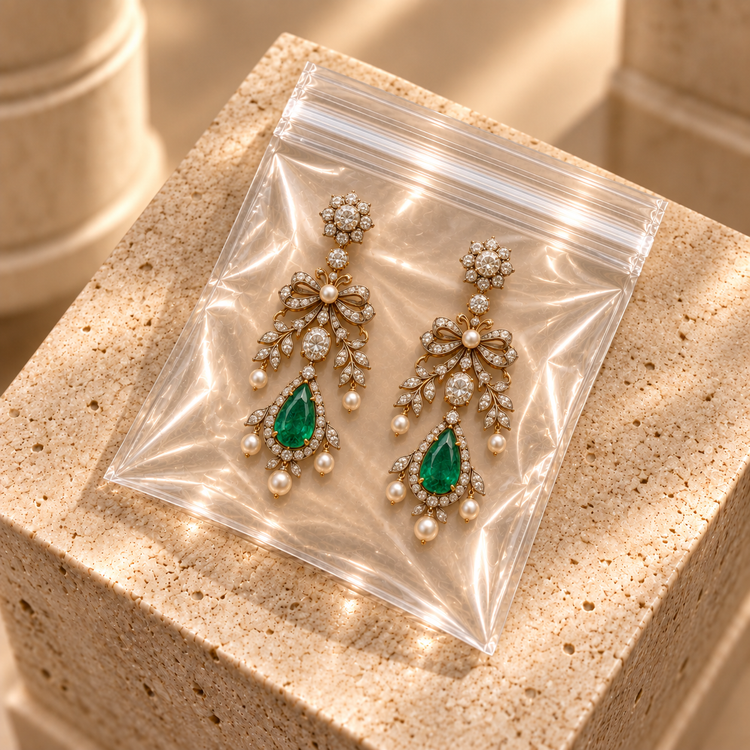
Best Small Resealable Bags for Earrings
Posted by AppleZipBags Team on Sep 8th 2026
The best small resealable bags for earrings depend on something many sellers overlook:
the type of earring being packaged.
Stud earrings, hoops and long drop earrings have completely different packaging dimensions.
A tiny pair of studs may need very little space, while large hoops require significantly more width and dangle earrings need additional length.
The best packaging therefore combines:
correct size + suitable thickness + product visibility + closure clearance + appropriate quantity.
For many everyday earring applications, small clear resealable bags around 2–2.5 mil provide a practical starting point.
Apple Zip Bags offers a dedicated selection of small resealable jewelry bags in 2.5 mil material, including clear and colored options that can be used for earrings and other small jewelry products.
The key is choosing the bag according to the finished earring package, not simply buying the smallest jewelry bag available.
Quick Answer: What Are the Best Small Bags for Earrings?
For many jewelry businesses, a practical starting point is:
clear 2.5 mil resealable bags sized to the complete pair of earrings or earring card.
Use this general framework:
| Earring Type | Bag Approach | Main Sizing Concern |
|---|---|---|
| Tiny studs | Extra-small | Card dimensions |
| Standard studs | Extra-small–small | Posts and backing |
| Cluster earrings | Small | Width and thickness |
| Small hoops | Small | Outside diameter |
| Large hoops | Small–medium | Width |
| Huggies | Extra-small–small | Thickness |
| Drop earrings | Small–medium | Length |
| Dangle earrings | Small–medium | Full hanging length |
| Statement earrings | Medium | Width + length |
| Earrings on cards | Size to card | Complete assembly |
For general inventory and fulfillment:
clear is usually the best color choice.
For quantity:
start with 100 when testing a new size and move toward 1,000 when the size becomes a proven everyday packaging SKU.
Why Resealable Bags Work Well for Earrings
Earrings are particularly well suited to individual packaging because they are:
-
Small
-
Easy to misplace
-
Often sold in pairs
-
Frequently attached to cards
-
Available in many similar variations
-
Difficult to identify from labels alone
Individual resealable packaging helps keep:
the pair + backs + card + SKU
together.
That can simplify the entire workflow from receiving inventory to fulfilling the customer order.
The Best Earring Bag Depends on the Earring Style
There is no universal earring bag size.
Consider the difference between:
¼-inch stud earrings
and:
3-inch statement earrings.
Both are earrings, but their packaging requirements are completely different.
Before choosing a bag, identify whether you are packaging:
-
Studs
-
Huggies
-
Hoops
-
Drops
-
Dangles
-
Chandeliers
-
Statement earrings
-
Clip-ons
-
Earrings mounted on cards
Then measure the finished configuration.
Best Small Bags for Stud Earrings
Stud earrings are usually the easiest category to package.
They require little surface area but can create one specific challenge:
the posts project backward.
A bag that looks large enough from the front may become tight once you account for:
-
Earring posts
-
Backs
-
Card thickness
Packaging Loose Stud Earrings
If studs are packaged without a display card, consider keeping:
-
Both earrings
-
Both backs
together in one small bag.
The bag should be large enough to open and close easily without allowing tiny components to interfere with the zipper.
Packaging Studs on Earring Cards
If studs are mounted on a card:
measure the card—not the earrings.
For example, if the studs are only half an inch wide but the display card measures:
2 × 2.5 inches,
the card becomes the primary sizing factor.
Protect Earring Posts
Earring posts can concentrate pressure against flexible packaging.
This is especially important when:
-
Posts are long
-
Posts are sharp
-
Bags are tightly packed in storage
-
Multiple packages are stacked together
Consider using:
-
Earring backs
-
Display cards
-
Protective post covers
-
Additional inserts
where appropriate.
Do not simply force protruding posts into an undersized bag.
Best Bags for Huggie Earrings
Huggies are compact but thicker than many studs.
Measure:
-
Width
-
Height
-
Depth
when closed.
A compact resealable bag can work well, but do not ignore the three-dimensional profile of the earrings.
Best Bags for Small Hoop Earrings
Hoops require more width than studs.
Measure:
the complete outside diameter of the hoop.
Do not measure only:
-
Wire thickness
-
Inner diameter
because the entire earring must fit through the opening and rest comfortably inside the bag.
Best Bags for Large Hoop Earrings
Large hoops often require moving up from an extra-small bag to a:
small or medium bag.
Avoid squeezing the hoops together simply to make them fit.
This can create:
-
Poor presentation
-
Unnecessary pressure
-
More difficult packing
If hoops are mounted on a card, measure the entire:
card + hoops
configuration.
Best Bags for Drop Earrings
Drop earrings require additional vertical space.
Measure from:
the highest point to the lowest point of the complete earring.
If the earrings are mounted on a card, include:
-
Card height
-
Portion extending below the card
in the measurement.
Best Bags for Dangle Earrings
Dangle earrings may move more freely than simple drops.
The packaging should allow them to rest naturally without excessive compression.
A bag that is too large can allow unnecessary movement.
A bag that is too short can force the earrings into an awkward position.
Choose:
the smallest comfortable size that accommodates their natural packaged arrangement.
Best Bags for Statement Earrings
Statement earrings may combine:
-
Significant width
-
Significant length
-
Multiple components
-
Stones
-
Beads
-
Decorative elements
For these products, do not automatically choose a "small jewelry bag" simply because the item is technically an earring.
Measure the actual product.
If a larger format is necessary, consider Apple Zip Bags' larger resealable bag options rather than forcing the product into an undersized package.
How to Measure Earrings for a Resealable Bag
Measure the complete package in three dimensions:
width + length + thickness.
Step 1: Arrange the Earrings
Place the earrings exactly as they will be packaged.
That may mean:
-
Loose pair
-
Attached to card
-
Attached to insert
Step 2: Measure Width
Measure the widest point.
For hoops, this is often the outside diameter.
For statement earrings, measure the complete decorative width.
Step 3: Measure Length
Measure from the highest to lowest point.
This matters especially for:
-
Drops
-
Dangles
-
Chandeliers
Step 4: Account for Thickness
Do not forget:
-
Posts
-
Backs
-
Beads
-
Stones
-
Raised settings
-
Thick cards
Step 5: Leave Closure Clearance
The earrings should sit below the resealable track.
Do not allow:
-
Posts
-
Backs
-
Cards
to interfere with the closure.
For a broader sizing methodology, Apple Zip Bags' packaging bag size guide explains how product width, length, depth and final packaged configuration affect bag selection.
Do Not Choose a Bag the Exact Size of the Earring Card
Suppose your earring card measures:
2 × 3 inches.
Choosing a bag with exactly the same usable dimensions may create a tight fit because the package also has:
-
Card thickness
-
Earrings protruding from the card
-
Earring backs
-
Closure requirements
Allow reasonable working clearance.
The correct goal is:
compact but comfortable.
Why Oversized Earring Bags Are Not Ideal
Going too large creates another problem.
An oversized bag can result in:
-
Excessive movement
-
More storage space
-
Less polished presentation
-
Wasted packaging material
For a jewelry business storing thousands of products, oversized packaging also increases the physical footprint of inventory.
What Thickness Is Best for Earring Bags?
For many everyday earring applications:
2–2.5 mil
is a practical general range.
Thickness should reflect:
-
Earring weight
-
Sharpness
-
Handling frequency
-
Packaging configuration
2 Mil Bags for Earrings
2 mil may be sufficient for:
-
Lightweight studs
-
Small flat earrings
-
Lightweight cards
-
Limited handling
2.5 Mil Bags for Earrings
For general-purpose earring inventory, 2.5 mil provides a useful middle ground.
Apple Zip Bags' 1,000-pack small jewelry bags currently use 2.5 mil material with a resealable closure and clear/color options.
This type of bag can be practical for many:
-
Studs
-
Huggies
-
Small hoops
-
Drops
-
Earring cards
when the correct dimensions are selected.
When Heavier Film May Be Useful
Consider a more substantial packaging solution when earrings are:
-
Heavy
-
Sharp
-
Large
-
Frequently handled
or contain components that place concentrated pressure against the bag.
Do not select thickness solely because "thicker sounds better."
Earring Posts Matter More Than Many Sellers Expect
A lightweight earring can still create a packaging challenge because of:
a sharp post.
This is different from packaging a smooth charm or flat pendant.
If the post presses directly against the film, consider using:
-
Earring back
-
Card
-
Protective insert
to distribute or cover that point.
Bag thickness alone should not be expected to solve every puncture concern.
Clear vs. Colored Bags for Earrings
For most earring businesses:
clear bags are the best default.
Why?
Because earrings are highly visual.
Employees can quickly identify:
-
Stud vs. hoop
-
Stone color
-
Metal finish
-
Shape
-
Design
without opening the package.
Clear Bags Improve Order Verification
Suppose your store carries the same earring design in:
-
Gold
-
Silver
-
Rose gold
-
Black
A clear bag lets the picker verify:
SKU + actual finish
before packing the order.
That provides an additional quality-control step.
When Colored Earring Bags Make Sense
Colored bags can support:
-
Collections
-
Categories
-
Departments
-
Branding
For example:
Pink = Studs
Blue = Hoops
Purple = Drops
But do not allow color to replace the SKU.
A blue bag might tell an employee:
"hoop earrings."
It does not identify the exact hoop style, finish or size.
Clear Bags With Colored Labels
For many jewelry businesses, an even simpler approach is:
clear bags + colored labels.
For example:
Clear bag + pink label = studs
Clear bag + blue label = hoops
Clear bag + purple label = drops
This provides:
-
Product visibility
-
Category coding
-
SKU identification
while reducing the number of bag colors that must be stocked.
Make Room for the Earring SKU Label
A useful earring inventory label might include:
SKU: ER-GD-102
Style: Hoop
Finish: Gold Tone
Size: 25mm
Qty: 1 Pair
The bag should be large enough for the label without completely covering the earrings.
For clear packaging, staff should ideally be able to see:
the label and earrings simultaneously.
Accurate Earring Labels Matter
If your label or product description identifies earrings by:
-
Gold content
-
Silver content
-
Platinum content
-
Gemstone
-
Pearl
-
Treatment
-
Weight
the description should accurately reflect the merchandise.
The FTC's Jewelry Guides address truthful representations of characteristics such as metallic content, size, weight, gemstones and treatments.
Packaging labels should therefore remain consistent with the product information customers receive.
Packaging Pearl Earrings
Pearls require additional care because their surfaces can be delicate.
GIA's jewelry care guidance notes that pearls can scratch and recommends appropriate separate jewelry storage.
For pearl earrings, consider whether the resealable bag should be combined with:
-
Soft card
-
Pouch
-
Protective insert
-
Jewelry box
depending on the value and intended storage period.
Do Resealable Bags Prevent Earring Scratches?
Individual packaging can help reduce direct contact between separate jewelry pieces.
That is useful because earrings stored loose with other jewelry can:
-
Rub
-
Catch
-
Scratch
-
Tangle
However, a standard plastic bag should not automatically be described as specialized:
-
Scratch-proof
-
Archival
-
Anti-tarnish
storage.
Delicate earrings may require additional protection.
Are Standard Earring Bags Anti-Tarnish?
Not automatically.
A standard resealable bag and a specialized anti-tarnish storage product are not the same thing.
If sterling silver or another material requires specific tarnish-control storage, choose a product specifically intended for that purpose.
Are Earring Bags Waterproof?
Do not assume that a resealable closure makes a bag waterproof.
Unless the product specification specifically supports waterproof performance, use the bag primarily for:
-
Organization
-
Containment
-
Visibility
-
Inventory handling
rather than making unsupported protective claims.
Earring Cards vs. Loose Earring Packaging
Both approaches can work.
Loose Earrings
Loose packaging may be useful for:
-
Low-cost studs
-
Findings
-
Wholesale components
-
Internal inventory
Earring Cards
Cards can improve:
-
Presentation
-
Organization
-
Pair retention
-
Label placement
They can also reduce movement within the bag.
The tradeoff is that the card usually requires a larger bag.
Should Each Pair of Earrings Have Its Own Bag?
For individually inventoried retail products:
usually yes.
One pair per labeled bag makes it easier to:
-
Count inventory
-
Pick orders
-
Verify SKUs
-
Keep pairs together
Wholesale earrings may be packaged differently when multiple identical pairs are sold as one unit.
Best Earring Bags for Ecommerce Sellers
For ecommerce, a strong internal packaging system is:
earrings → card or insert → clear resealable bag → SKU/barcode label.
Then the product can move through:
-
Inventory
-
Picking
-
Quality control
-
Fulfillment
without repeatedly being repackaged.
Best Earring Bags for Etsy Sellers
Small jewelry businesses may initially have:
-
Low volume
-
Changing designs
-
Different card sizes
That makes smaller bag quantities useful during the testing phase.
Once card dimensions and product categories become standardized, bulk purchasing becomes more practical.
Best Earring Bags for Wholesale Sellers
Wholesale sellers can consume packaging quickly.
Suppose one wholesale order contains:
-
25 pairs of studs
-
20 pairs of hoops
-
15 pairs of drops
If each pair receives an individual bag, that single order requires:
60 bags.
A seller processing multiple wholesale orders can move through 1,000 bags quickly.
100-Pack vs. 1,000-Pack Earring Bags
The correct quantity depends on:
certainty + usage.
Choose 100 Bags When
Use smaller quantities when:
-
Testing a new earring card
-
Testing bag dimensions
-
Launching a collection
-
Trying a new color
-
Monthly sales are low
Apple Zip Bags offers 100-pack small 2.5 mil jewelry bags that can be useful during this testing stage.
Choose 1,000 Bags When
Move toward larger quantities when:
-
Card dimensions are standardized
-
Bag size is proven
-
Multiple earring SKUs use the same bag
-
Monthly consumption is predictable
A simple rule is:
test with 100; standardize with 1,000.
Calculate Monthly Earring Bag Usage
Use:
pairs packaged per month × bags per pair = monthly bag usage
Example:
400 pairs monthly
× 1 bag each
=
400 bags per month
A 100-pack lasts approximately:
one week.
A 1,000-pack lasts approximately:
2.5 months.
For a stable packaging size, the larger quantity becomes much more practical.
Standardize Earring Card Sizes
One of the easiest ways to simplify earring packaging is to standardize:
the cards.
Instead of using:
-
1.5 × 2-inch cards
-
1.75 × 2.25-inch cards
-
2 × 2.5-inch cards
-
2.25 × 3-inch cards
for nearly identical products, consider whether fewer standardized card formats can work.
Fewer card dimensions can mean:
fewer bag dimensions.
Create Earring Packaging Categories
A practical system might include:
Extra Small
For:
-
Tiny studs
-
Huggies
-
Small components
Small
For:
-
Standard studs
-
Small hoops
-
Short drops
Medium
For:
-
Large hoops
-
Dangles
-
Statement earrings
This can cover much of an earring catalog without requiring a unique bag for every design.
Create Packaging SKUs
Assign internal packaging codes.
For example:
EAR-BAG-XS
Extra-small earring bag
EAR-BAG-S
Small earring bag
EAR-BAG-M
Medium earring bag
Then assign each product to the correct packaging SKU.
This makes packing easier for employees.
Example: Packaging Stud Earrings
Suppose the earrings are:
-
Small studs
-
Attached to a 2-inch card
-
Lightweight
-
Sold individually by pair
A practical solution may be:
small clear 2.5 mil resealable bag sized slightly larger than the finished card.
The clear material lets staff verify:
-
Stone
-
Finish
-
Design
without opening the package.
Example: Packaging Hoop Earrings
Suppose the hoops measure:
2 inches across.
Do not select the bag based on wire thickness.
Measure:
the complete outside diameter
and allow working clearance.
If the hoops are attached to a wider card, size to the card instead.
Example: Packaging Long Drop Earrings
Suppose a card is:
2.5 inches high
and the earrings extend:
1 inch below the card.
The complete package now requires more than:
3.5 inches of usable vertical room
plus appropriate closure clearance.
This is why measuring only the card can produce the wrong bag.
Example: Packaging Statement Earrings
Suppose a pair measures:
3 inches wide × 4 inches long.
A tiny jewelry bag is no longer appropriate.
Move to a larger size that lets the earrings rest comfortably rather than folding or compressing decorative components.
Small Earring Bags Are Usually Inner Packaging
For shipped orders, the resealable bag is typically one packaging layer.
It is useful for:
-
Keeping the pair together
-
Holding the card
-
Carrying the SKU
-
Organizing fulfillment
It should not automatically be treated as complete shipping protection.
FedEx's jewelry shipping guidance recommends cushioning jewelry, using suitable inner protection, and placing it within sturdy outer packaging.
Depending on the earrings, the full shipping system may include:
earrings → card → resealable bag → pouch or inner box → cushioning → outer shipping package.
High-Value Earrings Need More Than a Small Bag
For:
-
Diamond earrings
-
Fine gemstone earrings
-
High-value gold jewelry
-
Luxury designer earrings
a flexible bag may be useful for inventory organization, but structural protection becomes more important during shipping.
Use appropriate:
-
Pouch
-
Inner box
-
Cushioning
-
Secure outer package
based on value and fragility.
Common Earring Packaging Mistakes
Using One Bag Size for Every Earring
Studs and statement earrings need different packaging.
Measuring Only the Earring
Include cards, backs and inserts.
Ignoring Earring Posts
Posts can create concentrated pressure against the bag.
Choosing an Exact Fit
Leave working and closure clearance.
Using Bags Far Too Large
Avoid unnecessary movement and wasted space.
Ignoring Hoop Diameter
Measure the complete outside width.
Ignoring Drop Length
Measure the entire hanging length.
Covering the Earrings With the Label
Preserve visual identification.
Using Color Instead of a SKU
Color should support identification, not replace it.
Assuming 2.5 Mil Means Anti-Tarnish
Thickness and tarnish protection are different characteristics.
Assuming Resealable Means Waterproof
Do not make unsupported claims.
Buying 1,000 Before Testing the Card
Test the complete package first.
Treating the Bag as Complete Shipping Protection
Use appropriate outer packaging.
Earring Bag Buying Checklist
Before ordering bags for earrings, ask:
-
Am I packaging studs, hoops, drops or statement earrings?
-
Are the earrings loose or on cards?
-
What is the card width?
-
What is the total package length?
-
How thick is the finished package?
-
Do posts project backward?
-
Are protective backs installed?
-
Are there sharp components?
-
Does the package enter the bag easily?
-
Is there room for the zipper?
-
Is the bag unnecessarily large?
-
Is 2 mil sufficient?
-
Would 2.5 mil be more practical?
-
Does the item need additional puncture protection?
-
Do I want clear visibility?
-
Would color coding help?
-
Would colored labels be simpler?
-
Does the SKU label fit?
-
Can employees still see the earrings?
-
Is the bag used for inventory?
-
Is it customer-facing?
-
Does the product need a pouch?
-
Does it need a box?
-
Have I tested the actual earrings?
-
Have I tested the earring card?
-
Should I start with 100 bags?
-
Is the size proven enough for 1,000?
-
Can several earring styles share one bag size?
-
Can I standardize my card dimensions?
-
Does the final shipping package provide enough protection?
Frequently Asked Questions
What are the best small resealable bags for earrings?
For many everyday earring applications, a clear 2–2.5 mil resealable bag sized to the complete earrings or earring card is a practical starting point.
What size bag should I use for stud earrings?
Measure the complete:
studs + backs + card
configuration.
If the earrings are mounted on a card, size the bag primarily around the card and total package thickness.
What size bag should I use for hoop earrings?
Measure the complete outside diameter of the hoops.
If they are mounted on a card, measure the complete card-and-earring assembly.
What size bag should I use for drop earrings?
Measure from the highest to lowest point of the finished package and leave room for the resealable closure.
Are 2.5 mil bags good for earrings?
For many everyday earring applications, 2.5 mil provides a useful balance of flexibility and physical durability.
Are clear bags best for earrings?
Clear bags are generally an excellent default for inventory because employees can visually verify:
-
Style
-
Stone
-
Finish
-
Color
without opening the package.
Can I use colored bags for earrings?
Yes.
Colored bags can support:
-
Categories
-
Collections
-
Branding
but should not replace SKU labels.
Should earrings be stored separately?
Separating pairs can improve organization and reduce direct contact with other jewelry. Delicate earrings may require additional protective storage.
Are plastic earring bags anti-tarnish?
Not automatically.
Use specialized anti-tarnish materials when that property is required.
Will resealable bags protect earring posts?
They provide containment, but sharp or projecting posts may need:
-
Backs
-
Cards
-
Protective covers
-
Additional inserts
Should earrings be placed on cards before bagging?
Cards can improve:
-
Presentation
-
Pair organization
-
Labeling
-
Handling
but they are not required for every application.
Should I buy 100 or 1,000 earring bags?
Choose:
100 when testing a size or card.
Choose:
1,000 once the packaging is standardized and regularly used.
How many earring bag sizes should I stock?
Many sellers can cover much of their catalog with approximately:
2–3 core earring bag sizes
if their earring cards are standardized.
Can I ship earrings in only a resealable bag?
For most ecommerce shipments, the bag should be treated as inner packaging. Add appropriate structural protection and cushioning based on the earrings' value and fragility.
Final Verdict: Best Small Resealable Bags for Earrings
The best small resealable bags for earrings are not determined by one universal dimension.
Start with:
the earring style.
For studs:
focus on the:
card + posts + backs.
For hoops:
focus on:
outside diameter.
For drop and dangle earrings:
focus on:
complete vertical length.
For statement earrings:
evaluate:
width + length + thickness.
Then choose the smallest bag that provides comfortable:
-
Insertion
-
Product positioning
-
Label space
-
Closure clearance
For many everyday earring applications:
2–2.5 mil
is a practical range, with 2.5 mil offering a versatile general-purpose option.
For inventory:
clear bags are usually the strongest default
because they allow employees to verify the actual:
-
Design
-
Stone
-
Metal finish
-
Style
without opening every package.
For quantity:
start with 100 when the size is unproven.
Once your:
-
Earring cards
-
Bag dimensions
-
Labels
-
Packing process
are standardized:
move toward 1,000 for frequently used sizes.
And remember that the resealable bag is primarily an organizational and product-level packaging layer.
Delicate, sharp or valuable earrings may still require:
-
Protective backs
-
Cards
-
Inserts
-
Pouches
-
Boxes
-
Cushioning
-
Suitable outer shipping packaging
The most effective earring packaging system is ultimately:
measure → protect the posts → test the fit → standardize the card → standardize the bag → buy proven sizes in volume.