
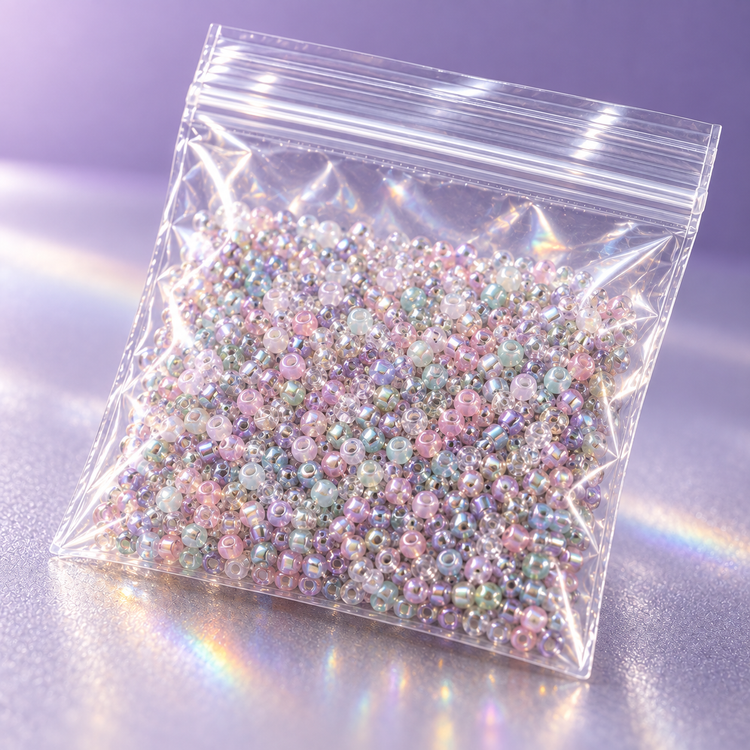
Beads Packaging Guide: Size, Thickness & Quantity
Posted by AppleZipBags Team on Sep 14th 2026
Bead packaging looks simple until you try to use the same bag for:
-
Tiny seed beads
-
Large gemstone beads
-
Full strands
-
Crystal beads
-
Metal spacer beads
-
Mixed bead kits
The right package depends mainly on three variables:
size, thickness and quantity.
Size determines whether the beads fit comfortably.
Film thickness affects handling and durability.
Quantity determines whether it makes more sense to test with a smaller pack or move into bulk packaging.
Apple Zip Bags offers jewelry bags for beads, jewelry components and other small items, with its standard jewelry bags currently listed at:
2.5 mil thickness.
For most bead sellers, the strongest packaging process is:
identify bead type → determine package quantity → measure actual product volume → leave closure space → select suitable thickness → test the bag → standardize successful sizes → buy in bulk once usage is predictable.
Quick Bead Packaging Guide
| Bead Type | Main Size Concern | Thickness Consideration | Quantity Strategy |
|---|---|---|---|
| Seed beads | Compact but high count | Standard flexible bag | Small test, then bulk |
| Gemstone beads | Diameter and depth | Consider weight | Test actual quantity |
| Glass beads | Size and fragility | Additional shipping protection may help | Standardize proven size |
| Crystal beads | Visibility and shape | Avoid overfilling | Buy bulk when recurring |
| Acrylic beads | High volume, low weight | Standard flexible bag | Choose by volume |
| Wooden beads | Bulky but lightweight | Standard flexible bag | Larger dimensions may be needed |
| Metal beads | Compact but heavy | Avoid overloading | Lower fill volume may work better |
| Bead strands | Width and height | Bag must fit entire strand | Test before bulk |
| Mixed kits | Multiple components | Separate inner bags may help | Forecast by kit volume |
Why Bead Bag Size Matters Most
A bag can technically hold the beads and still be a poor fit.
If it is too small:
-
Beads crowd the closure
-
Filling takes longer
-
The bag bulges
-
Heavy beads put more pressure on seams
-
Resealing becomes difficult
If it is too large:
-
Small beads shift excessively
-
Packaging uses more storage space
-
Product presentation looks less organized
The ideal bag provides:
comfortable product space plus room near the zipper.
Apple Zip Bags' bag size guide emphasizes choosing packaging around the actual item rather than relying on exact dimensions alone.
Choose Bag Size by Volume, Not Just Count
This is one of the most important bead-packaging rules.
Consider:
100 seed beads
versus:
100 12 mm gemstone beads.
The count is identical.
The physical volume is completely different.
Therefore:
bead count alone cannot determine bag size.
Weight Alone Does Not Determine Size Either
Acrylic beads may be:
large but lightweight.
Metal beads may be:
small but heavy.
The bag must accommodate:
physical volume first, then weight and handling needs.
Size Considerations for Seed Beads
Seed beads are compact.
A small bag can hold a surprisingly large quantity.
The primary sizing considerations are:
-
Quantity
-
Label space
-
Ease of pouring
-
Space below the zipper
Fire Mountain Gems provides a useful seed bead sizing reference showing how different seed bead sizes compare.
Do Not Fill Seed Bead Bags to the Top
Tiny beads near the zipper can interfere with closure.
Leave a clear area above the product.
That makes it easier to:
-
Seal
-
Open
-
Pour
-
Reseal
the package.
Size Considerations for Gemstone Beads
Gemstone beads may come in:
-
4 mm
-
6 mm
-
8 mm
-
10 mm
-
12 mm
-
Larger decorative sizes
As diameter increases:
bag volume requirements increase quickly.
A package of:
25 4 mm beads
and a package of:
25 12 mm beads
will require very different amounts of space.
Bead Shape Changes Capacity
Round beads pack differently from:
-
Chips
-
Nuggets
-
Cubes
-
Tubes
-
Drops
-
Stars
-
Flowers
Irregular shapes tend to create more unused space between pieces.
That may require a larger bag.
Size Considerations for Glass Beads
Glass beads can range from:
tiny seed-sized pieces
to:
large decorative beads.
For larger glass products:
consider both:
-
Volume
-
Fragility
The bag organizes the beads, but additional shipping protection may still be required.
Size Considerations for Crystal Beads
Crystal beads are often distinguished by:
-
Color
-
Finish
-
Transparency
-
Faceting
Clear packaging works particularly well because those characteristics remain visible.
Size Considerations for Acrylic Beads
Acrylic beads demonstrate why:
weight is not the same as volume.
A package may be very light but still occupy a large amount of space.
Choose based on:
-
Diameter
-
Shape
-
Quantity
rather than weight alone.
Size Considerations for Wooden Beads
Wooden beads may also require relatively large bags despite low weight.
Large:
-
Round beads
-
Geometric beads
-
Macramé beads
can fill packaging quickly.
Size Considerations for Metal Beads
Metal beads may be dense.
Avoid overloading one small bag simply because all the beads physically fit.
A lower fill quantity may be easier to:
-
Handle
-
Store
-
Ship
Size Considerations for Full Bead Strands
Strands require a completely different sizing method.
Do not calculate the bag as though the beads were loose.
Instead:
place the strand in the intended packaged position.
Then measure its:
-
Width
-
Height
-
Depth
Loose Beads vs. Stranded Beads
| Format | Main Sizing Priority |
|---|---|
| Loose seed beads | Volume and zipper space |
| Loose gemstone beads | Volume and weight |
| Short strand | Width and height |
| Full strand | Full packaged footprint |
| Mixed bead kit | Individual component volume |
What Does 2.5 Mil Mean?
Apple Zip Bags currently lists its jewelry bags at:
2.5 mil.
One mil equals:
0.001 inch.
Therefore:
2.5 mil = 0.0025 inch.
This number describes:
film thickness.
It does not mean:
-
2.5 inches
-
Bag capacity
-
Bag dimensions
Is 2.5 Mil Good for Bead Packaging?
For many everyday bead and jewelry-making applications:
2.5 mil can provide a useful balance between:
-
Flexibility
-
Visibility
-
Compact storage
-
Repeated handling
The ideal bag still depends on:
-
Bead weight
-
Sharpness
-
Package quantity
-
Handling frequency
2 Mil vs. 2.5 Mil vs. 4 Mil for Beads
| Film Thickness | General Character | Bead Application |
|---|---|---|
| 2 mil | Lightweight | Light organization |
| 2.5 mil | Flexible and substantial | Strong everyday choice |
| 4 mil | Heavier material | More demanding handling |
More thickness is not automatically better.
Choose according to the actual application.
When Heavier Film May Help
A heavier package may be worth considering when contents are:
-
Heavy
-
Frequently handled
-
Irregularly shaped
-
Abrasive
But thickness does not solve every problem.
Sharp components may still need:
-
Backing
-
Card
-
Additional inner protection
Watch for Sharp Beads and Findings
Some bead products may contain:
-
Pointed glass pieces
-
Wire
-
Pins
-
Metal findings
-
Sharp decorative edges
These can create concentrated pressure against the bag.
Use additional protection when needed.
Thickness Does Not Equal Archival Performance
A thicker standard plastic bag should not automatically be described as:
-
Archival
-
Museum-grade
-
Anti-tarnish
unless it is specifically designed and documented for those properties.
Clear vs. Colored Bead Bags
For most bead businesses:
clear bags are the stronger default.
They make it easier to identify:
-
Color
-
Size
-
Shape
-
Finish
without opening the package.
When Clear Bags Work Best
Clear packaging is especially useful for:
-
Seed beads
-
Gemstone beads
-
Crystal beads
-
Glass beads
-
Bead mixes
because visual identification matters.
When Colored Bags Work Best
Colored bags may help with:
-
Category coding
-
Collection separation
-
Internal organization
Example:
Clear = beads
Blue = findings
Pink = charms
Green = repair parts
Keep the system simple.
Label Space Matters
The bag should provide enough area for:
-
SKU
-
Bead type
-
Size
-
Quantity
-
Material
-
Hole size
without covering the product unnecessarily.
One SKU Per Bag
For most inventory systems:
one SKU per bag is the cleanest method.
This makes it easier to:
-
Count
-
Pick
-
Reorder
-
Verify
Shopify's guide to SKUs explains how structured product identifiers support organized inventory.
Example Bead Label
A label could read:
RQ-RND-8MM
Rose Quartz
8 mm Round
25 Pieces
This gives both:
visual confirmation + inventory identification.
How Many Bead Bags Should You Buy?
Once size and thickness are established:
choose quantity.
The most common decision is:
100 vs. 1,000 bags.
The best quantity depends on:
-
Whether the size is proven
-
Monthly package volume
-
Number of bead SKUs
-
Storage capacity
-
Wholesale demand
-
Seasonal demand
When to Buy 100 Bead Bags
Choose a smaller pack when:
-
Testing a new size
-
Launching a bead line
-
Comparing clear and colored bags
-
Testing label fit
-
Packaging small quantities
Apple Zip Bags' 100-pack small jewelry bags can be useful for validating packaging before committing to bulk.
When to Buy 1,000 Bead Bags
Move into larger quantities when:
-
The size is proven
-
Several bead SKUs use it
-
Monthly usage is stable
-
Reordering small packs becomes frequent
Apple Zip Bags' 1,000-pack small jewelry bags can be more practical for established packaging workflows.
100 vs. 1,000 Bead Bags
| Situation | Better Starting Point |
|---|---|
| Testing a new size | 100 |
| New bead line | 100 |
| Low monthly volume | 100 |
| Testing labels | 100 |
| Proven size | 1,000 |
| Many SKUs use same bag | 1,000 |
| Wholesale operation | 1,000 |
| Frequent reordering | 1,000 |
The safest sequence is:
test → validate → standardize → bulk buy.
Calculate Monthly Bead Bag Usage
Do not calculate demand only from customer orders.
One customer order may contain:
8 bead SKUs.
That may require:
8 separate bags.
A better formula is:
monthly orders × average individually packaged SKUs per order.
Example
Monthly orders:
120
Average packaged bead SKUs per order:
5
120 × 5 =
600 bags per month.
That is the figure to use for packaging planning.
Add Component and Sample Bags
You may also use bags for:
-
Samples
-
Spare beads
-
Clasps
-
Findings
-
Repair pieces
Include them in demand forecasts.
Calculate Annual Usage
If monthly usage is:
600 bags,
annual demand is:
600 × 12 =
7,200 bags.
At that volume:
bulk purchasing can make much more sense than buying repeated 100-packs.
Include Safety Stock
Packaging is operational inventory.
Do not plan to use the final bag before placing the next order.
Shopify's guide to safety stock and reorder points explains how buffer stock can help businesses absorb demand fluctuations and replenishment delays.
Example Safety Stock Calculation
Expected monthly use:
800 bags
20% buffer:
160 bags
Target availability:
960 bags.
In this example:
a 1,000-pack closely matches one month plus a buffer.
Calculate a Reorder Point
Use:
average daily usage × supplier lead time + safety stock.
Example:
Average daily usage:
30 bags
Lead time:
7 days
Safety stock:
150 bags
30 × 7 = 210
210 + 150 =
360 bags
Reorder when stock approaches:
360 bags.
Why Bead Businesses Need More Bags Than They Expect
Bead businesses often underestimate usage because:
one sale may contain many separately packaged products.
For example:
Order 1:
6 bead SKUs
Order 2:
10 bead SKUs
Order 3:
4 bead SKUs
Only:
3 customer orders
but:
20 bags used.
Standardize Core Bead Bag Sizes
Instead of carrying many nearly identical sizes:
standardize a smaller number of proven formats.
For example:
Extra small = seed beads
Small = standard loose beads
Medium = large gemstone beads
Large = strands or larger quantities
Why Standardization Helps
It reduces:
-
Purchasing complexity
-
Storage clutter
-
Packing mistakes
-
Training time
It also makes large-quantity purchases easier to justify.
Do Not Force Every Bead Into One Size
Standardization has limits.
A tiny bag suitable for:
seed beads
may not work for:
12 mm gemstone beads.
Likewise:
a full strand should not be forced into packaging intended for loose beads.
Calculate Cost Per Bag
Use:
pack price ÷ quantity = cost per bag.
Example:
100 bags for $8:
$8 ÷ 100 =
$0.08 per bag.
1,000 bags for $10:
$10 ÷ 1,000 =
$0.01 per bag.
Use current pricing before making purchasing decisions because prices may change.
Unit Cost Is Not the Only Consideration
A low per-bag cost does not help if:
-
The size is wrong
-
The beads do not fit
-
The bag is difficult to fill
-
Labels do not fit
-
Too much inventory sits unused
The correct order is:
fit first → workflow second → quantity third → unit cost fourth.
Calculate Packaging Cost Per Bead Product
Packaging may include:
-
Bag
-
Label
-
Insert
-
Outer mailer
-
Shipping box
Example:
Bag = $0.02
Label = $0.03
Insert = $0.05
Inner packaging total:
$0.10 per unit.
This helps with:
-
Pricing
-
Margin analysis
-
Wholesale quotes
Bead Packaging for Wholesale Sellers
Wholesale bead orders can use packaging quickly.
Example:
A buyer orders:
25 different bead SKUs
with:
5 packages of each.
That equals:
125 individual bags.
Wholesale sellers should keep more packaging buffer.
Bead Packaging for Etsy Sellers
An Etsy seller with:
40 orders per month
and:
3 bead SKUs per average order
uses approximately:
120 bags per month.
A 100-pack would not quite cover one month.
Bead Packaging for Growing Online Stores
Suppose you process:
150 orders per month
with:
6 individually packaged bead SKUs per order.
150 × 6 =
900 bags per month.
At that volume:
a 1,000-pack is much more practical.
Bead Packaging for Craft Shows
Craft shows may require bags for:
-
Retail display stock
-
Back stock
-
Customer purchases
Add event demand to normal monthly usage.
Bead Packaging for Subscription Kits
One kit may contain several individually bagged components.
Example:
Bag 1 = seed beads
Bag 2 = charms
Bag 3 = clasps
Bag 4 = cord
One kit may therefore consume:
four small bags.
Factor this into purchasing volume.
Plain vs. Branded Bead Bags
Plain bags are often useful for bead sellers because they can work across:
many different SKUs.
Branding can then be added through:
-
Labels
-
Stickers
-
Inserts
Apple Zip Bags' guide to custom-printed vs. plain jewelry bags discusses the tradeoffs between customization, budget and flexibility.
Plain Bags Reduce Obsolescence Risk
If:
-
Branding changes
-
Product lines change
-
A collection ends
plain bags can still be reused across other products.
That can make larger bulk orders less risky.
Bead Bags as Inner Packaging
Small resealable bags are usually best treated as:
inner packaging and organization.
They can then go into:
-
Mailers
-
Boxes
-
Kits
-
Larger bags
depending on the shipment.
Shipping Fragile Beads
Glass, crystal and some gemstone beads may require extra protection.
UPS provides general packaging guidance for selecting suitable internal protection and outer packaging.
Consider:
-
Cushioning
-
Separation
-
Small boxes
-
Padded mailers
when appropriate.
Do Not Assume a Resealable Bag Is Waterproof
A standard closure should not automatically be described as:
-
Waterproof
-
Hermetically sealed
-
Leakproof
unless specifically documented.
Do Not Assume Standard Bead Bags Are Archival
Likewise:
do not automatically describe normal jewelry bags as:
-
Archival
-
Museum-grade
-
Anti-tarnish
without product-specific support.
Common Bead Packaging Mistakes
Choosing Bags by Count Alone
Volume varies dramatically by bead size.
Choosing Bags by Weight Alone
Lightweight beads can still be bulky.
Ignoring Bead Shape
Irregular pieces need more space.
Filling the Bag to the Zipper
Leave working room.
Treating Loose and Stranded Beads the Same
They require different dimensions.
Ignoring Heavy Metal Beads
Avoid overloading small packages.
Ignoring Sharp Components
Use extra protection when appropriate.
Choosing Opaque Packaging for Large Inventories
Clear packaging makes visual identification easier.
Forgetting Labels
Similar products can be difficult to distinguish.
Using Too Many Bag Sizes
Standardize where practical.
Buying 1,000 Before Testing
Validate the size first.
Calculating Usage by Orders Instead of Packaged SKUs
One order may use many bags.
Forgetting Safety Stock
Packaging shortages interrupt fulfillment.
Treating Small Bags as Complete Shipping Protection
Fragile beads may need more protection.
Bead Packaging Buying Checklist
Before ordering bags, confirm:
-
What bead material is being packaged?
-
What is the bead diameter?
-
What is the bead shape?
-
Are the beads loose or stranded?
-
How many beads go into each bag?
-
What physical volume do they occupy?
-
Is the package sold by count or weight?
-
Is the bag easy to fill?
-
Is there space below the zipper?
-
Does the closure seal easily?
-
Are the beads heavy?
-
Are there sharp components?
-
Is the product fragile?
-
Should the bag be clear?
-
Would color coding help?
-
Is there enough label space?
-
Is the SKU shown?
-
Is the bead size shown?
-
Is quantity shown when relevant?
-
Is hole size important?
-
Can this size work across multiple SKUs?
-
Can the number of bag sizes be standardized?
-
Is the size new?
-
Should 100 be tested first?
-
Is the size already proven?
-
Would 1,000 reduce reordering?
-
How many bags are used monthly?
-
Have multi-SKU orders been included?
-
Are sample and component bags included?
-
Is seasonal demand included?
-
Is wholesale demand included?
-
Is safety stock included?
-
Is there a reorder point?
-
Is suitable outer shipping protection planned?
-
Have unsupported waterproof or archival claims been avoided?
Frequently Asked Questions
What size bag should I use for beads?
Choose according to:
-
Bead size
-
Shape
-
Quantity
-
Loose or stranded format
Test the actual finished package before buying in bulk.
What thickness is good for bead bags?
For many everyday bead applications:
2–2.5 mil
can be a practical range.
Apple Zip Bags currently lists its jewelry bags at:
2.5 mil.
What does 2.5 mil mean?
It means:
0.0025 inch film thickness.
It does not refer to bag dimensions.
Are thicker bags always better for beads?
No.
The best thickness depends on:
-
Product weight
-
Shape
-
Handling
-
Storage
Are clear bags best for beads?
For most inventory and fulfillment:
yes.
Clear bags make it easy to see:
-
Color
-
Shape
-
Finish
-
Size
without opening the package.
What bag is best for seed beads?
A compact clear resealable bag with enough:
-
Product space
-
Label room
-
Zipper clearance
usually works well.
What bag is best for gemstone beads?
Choose based on:
-
Diameter
-
Quantity
-
Weight
-
Depth
rather than count alone.
What about bead strands?
Measure the full strand in its final packaged position.
Should each bead SKU have its own bag?
For inventory management:
generally yes.
Should I buy 100 or 1,000 bead bags?
Choose:
100
when testing.
Choose:
1,000
when:
-
The size is proven
-
Multiple SKUs use the bag
-
Monthly usage is predictable
How do I calculate monthly bead bag demand?
Use:
monthly orders × average individually packaged SKUs per order.
Then add:
-
Samples
-
Component bags
-
Safety stock
How much safety stock should I keep?
A practical starting point may be:
10–25% above expected usage,
depending on demand variability and supplier lead time.
Can I use one bag size for every bead?
Usually not.
However:
standardizing several core sizes can simplify operations.
Are bead bags enough for shipping?
They are generally better treated as inner packaging.
Fragile beads may need:
-
Padding
-
Boxes
-
Protective outer packaging
Are resealable bead bags waterproof?
Do not assume standard resealable bags are waterproof or hermetically sealed unless specifically documented.
Are standard bead bags archival?
Not automatically.
Archival performance requires packaging specifically designed for that purpose.
Final Verdict: Bead Packaging Size, Thickness and Quantity
The best bead-packaging system begins with:
size.
Choose dimensions based on:
actual physical volume, not bead count alone.
A package of tiny seed beads and a package containing the same number of:
12 mm gemstone beads
need completely different amounts of space.
Then evaluate:
film thickness.
For many everyday jewelry-supply applications:
2.5 mil resealable bags
offer a practical balance of:
-
Flexibility
-
Visibility
-
Compact storage
-
Easy handling
But more thickness is not automatically better.
Finally, determine:
quantity.
Start with:
100 bags
when testing:
-
New dimensions
-
New bead lines
-
New labels
-
New packaging workflows
Move to:
1,000 bags
after the format is proven and demand is predictable.
For bead businesses in particular:
calculate usage based on:
individual bead packages, not customer order count.
One customer order may require:
5, 10 or even 20 separate bags.
The strongest packaging sequence is:
identify bead type → determine loose or stranded format → choose package quantity → test actual volume → leave zipper clearance → select suitable thickness → choose clear or colored → label by SKU → standardize core sizes → calculate monthly bag consumption → add safety stock → bulk-buy proven packaging.
That creates a bead packaging system built for:
organization, efficient fulfillment, inventory control and scalable purchasing.