
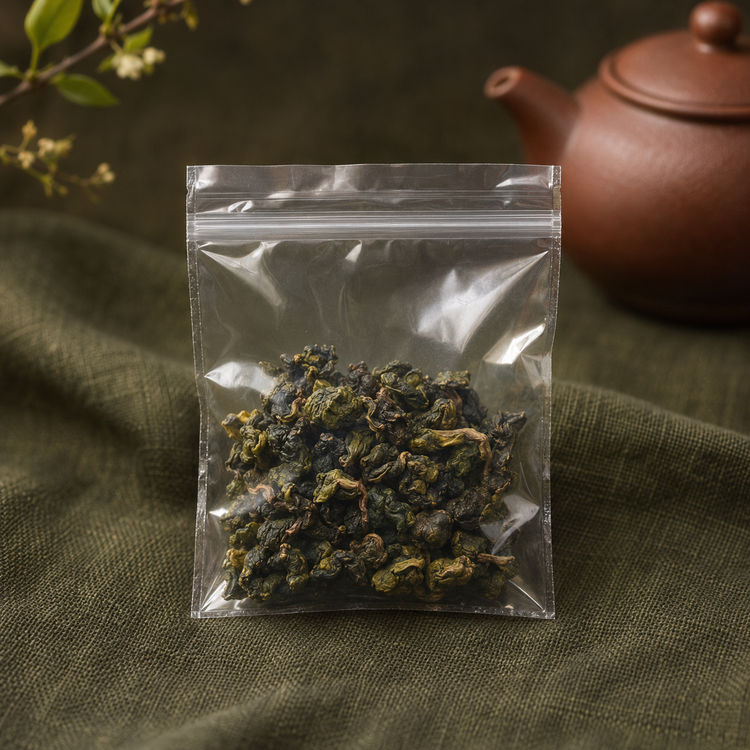
Tea Samples Packaging Guide: Size, Thickness and Quantity
Posted by AppleZipBags Team on Nov 5th 2026
Tea sample packaging works best when three decisions fit together: the bag holds the portion comfortably, the material provides appropriate protection, and the order quantity matches actual demand.
Start with a fill trial using the real tea. A five-gram portion of rolled leaves can occupy much less space than five grams of flowers, long leaves, or fruit pieces. Weight alone cannot determine the right bag dimensions.
Apple Zip Bags offers a small resealable bag collection for compact packaging needs. Confirm the exact selected bag’s suitability for direct tea contact and your proposed storage conditions before filling.
Tea Sample Packaging: The Three Main Decisions
| Decision | What to establish | Common mistake |
|---|---|---|
| Size | Usable space for the actual portion and closure | Choosing by weight alone |
| Thickness | Handling strength and documented material performance | Assuming thicker means better freshness protection |
| Quantity | Demand by blend, kit, and production period | Buying bulk before testing fit |
The closure, label, and outer shipping package also affect how the finished sample performs.
1. Choose Bag Size Around Filled Volume
Define the sample portion before comparing dimensions.
Record the tea type, portion weight, brewing directions, and whether the packet should support one or several brewing sessions.
Then test the portion in a candidate bag.
Different Teas Need Different Amounts of Space
| Tea format | Size consideration |
|---|---|
| Compact rolled leaves | Leave room for filling and pouring |
| Long, delicate leaves | Avoid a fit that requires crushing |
| Fluffy flowers and botanicals | Allow more volume for the same weight |
| Fruit and spice blends | Check how firm pieces sit against the film |
| Fine tea powder | Keep the closure area free of particles |
| Individually wrapped sachets | Fit the existing wrapper without folding |
There is no universal “five-gram tea bag size.” A successful fit needs to be checked with the actual blend.
Run a Practical Size Trial
- Weigh the intended portion.
- Fill the bag without compressing the leaves.
- Leave sufficient space below the zipper.
- Close the zipper fully.
- Check that the seams are not strained.
- Open the bag and pour out the sample.
- Apply the proposed label.
Use the 100-count small bag options to compare candidate formats before committing to a larger order.
If filling or closing requires force, evaluate the usable space in the larger resealable bag range.
2. Check How Bag Dimensions Are Measured
Ask whether the listed length includes the header above the zipper. Confirm the usable internal width and length rather than assuming the entire flat area can hold tea.
Also remember that a flat bag changes shape when filled. Its apparent width becomes smaller as it expands around the contents.
| Measurement | Why it matters |
|---|---|
| Overall width | Helps compare the external format |
| Usable internal width | Determines the opening and available space |
| Overall length | May include an unusable header |
| Length below the zipper | More relevant to product fit |
| Label area | Must accommodate readable information |
Keep the sample comfortably below the closure. Leaves or powder trapped in the zipper can prevent complete engagement.
3. Understand Film Thickness
Plastic bag thickness is often expressed in mil. One mil equals 0.001 inch; it does not mean one millimeter.
| Film thickness | Millimeters | Micrometers |
|---|---|---|
| 1 mil | 0.0254 mm | 25.4 µm |
| 2 mil | 0.0508 mm | 50.8 µm |
| 2.5 mil | 0.0635 mm | 63.5 µm |
| 3 mil | 0.0762 mm | 76.2 µm |
| 4 mil | 0.1016 mm | 101.6 µm |
These conversions follow the relationship listed in the NIST unit-conversion tables. NIST
Confirm whether the supplier’s specification refers to an individual film wall and whether it includes a stated tolerance.
Is 2.5 Mil Suitable for Tea Samples?
Thickness alone cannot answer that question.
Apple Zip Bags lists 2.5 mil products, but suitability depends on the exact material, intended food contact, closure performance, handling, and storage period.
Evaluate whether the filled bag withstands your packing and distribution process without punctures, seam damage, or product escape.
4. Separate Strength From Freshness Protection
A thicker film may improve handling strength within a comparable material structure. It does not automatically establish better oxygen, moisture, light, or aroma protection.
Accu-Seal’s packaging FAQ notes that oxygen and moisture can pass through common polyethylene and polypropylene materials over time. Closing the bag does not eliminate transmission through the film. accu-seal.com
For tea sample packaging, assess:
- Film composition.
- Water-vapor and oxygen barrier performance.
- Light exposure.
- Aroma retention and odor protection.
- Seam and zipper integrity.
- Expected time between filling and brewing.
Tea producer Teatulia’s storage guidance recommends protection from light, heat, moisture, and strong odors. www.teatulia.com
Do not assign a shelf life based solely on thickness or closure type.
5. Confirm the Exact Bag’s Food-Contact Suitability
Request documentation covering the selected product, including its color or printing where relevant, and the proposed conditions of use.
The FDA’s guidance on determining the regulatory status of food-contact materials explains that the components and applicable conditions determine suitability. It also describes requesting a manufacturer’s letter of guaranty. www.fda.gov
A general description such as “plastic bag” or “LDPE” does not establish suitability for every food-packaging application.
Keep the confirmed product specification with your purchasing records so future orders match the tested package.
6. Choose the Closure Before Finalizing Size
A zipper provides convenient access, but an ordinary resealable closure generally does not show whether a package has previously been opened.
If an initial seal is needed, evaluate a pouch designed with a compatible heat-sealable header above the zipper.
Rightpak’s heat-sealing guidance describes this combined format. www.rightpak.co.uk
Confirm material compatibility and required sealing space before applying heat. Do not assume every resealable bag supports heat sealing.
7. Calculate Quantity by Finished Sample Kit
Calculate demand from the production plan:
Base requirement = number of kits × sample packets per kit
Then add an allowance based on your observed packing losses, quality checks, and additional demand.
Example: A Four-Tea Tasting Kit
| Requirement | Bags |
|---|---|
| 200 kits × 4 samples | 800 |
| Illustrative 5% packing allowance | 40 |
| Total planned requirement | 840 |
The 5% allowance is an example, not a universal recommendation. Replace it with evidence from your own packing process.
Calculate by Size and Variant
If one blend needs a larger bag, split the order.
For 200 kits containing three compact samples and one bulky sample, the base requirement is:
- 600 compact bags.
- 200 larger bags.
Do not order 800 bags of one size unless every blend passes the same fit trial.
8. Decide Between 100 and 1,000 Bags
| Situation | Practical starting point |
|---|---|
| New blend or uncertain fit | Smaller trial quantity |
| One limited event | Order around confirmed demand |
| Multiple untested sizes | Test before consolidating |
| Established recurring sampler | Consider bulk purchasing |
| Likely packaging redesign | Limit surplus inventory |
Once the specification is confirmed, compare the 1,000-count small bag options.
For recurring production, use:
Reorder point = expected usage during supplier lead time + safety stock
Base safety stock on demand variation, delivery reliability, and available storage. Submit an Apple Zip Bags wholesale inquiry with your selected specification and expected usage.
9. Include Labeling and Outer Packaging in the Trial
A filled sample still needs to fit its label, tasting kit, and shipping carton.
Check that labels remain readable and attached during handling. Plan space for applicable product information and useful brewing directions.
The FDA Food Labeling Guide provides a starting resource, although FDA notes that portions—including nutrition-labeling material—do not reflect all current requirements. Check the requirements applicable to your product and distribution context. www.fda.gov
Test the complete kit rather than evaluating an empty bag alone.
Frequently Asked Questions
What bag size holds five grams of tea?
It depends on leaf shape and blend density. Fill trials provide a more reliable answer than weight alone.
Does 2.5 mil mean 2.5 millimeters?
No. It equals 0.0635 mm, or 63.5 micrometers.
Are thicker bags always better?
No. Compare strength, barrier performance, closure quality, and intended-use suitability together.
Should I buy 1,000 bags immediately?
Test the exact size and material first. Bulk purchasing becomes more useful once the packaging and demand are established.
What information should I send Apple Zip Bags?
Contact Apple Zip Bags with your tea type, portion weight, required usable dimensions, proposed storage period, closure needs, and quantity. Request confirmation that the exact selected bag suits the intended application.