
Spices Packaging Guide: Size, Thickness and Quantity
Posted by Apple Zip Bags on Nov 6th 2026
The right spice bag is the smallest one you can fill cleanly, close completely, and label clearly. Start by testing your actual portion. Then choose a film that can handle the product and storage conditions, and calculate how many bags you need in each size.
A bag that fits 10 grams of ground cumin might not fit 10 grams of a blend with dried onion and chili flakes. And a bag that holds whole cloves comfortably on the packing table may still need a closer look at the seams after shipping.
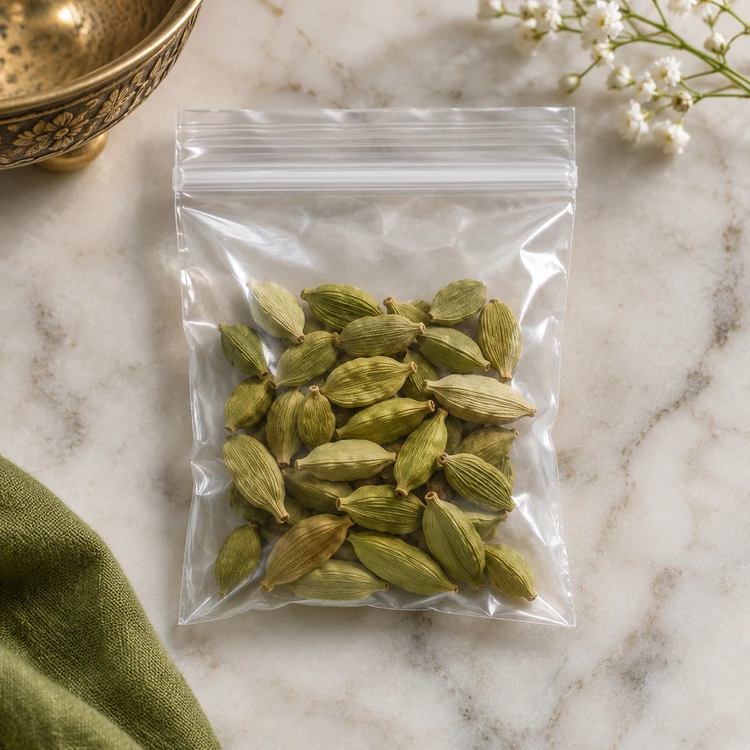
Use the Apple Zip Bags small resealable bag collection to compare compact formats. If loose spices will touch the bag directly, confirm that the exact product and variant are suitable for your intended use.
1. Choose Bag Size Using the Actual Spice Portion
Weigh the portion, then fill the bag with the scoop or funnel you plan to use during production. Check the usable width between the seams and usable height below the zipper. Ask how the seller measures the bag, since the listed length may include space above the closure.
| Spice format | What to prioritize | Sign the bag may be too small |
|---|---|---|
| Ground turmeric, paprika, or cumin | An opening wide enough for clean filling | Powder repeatedly collects in the zipper |
| Peppercorns or whole cumin seeds | Room for the contents to settle and pour | The filled bag bulges against the side seams |
| Cloves or star anise | Clearance around rigid or pointed pieces | Pieces leave pressure marks or poke the film |
| Rubs with herbs, flakes, or dried vegetables | More usable volume and a flat label area | The blend crowds the closure or wrinkles the label |
Start with a 100-count pack of small resealable bags if you’re testing a new format. If the bulkiest blend makes the zipper hard to close or the label hard to apply, compare the larger bag options before adding more packing steps to make a small bag work.
2. Choose Film Thickness for Handling and Barrier Properties for Storage
One mil is one-thousandth of an inch. When comparing products, ask whether the stated thickness is measured per film wall. The conversions below follow the NIST unit conversion tables. www.nist.gov
| Film thickness | Millimeters | Micrometers |
|---|---|---|
| 2 mil | 0.0508 mm | 50.8 µm |
| 2.5 mil | 0.0635 mm | 63.5 µm |
| 3 mil | 0.0762 mm | 76.2 µm |
| 4 mil | 0.1016 mm | 101.6 µm |
Thickness alone does not tell you how well a bag will protect spice aroma or limit moisture exposure. For handling, test for punctures, seam damage, and leakage around the zipper. For storage, ask for relevant film and package specifications. Accu-Seal’s technical FAQ explains that oxygen and moisture can pass through common polyethylene and polypropylene films over time. accu-seal.com
A 2.5 mil bag that passes a short packing trial may still be unsuitable for a sampler that sits in storage for weeks. Test the filled packets for the intended storage period, including how they perform next to strongly scented blends. For customer instructions, McCormick’s spice storage guidance recommends a cool, dry cupboard away from the sink or range and avoiding direct exposure to steam when dispensing. www.mccormick.com
3. Check the Closure and Label on a Filled Packet
A resealable zipper is practical for seasoning blends customers will use more than once. During the trial, check whether they can open, pour, and reclose the packet without getting powder in the track.
If you need visible evidence of first opening, evaluate a pouch designed with a heat-sealable header above the zipper. Confirm that the pouch and sealer are compatible. A standard press-to-close zipper does not provide the same indication that a package has been opened. www.rightpak.co.uk
Request food-contact documentation for the exact film and any selected color or print. Give the supplier the spice type and expected contact conditions. The FDA’s food-contact material guidance explains how components and intended use affect suitability and notes that buyers can request a manufacturer’s letter of guaranty. FDA
Apply the final label to the filled packet. Check that it sits flat, stays readable, and leaves the zipper accessible. For products you distribute or sell, use the FDA Food Labeling Guide as a starting point and verify the current requirements that apply to your product. www.fda.gov
4. Calculate Order Quantity by Bag Variant
Count how many packets of each size, color, or material go into one kit. Multiply by the number of kits, then add an allowance based on your packing trial.
Suppose you’re preparing 250 spice sampler kits. Each contains two ground spices in compact bags and one coarse blend in a larger bag. With an illustrative 4% packing allowance:
| Bag variant | Base requirement | Extras | Total |
|---|---|---|---|
| Compact bags: 2 per kit | 500 | 20 | 520 |
| Larger bags: 1 per kit | 250 | 10 | 260 |
| Total | 750 | 30 | 780 |
A thousand compact bags would cover the total packet count but leave you without the 260 larger bags. If the compact format also works for your next run, compare the 1,000-count small bag options. Compare total delivered cost and expected usage for each variant. For repeat production, send your estimated quantities by size and color through the Apple Zip Bags wholesale inquiry form.
Frequently Asked Questions
What size bag holds 10 grams of spice?
There’s no universal size. Ten grams of fine powder and ten grams of a flaky rub can take up different amounts of space. Test the actual portion with your filling tool and leave enough room to close the bag cleanly.
Is 2.5 mil thick enough for whole spices?
It may be suitable for some products, but check the exact film and filled bag. Round peppercorns and pointed cloves put different pressure on the material. Inspect the film, seams, and zipper after handling the finished packet.
When should I switch from 100 bags to 1,000?
Switch once the exact bag has passed your fill, closure, label, and storage checks and you have enough planned demand for that variant. If you need help comparing formats, contact Apple Zip Bags with your spice type, portion weight, intended storage period, and estimated quantity.