
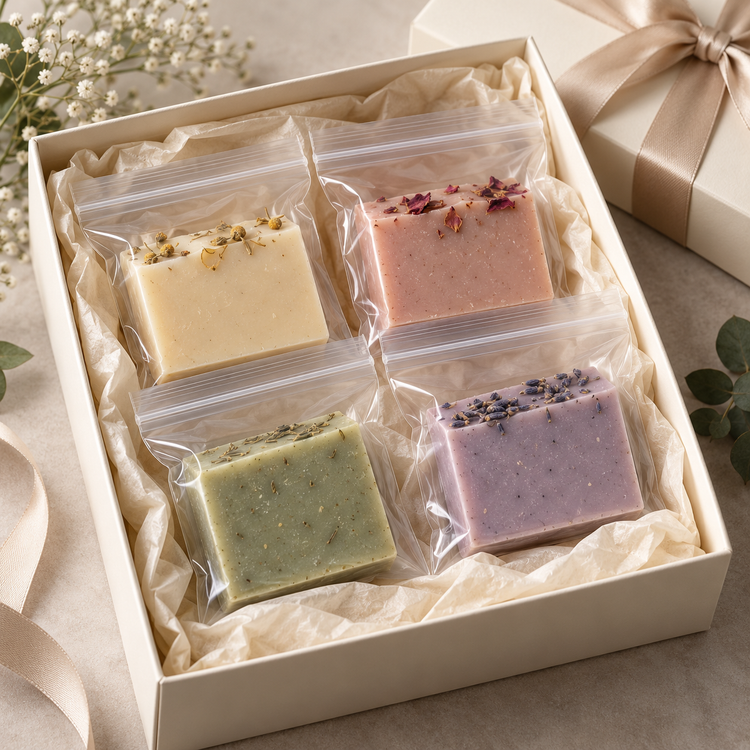
Soap Samples Packaging Guide: Size, Thickness and Quantity
Posted by AppleZipBags Team on Oct 24th 2026
A soap sample may be small, but its packaging has several jobs. It should accommodate the product without damaging its edges, keep identifying information attached, and suit the soap’s formulation and storage needs.
Choosing packaging becomes easier when you separate the decision into three parts:
-
Size: Does the complete wrapped sample fit comfortably?
-
Thickness: Does the bag’s construction suit the intended handling?
-
Quantity: How many packages will you actually use?
Start with a finished sample, including its primary wrapping and label. Test that complete arrangement before selecting a bag size or placing a bulk order.
This guide explains how to compare packaging for individual soap samples, market giveaways, customer-order inserts, and discovery sets.
Soap Sample Packaging at a Glance
| Packaging Decision | What to Check | Why It Matters |
|---|---|---|
| Soap readiness | Appropriate curing, cooling, or hardening | Packaging should follow the formulation’s preparation requirements |
| Primary wrapping | Suitability for direct contact | Different soap types can need different wrapping |
| Bag dimensions | Width, usable height, and allowance for depth | A flat bag loses available space around a thick sample |
| Film thickness | Material, seams, closure, and handling | Thickness alone does not establish performance |
| Label space | Readable identification and product information | Samples should remain identifiable after opening |
| Quantity | Individual packets and outer bags | Different formats have different usage rates |
| Storage period | Expected time before distribution | Compatibility testing should reflect actual use |
Compare formats in the Apple Zip Bags collection after establishing what your soap and presentation require.
Before Sizing: Identify the Soap Type
Packaging for soap samples should begin with the formulation rather than the bag.
Cold-Process Soap
Cold-process soap should complete its appropriate curing process before final packaging.
Bramble Berry’s explanation of soap curing describes the water loss and changes that take place during this stage.
Follow a process appropriate to the recipe and conditions. A sealed bag should not be used as a substitute for curing.
Melt-and-Pour Soap
Melt-and-pour soap has different moisture considerations.
Glycerin can attract moisture from the surrounding air, producing surface droplets commonly called glycerin dew. Soap Queen’s guide to explaining and preventing glycerin dew discusses this behavior and wrapping considerations.
Follow the soap-base supplier’s recommendations. General-purpose zipper bags should not automatically replace suitable primary wrapping.
Individually Wrapped Samplers
An outer resealable bag can group appropriately wrapped samples with a product card.
This separates two functions: the primary wrapping addresses each soap’s requirements, while the outer bag provides organization and presentation.
Part 1: Choosing the Right Bag Size
The useful measurement is the complete package—not the bare soap alone.
Include:
-
Primary wrapping.
-
Labels.
-
Raised decoration.
-
A backing or information card.
-
Any additional samples sharing the bag.
Measure Width, Height, and Depth
A soap sample is three-dimensional. As it expands a flat bag, it uses space across the bag’s width and height.
A bag that appears large enough beside the sample may become too tight once filled.
For rectangular samples, adding the sample’s depth to its width can provide a rough starting point for estimating flat-bag width. Additional clearance is still necessary, and a physical fit test should determine the final choice.
Check Usable Height Below the Zipper
Confirm how the supplier states dimensions.
The overall length may include material above the closure. The usable area beneath the zipper determines whether the sample and any insert fit comfortably.
Test the Opening
A wide or decorative sample must pass through the opening without catching.
Do not force raised details, textured tops, or sharp corners into a narrow bag. Choose a larger format if insertion damages the design or stretches the film excessively.
Illustrative Bag Sizes for Testing
These dimensions are planning examples, not guaranteed fits or a statement of available inventory.
| Illustrative Bag Size | Possible Application | Main Fit Check |
|---|---|---|
| 2 × 3 inches | Very small, thin wrapped samples | Depth and label space |
| 3 × 4 inches | Small wrapped rectangles or mini bars | Comfortable insertion and closure |
| 4 × 6 inches | Larger samples with an information card | Combined thickness |
| 5 × 7 inches | A compact assortment | Arrangement of wrapped samples |
| 6 × 9 inches | A larger discovery set | Total bulk and presentation |
For smaller trials, review the 100-pack small-size bag options. Confirm the selected variant’s dimensions and pack count before ordering.
Leave Room for Comfortable Removal
A tightly fitted package may look neat but become frustrating to open.
Check whether the recipient can remove the sample without squeezing it against the zipper or tearing the packaging.
Leave the closure clear of the soap and its decoration. If the sample presses directly against the sealing area, adjust the size.
For multi-sample assortments, compare dimensions in the large resealable bag collection.
Part 2: Understanding Film Thickness
Film thickness is commonly expressed in mils.
One mil equals one-thousandth of an inch. It is different from a millimeter.
| Film Thickness | Inches | Approximate Micrometers |
|---|---|---|
| 1 mil | 0.001 | 25.4 |
| 2 mil | 0.002 | 50.8 |
| 2.5 mil | 0.0025 | 63.5 |
| 3 mil | 0.003 | 76.2 |
| 4 mil | 0.004 | 101.6 |
Thickness contributes to how packaging handles, but it does not describe the entire bag.
Also compare:
-
Material.
-
Seam construction.
-
Closure.
-
Usable dimensions.
-
Fill weight.
-
Intended application.
Apple Zip Bags lists 2.5 mil products among its small bag options. Check the specifications for the selected format.
What Thickness Does—and Does Not—Tell You
A sturdier film may feel more substantial during packing and handling. However, thickness alone does not establish:
-
Moisture-barrier performance.
-
Fragrance retention.
-
Compatibility with the formulation.
-
Protection against crushing.
-
Suitability for long-term storage.
A thick bag made from an unsuitable material is not a good choice simply because it feels durable.
Assess the Actual Filled Packet
Package a representative sample and handle it as intended.
Check the seams and closure, look for excessive strain, and assess how easily the sample can be removed.
For shipping, evaluate cushioning and the outer package separately. Flexible film alone does not prevent chipped corners or crushed decorative details.
Test Soap and Packaging Compatibility
Use the actual formulation, wrapping, label, and bag.
Observe the package under representative conditions for a period relevant to your distribution schedule.
Check for:
-
Soap sticking to the film.
-
Surface moisture.
-
Color transfer.
-
Film distortion.
-
Label lifting.
-
Unexpected changes in fragrance or appearance.
Soap Queen’s guidance on storing handmade bath products explains why storage conditions matter to product quality.
Keep a record of the formulation, packaging specification, and observations so you can reproduce a successful arrangement.
Follow Wrapping Guidance for Melt-and-Pour Samples
A resealable outer bag may be convenient, but the soap may still need suitable primary wrapping.
Wholesale Supplies Plus provides melt-and-pour packaging FAQs covering common questions.
Bramble Berry’s explanation of shrink wrapping also distinguishes approaches for different soap types.
Choose the primary wrapping around the specific base and follow the supplier’s instructions.
Part 3: Choosing the Right Quantity
Quantity planning should reflect the number of completed packages and the role of each bag.
Individual Samples
If every sample receives one outer bag, the calculation is straightforward:
Bags needed = individually bagged samples planned
Add a practical allowance for packing errors or confirmed additional demand.
Discovery Sets
An assortment may use several individual packages and one outer bag.
For example:
| Component | Packages per Set | Requirement for 100 Sets |
|---|---|---|
| Individually packaged samples | 4 | 400 |
| Outer assortment bag | 1 | 100 |
Calculate each format separately. The individual wrapping may also be a different material from the outer bag.
When to Buy 100 Bags
A smaller pack is useful when:
-
You are testing a new size.
-
Compatibility trials are incomplete.
-
Labels are still changing.
-
You are preparing a limited event.
-
Several sample shapes need different formats.
-
You have not finalized the assortment.
A small trial can reveal that a label needs more space or that the complete wrapped sample is thicker than expected.
When to Buy 1,000 Bags
A larger supply becomes practical when:
-
The packaging format is proven.
-
Sample dimensions are consistent.
-
Distribution happens regularly.
-
Demand is reasonably predictable.
-
You have suitable space for unused stock.
Do not base the decision solely on unit price. Packaging changes or unsuitable fit can reduce the value of a larger purchase.
Estimate Months of Supply
Use:
Months of supply = bags purchased ÷ average bags used per month
| Monthly Usage for One Format | 100 Bags Last Approximately | 1,000 Bags Last Approximately |
|---|---|---|
| 25 | 4 months | 40 months |
| 50 | 2 months | 20 months |
| 100 | 1 month | 10 months |
| 250 | 0.4 months | 4 months |
| 500 | 0.2 months | 2 months |
These examples assume steady use.
Calculate confirmed event requirements separately from ordinary monthly distribution.
Compare Delivered Cost per Bag
Use the total purchase cost:
Delivered cost per bag = total cost ÷ number of bags received
Include applicable shipping, taxes, and discounts.
Compare equivalent products. Differences in material, size, thickness, printing, and closure can make a simple pack-price comparison misleading.
A smaller purchase may be more economical for a limited campaign even when its unit cost is higher.
Plan Presentation Before Finalizing Dimensions
Labels and cards are part of the package.
Keep each sample identifiable after it is removed from the outer assortment. A product name printed only on the discovery-set bag may become separated from the individual soap.
For presentation ideas, browse Soap Queen’s soap packaging resources.
Clear bags can show colors and designs, while printed or colored outer bags can distinguish collections. Test the filled arrangement to ensure essential information remains readable.
Assess Mixed-Fragrance Sets Together
A zipper closure does not necessarily prevent fragrance migration.
Test different scents in the complete assortment over the intended storage period. Do not assume individual plastic packets will fully isolate them.
Keep the individual primary wrapping and outer packaging roles clear throughout the assessment.
Common Packaging Mistakes
Measuring Bare Soap
Include wrapping, labels, cards, and decoration.
Choosing the Smallest Possible Bag
Allow room for loading, removal, and closure.
Selecting Thickness Alone
Assess material, construction, compatibility, and fit together.
Packaging Before the Soap Is Ready
Complete the appropriate curing, cooling, or hardening process.
Buying Equal Quantities of Every Format
Inner and outer packaging often have different usage rates.
Treating a Zip Closure as a Barrier Guarantee
Confirm relevant specifications and test the actual formulation.
Ordering Bulk Before Finalizing Labels
A larger card or revised information layout may change the required bag size.
Frequently Asked Questions
What size bags should I use for soap samples?
Measure the complete wrapped sample, including depth and any inserts. Confirm comfortable insertion, closure, and removal with a physical trial.
Is 2.5 mil thickness suitable for soap packaging?
It may suit some applications, especially outer packaging, but assess the specific material, construction, formulation, and storage conditions.
Can soap go directly into a resealable bag?
Direct-contact suitability depends on the formulation and packaging material. Obtain relevant information and test the actual combination.
Should cold-process samples cure before packaging?
Complete the appropriate curing process before final packaging.
Do melt-and-pour samples need separate wrapping?
Follow the base supplier’s recommendations. A general-purpose zipper bag should not automatically replace suitable primary wrapping.
Should I buy 100 or 1,000 bags?
Start smaller while testing. Consider larger quantities after the format is established and demand supports the purchase.
How many bags do sampler sets require?
Count individual packages and outer bags separately, then calculate requirements for each format.
Build Purchasing Decisions Around a Finished Sample
Prepare one complete package, assess its fit and performance, and calculate how many of each format you will use.
That tested sample gives you a practical basis for choosing size, construction, and quantity. For product-specific material and sizing questions, contact Apple Zip Bags with your intended application and sample dimensions.