
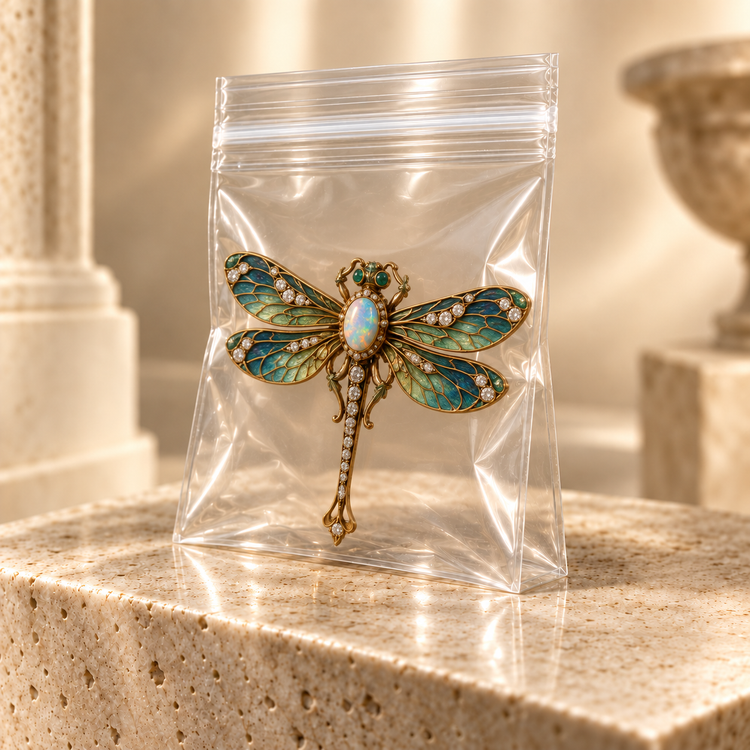
How to Choose Packaging Bags for Jewelry
Posted by AWS Team on Sep 8th 2026
Choosing the right packaging bag for jewelry starts with a deceptively simple question:
What exactly are you packaging?
A tiny stud earring and a rigid bracelet may both be jewelry, but they require very different packaging.
The best jewelry bag depends on several factors:
-
Product dimensions
-
Product thickness
-
Jewelry type
-
Weight
-
Sharp edges
-
Whether a display card is used
-
Whether the bag is for inventory or customer presentation
-
How frequently the bag will be handled
-
Whether labels or barcodes need to fit
-
Monthly packaging volume
For many everyday jewelry applications, small resealable bags around 2–2.5 mil offer a practical combination of compactness, flexibility, visibility and repeated-use convenience.
Apple Zip Bags offers a dedicated range of small jewelry packaging bags in 2.5 mil material, including clear and colored options for jewelry, beads, charms and other small items.
The best way to choose is not to start with a bag.
Start with the jewelry.
Then work through:
product → dimensions → thickness → bag size → film thickness → color → quantity.
Quick Answer: How Do You Choose Packaging Bags for Jewelry?
Use this process:
-
Identify the jewelry type.
-
Measure the complete packaged item.
-
Account for jewelry thickness.
-
Leave room for the closure.
-
Decide whether the bag needs to be clear or colored.
-
Choose an appropriate film thickness.
-
Make room for labels or barcodes.
-
Decide whether the bag is for inventory, presentation or shipping preparation.
-
Test the actual jewelry.
-
Buy larger quantities only after the size is proven.
For many jewelry businesses, a useful general starting point is:
small clear 2.5 mil resealable bags for everyday inventory and fulfillment.
Start With the Jewelry Type
Different jewelry categories create different packaging requirements.
A useful starting framework is:
| Jewelry Type | Main Packaging Consideration |
|---|---|
| Rings | Compact size and label space |
| Stud earrings | Very small dimensions |
| Hoop earrings | Width |
| Drop earrings | Length |
| Pendants | Shape and chain configuration |
| Necklaces | Tangling and chain movement |
| Bracelets | Diameter and thickness |
| Watches | Bulk and depth |
| Charms | Small size and SKU organization |
| Beads | Quantity and weight |
| Findings | Tiny components and labeling |
The bag should match the physical product rather than forcing every jewelry SKU into one standard format.
Measure the Complete Packaged Item
The first major sizing mistake is measuring only the jewelry itself.
If earrings are attached to a card, you need to measure:
the card + earrings.
If a pendant is placed on a backing card, measure:
the entire card assembly.
If a bracelet has an insert, measure:
the bracelet + insert.
Apple Zip Bags' packaging bag size guide recommends considering length, width, height and weight rather than choosing packaging based on only one dimension.
Measure the Widest Point
Jewelry is often irregularly shaped.
A decorative pendant may be:
-
Narrow through the center
-
Much wider around the outer design
Use the widest point.
Do the same for:
-
Brooches
-
Hoops
-
Statement earrings
-
Large charms
Measure the Longest Point
Length becomes especially important for:
-
Drop earrings
-
Chains
-
Head pins
-
Eye pins
-
Long pendants
Do not sharply bend a piece simply to make it fit into a smaller bag.
Measure Thickness
Three-dimensional jewelry uses more bag capacity than flat jewelry.
Examples include:
-
Rings
-
Beaded bracelets
-
Watches
-
Cuffs
-
Large gemstones
-
Thick coin-style pendants
Two items can have the same front dimensions but require different bags because one is much thicker.
Leave Room for the Resealable Closure
The jewelry should not fill the bag all the way to the zipper.
Leave enough room to:
-
Insert the item
-
Close the bag easily
-
Reopen it
-
Apply a label if necessary
If beads, charms or jewelry constantly sit inside the closure track:
the bag is too small or overfilled.
Do Not Choose an Exact Fit
Suppose a jewelry card measures exactly:
2 × 3 inches.
A 2 × 3 bag may still be too tight.
The bag must also account for:
-
Card thickness
-
Jewelry protruding from the card
-
Easy insertion
-
Closure clearance
Choose:
a comfortable fit rather than the smallest theoretical fit.
How to Choose Bags for Rings
Rings are compact and usually do not require large packaging.
For an individual ring, look for:
-
Small dimensions
-
Enough space for a SKU label
-
Easy opening and resealing
-
Limited unnecessary movement
Rings on Cards or Inserts
If the ring sits on a:
-
Display card
-
Foam insert
-
Tag
size the bag around the entire assembly.
For customer-facing premium jewelry, the resealable bag may serve primarily as inventory packaging before the ring is moved into a pouch or box.
How to Choose Bags for Earrings
Earrings vary significantly by style.
Stud Earrings
Studs usually need:
-
Extra-small or small bags
-
Compact cards
-
Limited empty space
Hoop Earrings
Hoops require more width.
Measure the complete outside diameter.
Drop Earrings
Drop earrings require more vertical room.
The bag should be long enough so that the jewelry hangs or rests naturally without being pressed against the zipper.
How to Choose Bags for Necklaces
Necklaces need a balance between compactness and movement control.
A very large bag may allow:
-
Chain movement
-
Tangling
A very small bag may force:
-
Tight folding
-
Compression
Arrange the necklace the way you intend to store or present it, then size the bag around that configuration.
How to Choose Bags for Bracelets
Bracelets may be:
-
Fine chains
-
Rigid bangles
-
Cuffs
-
Beaded designs
-
Heavy-link styles
A flexible chain bracelet may need very little space.
A rigid bangle needs much more.
Measure the actual packaged shape instead of relying on wearable diameter alone.
How to Choose Bags for Pendants and Charms
Pendants and charms are ideal for compact resealable bags because they are easy to:
-
Lose
-
Mix together
-
Misidentify
A clear bag also makes design identification faster.
If a pendant includes a chain, package and measure the complete product.
If charms are sold in multiples, size the bag for:
the total quantity—not one charm.
How to Choose Bags for Beads
Bead packaging depends on:
-
Bead diameter
-
Quantity
-
Material
-
Total weight
A small quantity of seed beads occupies little space.
A bag containing large gemstone beads can become bulky and heavy.
Do not select size based only on piece count.
How to Choose Bags for Jewelry Findings
Small resealable bags work especially well for:
-
Jump rings
-
Clasps
-
Crimps
-
Ear wires
-
Earring backs
-
Connectors
-
Head pins
-
Eye pins
The goal is often not presentation.
It is:
inventory separation and identification.
A label might include:
-
SKU
-
Diameter
-
Gauge
-
Finish
-
Quantity
Choose the Right Film Thickness
Bag thickness and bag dimensions solve different problems.
Size answers:
Will the jewelry fit?
Thickness answers:
Is the film substantial enough for the contents and handling?
2 Mil Bags
2 mil can work for lightweight applications such as:
-
Flat jewelry
-
Lightweight pendants
-
Small components
-
Temporary storage
2.5 Mil Bags
For many jewelry businesses, 2.5 mil is a strong middle-ground choice.
Apple Zip Bags' current small jewelry bags use 2.5 mil film, including its 1,000-pack small jewelry bags.
This thickness can work well for:
-
Rings
-
Earrings
-
Charms
-
Pendants
-
Beads
-
Findings
4 Mil Bags
Heavier film may make more sense when:
-
Jewelry is heavy
-
Components are sharp
-
Bags are opened repeatedly
-
Multiple metal items are grouped together
Do not choose 4 mil automatically.
More thickness can also mean:
-
More bulk
-
More material
-
Higher cost
Thickness Does Not Equal Specialized Protection
A 4 mil bag is physically thicker than a 2 mil bag.
That does not automatically mean it is:
-
Anti-tarnish
-
Archival
-
Waterproof
-
Scratch-proof
Specialized protection should only be claimed when supported by the specific product specification.
GIA advises storing jewelry in ways that reduce direct contact and scratching, and specifically notes that sterling silver can benefit from purpose-designed anti-tarnish storage.
Choose Clear or Colored Jewelry Bags
For most jewelry businesses:
clear is the strongest default.
Clear bags make it easier to visually confirm:
-
Design
-
Stone
-
Finish
-
Metal color
-
Quantity
without opening the bag.
When Clear Bags Are Best
Choose clear bags for:
-
Ecommerce fulfillment
-
Inventory picking
-
Photography
-
Quality control
-
Wholesale sorting
When Colored Bags Are Useful
Colored bags can help with:
-
Product categories
-
Collections
-
Departments
-
Repair status
-
Workflow stages
For example:
-
Blue = necklaces
-
Green = rings
-
Pink = earrings
-
Yellow = bracelets
Color should supplement the SKU system.
It should not replace it.
Consider Clear Bags With Colored Labels
An alternative to carrying many colored bag SKUs is:
clear bag + colored label.
This gives you:
-
Product visibility
-
Category coding
-
Fewer packaging SKUs
-
Easier bulk purchasing
For many businesses, this is simpler than stocking several colors in every bag size.
Make Sure the Label Fits
A packaging bag should have enough room for:
-
SKU
-
Product name
-
Size
-
Material
-
Quantity
-
Barcode
But the label should not cover the entire product.
A good clear-bag system allows employees to:
read the label and see the jewelry at the same time.
Use Accurate Jewelry Descriptions
If labels identify jewelry by:
-
Precious-metal content
-
Stone type
-
Treatment
-
Pearl type
-
Material
those descriptions should be accurate.
The FTC's Jewelry Guides are intended to help businesses avoid misleading claims about precious metals, gemstones, diamonds, pearls and related jewelry characteristics.
Packaging labels should therefore match the actual product listing and specifications.
Decide Whether the Bag Is for Inventory or Presentation
Not every bag has to perform the same job.
Inventory Packaging
Priorities include:
-
Visibility
-
SKU labeling
-
Compact storage
-
Fast picking
Customer Presentation
Priorities may include:
-
Branding
-
Color
-
Clean appearance
-
Gift experience
Shipping Preparation
Priorities include:
-
Product separation
-
Keeping components together
-
Preventing small items from being lost inside the shipping package
Separating these functions makes packaging easier to design.
Plain vs. Branded Jewelry Bags
Plain bags are practical for:
-
Startups
-
Internal inventory
-
Testing new products
-
Wholesale operations
-
Changing product catalogs
Branded bags become more attractive when:
-
Packaging sizes are stable
-
Order volume is predictable
-
Brand recognition matters
Apple Zip Bags' guide to custom printed vs. plain jewelry bags discusses this decision in terms of branding goals, budget, order volume and customer experience.
Choose the Right Quantity
Once you know the correct bag specification, choose how many to buy.
Start With 100 When Testing
A smaller pack is useful when:
-
Trying a new size
-
Testing a color
-
Launching a product
-
Packaging volume is low
Apple Zip Bags currently offers 100-pack small 2.5 mil jewelry bags for lower-volume purchasing and testing.
Move to 1,000 When Proven
1,000-count packs become more practical when:
-
Size is confirmed
-
Monthly usage is predictable
-
Several SKUs use the same bag
-
Reordering small packs becomes inefficient
A useful rule is:
test with 100; standardize with 1,000.
Calculate Monthly Bag Usage
Use:
monthly units packaged × bags per unit = monthly bag requirement
For example:
500 jewelry pieces monthly
× 1 bag each
=
500 bags per month.
If jewelry kits require three separate inner bags:
200 kits × 3
=
600 bags monthly.
Calculate actual bag consumption rather than order count alone.
Standardize a Few Core Sizes
Most jewelry businesses do not need dozens of bag dimensions.
A practical system might use:
Extra Small
For:
-
Seed beads
-
Crimps
-
Earring backs
-
Tiny charms
Small
For:
-
Rings
-
Stud earrings
-
Small pendants
-
Charms
Medium
For:
-
Bracelets
-
Necklaces
-
Hoop earrings
-
Larger cards
Large
For:
-
Watches
-
Jewelry sets
-
Oversized display cards
Apple Zip Bags also offers larger resealable bag sizes for products that need more room.
Avoid Using One Bag Size for Everything
One oversized bag may appear convenient, but it often creates:
-
Poor presentation
-
Wasted material
-
More product movement
-
Inefficient storage
A seed bead and a necklace should not necessarily use the same bag.
Avoid Stocking Too Many Nearly Identical Sizes
The opposite problem is maintaining:
-
2 × 2
-
2 × 2.5
-
2 × 3
-
2.25 × 3
-
2.5 × 3
-
2.5 × 3.25
when only a few standardized dimensions could cover most inventory.
Simpler packaging inventories are easier to:
-
Train
-
Count
-
Reorder
-
Store
Test the Actual Jewelry Before Buying Bulk
Do not rely only on measurements.
Perform a real packaging test.
Test Procedure
-
Insert the jewelry.
-
Close the bag.
-
Reopen it.
-
Remove the jewelry.
-
Apply the label.
-
Put it in the storage bin.
-
Pick it as if filling an order.
-
Add it to the final shipping package.
A bag can technically fit while still being:
operationally frustrating.
Check Sharp Edges and Posts
Certain jewelry components can stress flexible packaging.
Examples include:
-
Earring posts
-
Brooch pins
-
Sharp prongs
-
Head pins
-
Wire components
In these cases, consider:
-
Backing card
-
Protective insert
-
Heavier film
-
Alternative packaging
A larger bag alone does not solve puncture risk.
Consider Jewelry Weight
Small jewelry can still be heavy.
For example:
-
Dense metal charms
-
Large beads
-
Watches
-
Multiple coins
-
Heavy bracelets
Evaluate:
weight + dimensions + film strength
together.
Separate Jewelry Where Appropriate
Individual packaging helps keep jewelry pieces from rubbing directly against one another.
GIA recommends storing jewelry separately rather than tossing pieces together, because direct contact can contribute to scratching and damage.
For delicate or valuable jewelry, additional storage such as:
-
Pouch
-
Padded compartment
-
Jewelry box
may also be appropriate.
Packaging Bags Are Usually Inner Packaging
A resealable jewelry bag is generally not the complete shipping system.
FedEx's current jewelry-shipping guidance recommends protecting jewelry with suitable wrapping or cushioning, placing it in a snug inner box, and then using sturdy outer corrugated packaging to prevent movement in transit.
Think of the resealable bag as:
product containment and organization.
Then use suitable outer packaging for transportation.
Shipping Packaging Should Not Bulge
USPS advises using packaging that is strong enough to protect its contents and does not bulge, with enough room for cushioning where needed.
That makes correct inner-bag sizing useful because oversized inner packaging can contribute unnecessary bulk to the complete shipment.
Example: Choosing a Bag for a Ring
Suppose you sell a ring that measures roughly:
1 inch across.
If it is loose:
-
Use a compact small bag.
-
Leave room for the label and closure.
If it is mounted on a 2-inch card:
-
Measure the card instead.
-
Choose a bag slightly larger than the complete card.
The packaging decision changes because:
the finished package changed.
Example: Choosing a Bag for Earrings
Suppose you sell drop earrings on a:
2 × 3 inch card.
The earrings extend another:
0.5 inch below the card.
Your finished product is now longer than 3 inches.
Choose the bag for:
the full finished length.
Example: Choosing a Bag for Beads
Suppose you sell:
50 gemstone beads per package.
Arrange all 50 beads as they will actually sit in the bag.
Measure:
-
Width
-
Length
-
Thickness
Then evaluate whether the weight justifies a more substantial film.
Example: Choosing a Bag for a Necklace
Arrange the necklace in the intended packaged configuration.
Avoid:
-
Oversized space that encourages tangling
-
Tight folds that compress the chain
Then select the smallest comfortable bag.
Example: Choosing a Bag for a Watch
A watch has:
-
Face width
-
Case thickness
-
Strap
-
Buckle
Measure the complete watch configuration.
A small jewelry bag designed for rings or earrings may not be appropriate.
Use a larger size or another packaging format.
Common Jewelry Packaging Bag Mistakes
Measuring Only the Jewelry
Measure cards, holders and inserts too.
Choosing an Exact Fit
Leave working clearance.
Ignoring Product Thickness
Three-dimensional pieces need additional room.
Forgetting Closure Space
Keep products below the zipper.
Using One Bag Size for Everything
Standardize several useful sizes instead.
Stocking Too Many Dimensions
Avoid unnecessary complexity.
Assuming Thicker Always Means Better
Choose thickness according to actual physical needs.
Assuming Thickness Means Anti-Tarnish
It does not.
Assuming Resealable Means Waterproof
Do not make unsupported claims.
Choosing Colored Bags Without a System
Use color intentionally.
Using Color Instead of SKUs
Keep unique item identification.
Choosing a Bag Too Small for the Label
Plan for inventory information.
Buying 1,000 Before Testing
Validate the bag first.
Ignoring Sharp Jewelry Components
Use protective backing or stronger packaging when needed.
Treating the Bag as Complete Shipping Protection
Use appropriate outer packaging.
Jewelry Packaging Bag Buying Checklist
Before selecting a bag, ask:
-
What type of jewelry am I packaging?
-
What is the widest point?
-
What is the longest point?
-
How thick is it?
-
How much does it weigh?
-
Is it mounted on a card?
-
Does it have an insert?
-
Is it inside another holder?
-
How many pieces go in one bag?
-
Is anything sharp?
-
Does the product enter the opening easily?
-
Is there room for the closure?
-
Is the bag excessively large?
-
Does the jewelry sit naturally?
-
Is 2 mil sufficient?
-
Would 2.5 mil be more practical?
-
Does the product genuinely need 4 mil?
-
Do I want clear visibility?
-
Would color coding help?
-
Could clear bags with colored labels be simpler?
-
Does a SKU label fit?
-
Can I still see the jewelry?
-
Is the bag used for inventory?
-
Is it customer-facing?
-
Is it part of shipping preparation?
-
Does the jewelry need a pouch or box?
-
Have I tested the actual product?
-
Should I start with 100 bags?
-
Is the size proven enough for 1,000?
-
Can several jewelry SKUs share one standardized bag size?
Frequently Asked Questions
What type of bag is best for jewelry?
For many everyday jewelry-business applications, a small clear resealable bag around:
2–2.5 mil
is a practical starting point.
The exact choice depends on jewelry dimensions, thickness, weight and handling.
How do I choose a jewelry bag size?
Measure the complete packaged product:
width + length + thickness.
Include cards, holders and inserts.
Then leave enough clearance for comfortable insertion and closure.
Should the bag be larger than the jewelry?
Slightly.
Avoid an exact tight fit, but also avoid dramatically oversized packaging.
What thickness is best for jewelry bags?
For many lightweight and moderate jewelry applications:
2–2.5 mil
is practical.
Heavier or sharper pieces may require more robust packaging.
Is 2.5 mil good for jewelry?
Yes.
For general inventory, storage and fulfillment, 2.5 mil provides a versatile balance of flexibility and everyday durability.
Do I need 4 mil jewelry bags?
Only when the contents or handling justify the additional thickness.
A simple pair of earrings does not automatically require 4 mil film.
Should jewelry bags be clear?
Clear is generally the most versatile choice because it allows visual product verification.
Are colored bags useful?
Yes.
They can support:
-
Category coding
-
Collections
-
Repair status
-
Branding
Should jewelry bags have labels?
For business inventory, labels can significantly improve identification.
Useful fields include:
-
SKU
-
Product name
-
Size
-
Material
-
Quantity
How do I choose bags for earrings?
Measure the full earrings or complete display card.
Studs may use very small bags, while hoops and drop earrings need more space.
How do I choose bags for necklaces?
Arrange the necklace the way it will actually be stored or shipped, then measure that configuration.
How do I choose bags for rings?
Use a compact bag slightly larger than the loose ring or its finished display card.
How do I choose bags for beads?
Measure the complete quantity being sold or stored and account for total weight.
Should I buy 100 or 1,000 jewelry bags?
Choose:
100 when testing.
Choose:
1,000 after the size, color and application are proven.
How many jewelry bag sizes should I use?
Many businesses can cover most inventory with:
3–5 standardized sizes.
Are jewelry bags anti-tarnish?
Not automatically.
Use specialized anti-tarnish storage when the jewelry requires it.
Can I ship jewelry in only a resealable bag?
Usually not.
Use appropriate cushioning, inner packaging and outer shipping protection based on the value and fragility of the jewelry.
Final Verdict: How to Choose Packaging Bags for Jewelry
Learning how to choose packaging bags for jewelry becomes much easier when you work through the decision in the correct order.
Start with:
the actual jewelry.
Then evaluate:
width → length → thickness → weight → closure clearance.
Next, choose the appropriate film thickness.
For many everyday jewelry applications:
2–2.5 mil
is a practical range, with 2.5 mil offering a versatile middle ground for many rings, earrings, charms, beads, findings and pendants.
Choose:
clear bags
when visibility and fast inventory verification matter.
Use:
colored bags or colored labels
when they support a real organization or branding system.
For bag size:
measure the complete finished configuration.
That means including:
-
Jewelry cards
-
Inserts
-
Holders
-
Product thickness
-
Multiple-item quantities
Then test the actual product.
Do not jump directly from:
“this dimension looks right”
to:
“buy 1,000.”
Instead:
measure → test → standardize → buy in volume.
Once a bag size has proven itself, standardize several core dimensions across the catalog rather than stocking dozens of nearly identical bags.
And remember the role of the packaging bag.
It is excellent for:
-
Product separation
-
Visibility
-
SKU labeling
-
Inventory
-
Picking
-
Fulfillment
But delicate or valuable jewelry may still need:
-
Pouches
-
Cards
-
Cushioning
-
Boxes
-
Suitable outer shipping packaging
The best jewelry packaging bag is ultimately not the smallest, thickest or most decorative option.
It is the one that:
fits comfortably, protects appropriately, supports identification and makes the business easier to operate.