
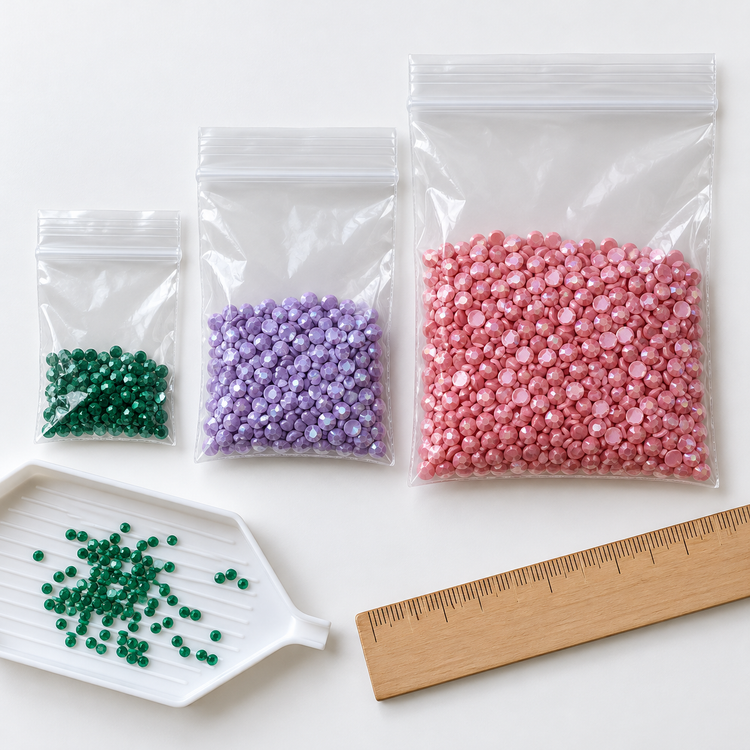
Diamond Painting Pieces Packaging Guide: Size, Thickness and Quantity
Posted by AppleZipBags Team on Oct 23rd 2026
Diamond painting pieces are easier to manage when their packaging fits the way you work. A crowded bag makes pouring awkward. An oversized packet takes up unnecessary space. Missing labels can leave a collection of leftover drills difficult to identify.
Choosing suitable packaging starts with three decisions:
-
Size: How much room does each drill portion need?
-
Thickness: Does the bag handle comfortably with its intended contents?
-
Quantity: How many packets will your projects actually use?
Choose bags that leave room below the zipper, allow controlled transfers, and keep identifying information readable. Test a complete packet before purchasing a larger supply.
This guide explains how to make those decisions for active projects, leftover colors, and organized kit preparation.
Diamond Painting Packaging at a Glance
| Packaging Need | Size Priority | Construction Priority | Quantity Planning |
|---|---|---|---|
| Small accent-color portions | Easy access without excessive empty space | Convenient closure | Count separately identified colors |
| Large background-color portions | Capacity with clear zipper space | Comfortable handling when filled | Allow multiple packets if necessary |
| Leftover drills | Compact fit and readable labels | Suitable for repeated retrieval | Count identified portions |
| Active-project supplies | Easy pouring and refilling | Closure that works comfortably | Calculate by project |
| Complete color sets | Room for all inner packets | Outer bag suited to combined bulk | One outer bag per grouped set |
| Reserve supplies | Fit inside the chosen organizer | Intact seams and closure | Forecast actual replacement use |
Start with a representative sample of your drills before comparing the Apple Zip Bags collection.
Part 1: Choosing the Right Bag Size
Bag size should follow the amount of drills stored and the way you transfer them.
A small accent color may need little capacity, while a background color may occupy several packets. Using one size for everything can simplify purchasing, but it should still work comfortably across those different quantities.
Measure the Filled Packet
An empty bag does not show how it will behave once loaded.
Drills create depth, reducing the space available across a flat bag’s width and height. Test the intended portion rather than estimating from the bag laid flat.
Check whether you can:
-
Hold the packet comfortably.
-
Open it without pushing drills upward.
-
Pour a small amount into a tray.
-
Return unused pieces.
-
Close it without trapping drills in the zipper.
Leave Headroom Below the Closure
The bag should have clear space above the contents.
That headroom gives you room to grip the opening and inspect the zipper. If drills constantly collect in the sealing area, reduce the portion or choose a larger size.
Check the Usable Dimensions
Confirm how the supplier measures the bag.
The overall height may include material above the zipper. The usable area below the closure determines the space available for the contents.
Opening width matters too, especially when returning drills from a tray or funnel.
Illustrative Bag Sizes for Testing
These dimensions are planning examples, not guaranteed fits or a statement of available inventory.
| Illustrative Size | Possible Application | What to Test |
|---|---|---|
| 2 × 3 inches | Smaller drill portions | Opening access and label placement |
| 3 × 4 inches | Moderate portions or larger labels | Comfortable pouring and refilling |
| 4 × 6 inches | Larger reserve quantities | Fill weight and organizer fit |
| 5 × 7 inches | Grouping several small packets | Combined bulk |
| 6 × 9 inches | Project groups with an inventory sheet | Full arrangement and storage fit |
There is no dependable universal drill count for each bag size. Shape, dimensions, fill level, and the particular bag all affect capacity.
For testing smaller formats, review the 100-pack small-size bag options. Confirm the selected variant’s usable dimensions and pack quantity.
Match Size to Your Working Routine
For Active Colors
Prioritize easy opening, controlled pouring, and comfortable refilling.
Try the bag with your actual tray. A packet that stores neatly but makes every transfer awkward may not suit frequent use.
For Leftover Drills
Compact storage and readable identification become especially important.
Keep enough room for the label and avoid creating packets so tightly filled that they are difficult to inspect.
Diamond Art Club’s diamond painting storage tips discuss organizing colors and maintaining their identifying references.
For Large Quantities
Divide a supply between matching labeled packets when that makes handling easier.
Use consistent identification, followed by a packet count such as “1 of 2” and “2 of 2.” This helps prevent a second portion from being overlooked.
Part 2: Understanding Bag Thickness
Plastic film thickness is commonly expressed in mils.
One mil equals one-thousandth of an inch. It is different from a millimeter.
| Film Thickness | Inches | Approximate Micrometers |
|---|---|---|
| 1 mil | 0.001 | 25.4 |
| 2 mil | 0.002 | 50.8 |
| 2.5 mil | 0.0025 | 63.5 |
| 3 mil | 0.003 | 76.2 |
| 4 mil | 0.004 | 101.6 |
Thickness contributes to handling performance, but it does not describe the complete bag.
Also assess the material, seams, closure, opening, and intended fill.
How to Evaluate Thickness for Drills
Test a Realistic Portion
A nearly empty sample does not tell you how the packet will handle at its normal fill level.
Fill the bag, close it, and place it in the intended organizer. Then retrieve it and transfer some drills as you would during a session.
Look for strain, awkward gripping, or difficulty operating the zipper.
Consider Repeated Access
A reserve packet may be opened infrequently. An active-project packet may be handled many times.
Assess whether the complete construction suits that routine.
Inspect the Closure and Seams
Film thickness does not compensate for a damaged zipper or seam.
Check packets before use and replace any with punctures, splits, or closures that no longer work properly. Transfer the identifying information with the contents.
Apple Zip Bags lists 2.5 mil products among its 1,000-pack small bag options. Compare the selected format’s specifications before purchasing.
Choose Visibility Alongside Thickness
Clear packaging makes it easier to inspect contents and read labels.
Tinted or printed bags can support categorization, but check whether the design interferes with identification. Avoid making close shade comparisons through colored film.
A useful arrangement is:
-
Clear packets for individual colors.
-
Labeled outer packaging for project groups.
-
A consistent organizer for the complete collection.
For larger grouped sets, compare the dimensions in the large resealable bag collection.
Labels Are Part of the Packaging Specification
Plan the label before finalizing bag size.
Include the information needed to identify the drills later:
-
Supplier or kit brand.
-
Project name.
-
Color code exactly as supplied.
-
Canvas symbol, where useful.
-
Round or square shape.
-
Special finish, if applicable.
DiamondPainting.com’s guide to organizing diamond drills discusses labeled bags and other storage approaches.
Separate Symbols from Color Codes
A canvas symbol belongs to that project’s legend. It may identify something different in another kit.
Retain the supplied color reference and project origin alongside the symbol.
Keep Uncertain Matches Separate
Do not combine leftovers solely because their colors look similar.
Check shape, finish, supplier, appearance, and fit. Preserve separate packets when compatibility is uncertain.
Part 3: Choosing the Right Quantity
Count the number of separately identified portions you plan to package.
A project with 35 colors might use approximately 35 inner bags, but larger color supplies may need more than one packet. Existing suitable storage may reduce the number of new bags required.
Example: Packaging Multiple Projects
Suppose you are organizing four projects, each with 30 separately bagged colors.
| Packaging Requirement | Calculation | Bags Needed |
|---|---|---|
| Inner color packets | 4 projects × 30 colors | 120 |
| Outer project bags | 4 projects × 1 | 4 |
| Total across both formats | 124 |
If some colors need multiple packets, add those separately.
The small inner bags and larger outer bags have different demand, so calculate each size independently.
When to Buy 100 Bags
A smaller pack makes sense when:
-
You are testing dimensions.
-
You have a limited collection.
-
You are organizing a few projects.
-
You have not finalized label placement.
-
Your storage system is changing.
-
Different quantities may require different formats.
Testing first can prevent a large supply of bags that are difficult to pour from or too narrow for your labels.
When to Buy 1,000 Bags
A larger pack may suit:
-
Frequent diamond painters.
-
Established kit-packing operations.
-
Clubs sharing a purchase.
-
Large, regularly maintained leftover collections.
-
Users with a proven standard format.
Base the decision on actual use rather than the apparent size of the discount.
Calculate Months of Supply
Use:
Months of supply = bags purchased ÷ average new bags used per month
| Monthly Usage | 100 Bags Last Approximately | 1,000 Bags Last Approximately |
|---|---|---|
| 10 | 10 months | 100 months |
| 25 | 4 months | 40 months |
| 50 | 2 months | 20 months |
| 100 | 1 month | 10 months |
| 200 | Half a month | 5 months |
These examples assume steady usage. Count new bags needed, rather than every time you open an existing packet.
Compare Delivered Cost per Bag
Use the total purchase cost:
Delivered cost per bag = total cost ÷ number of bags received
Include applicable shipping, taxes, and discounts.
Compare equivalent dimensions, materials, thicknesses, and designs. A lower unit price does not provide practical value if the bag obscures the label or makes transfers inconvenient.
For product-specific purchasing questions, contact Apple Zip Bags with your dimensions and expected quantity.
Combine Bags with Other Storage Formats
Bags do not have to serve every part of the process.
You may prefer containers for frequently used colors and resealable bags for reserves or leftovers.
For examples of structured alternatives, compare ARTDOT’s diamond painting storage containers.
Diamond Art Club’s storage organizers and containers provide another reference for arranging active supplies.
If a color occupies both a working container and a reserve bag, label both consistently.
Account for Tools and Trays
Project storage may include a tray, applicator, or other accessories.
Check their dimensions separately and protect pointed tools appropriately. Do not place exposed points where they can puncture packets.
Browse examples of diamond painting tools and accessories when planning the space required for your complete setup.
A supportive outer box or case can help keep the grouped supplies manageable.
Keep Small Pieces Securely Stored
Drills and loose packaging should be kept away from young children and animals.
Close packets after handling, check the work surface for spills, and return supplies to a designated location.
The U.S. Consumer Product Safety Commission’s small-parts guidance provides information about small-parts considerations for children’s products.
Common Packaging Mistakes
Choosing Capacity from Color Count Alone
Different colors can occupy very different volumes.
Filling into the Zipper Area
Leave headroom for handling and closure.
Selecting Thickness Without Testing
Evaluate the filled packet and its complete construction.
Transferring Before Labeling
Prepare identification before opening the original supply.
Buying Equal Quantities of Every Size
Inner packets and outer project bags have different usage rates.
Combining Uncertain Leftovers
Preserve separate identification when compatibility is unclear.
Ordering Bulk Before Trying Transfers
Test pouring, refilling, and organizer fit first.
Frequently Asked Questions
What size bags are best for diamond painting pieces?
Choose around the intended portion and transfer method. Leave clear space below the zipper and test the bag in your organizer.
How many drills fit in a small bag?
There is no universal count. Capacity depends on drill dimensions, shape, bag construction, and the chosen fill level.
Is 2.5 mil thickness suitable?
It may suit some organizational uses, but assess the specific bag with your intended contents and handling routine.
Should every color use the same size?
Only if that format works comfortably. Larger quantities may need a different size or several matching packets.
Should I buy 100 or 1,000 bags?
Start smaller when testing or organizing a limited number of projects. Consider a larger supply once the format is proven and recurring use supports it.
Can bags replace rigid containers?
They can serve many storage tasks. Some users prefer containers for active colors and bags for compact reserves.
What information belongs on the label?
Preserve the supplied code, supplier, project reference, shape, and any special finish information.
Build Your System Around a Tested Packet
Start with one representative portion, a complete label, and your usual tray.
Check fit, closure, pouring, refilling, and storage before choosing a larger quantity. A packet that works comfortably throughout that routine gives you a useful standard for organizing the rest of your collection.