
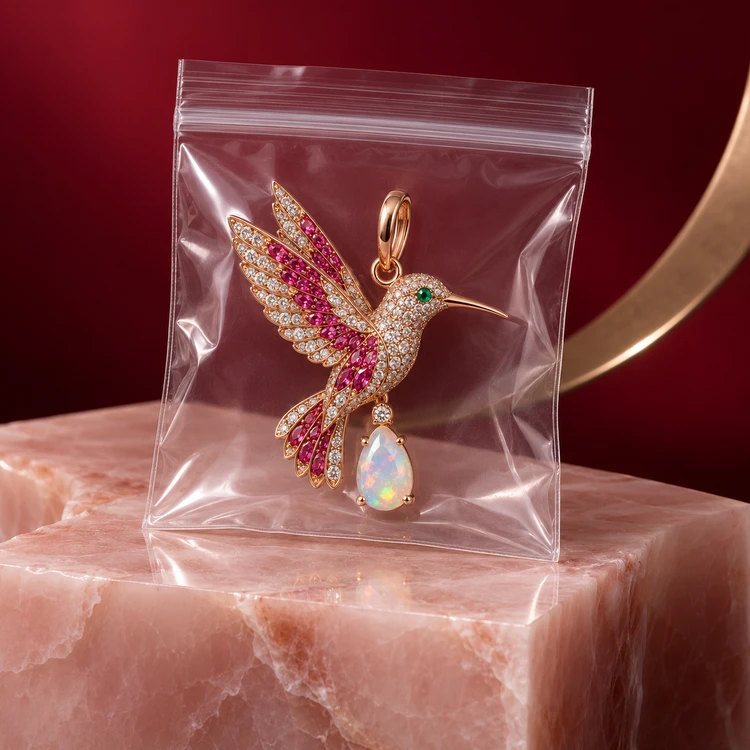
Clear vs Colored Jewelry Bags: Which Is Better for Inventory?
Posted by AppleZipBags Team on Sep 7th 2026
When comparing clear vs. colored jewelry bags for inventory, there is no universal winner.
The better option depends on what you need to identify first.
Choose:
clear jewelry bags
when you want employees to see the actual:
-
Ring
-
Earrings
-
Necklace
-
Bracelet
-
Charm
-
Bead
-
Stone
-
Watch
without opening the bag.
Choose:
colored jewelry bags
when you want the packaging itself to communicate information such as:
-
Product category
-
Metal type
-
Size group
-
Collection
-
Department
-
Repair status
-
Inventory location
-
Order status
For many jewelry businesses, the strongest inventory system is actually:
a combination of clear visibility + consistent labels + selective color coding.
Apple Zip Bags currently offers clear and colored options among its small resealable jewelry bags, specifically positioning those options for sorting styles, sizes and SKUs. Apple Zip Bags 2.5 Mil Jewelry Bags
The goal is not to make inventory colorful.
The goal is to make it:
faster to identify, harder to mix up and easier to count.
Quick Answer: Clear vs. Colored Jewelry Bags
| Inventory Need | Clear Bags | Colored Bags |
|---|---|---|
| See jewelry immediately | Excellent | Depends on transparency |
| Identify product category from distance | Moderate | Excellent |
| Compare stones or finishes | Excellent | Moderate |
| SKU organization | Excellent with labels | Excellent with labels + color |
| Ring inventory | Excellent | Excellent for size/category coding |
| Earrings | Excellent | Excellent for collections |
| Necklaces | Excellent | Useful for type/status coding |
| Beads and findings | Excellent | Excellent for category coding |
| Repair department | Good | Excellent for workflow status |
| Picking speed | Excellent when products look different | Excellent when categories look similar |
| Photography preparation | Excellent | Moderate |
| Customer-facing presentation | Excellent | Strong branding potential |
| Barcode labels | Excellent | Excellent |
| Visual inventory audits | Excellent | Excellent when coding is consistent |
| Mixed jewelry inventory | Excellent | Best as supplemental coding |
For most jewelry businesses:
clear bags are the strongest default inventory choice.
Colored bags become especially valuable when:
color communicates a defined inventory rule.
What Are Clear Jewelry Bags?
Clear jewelry bags allow the contents to remain visible through the packaging.
That can be particularly useful for:
-
Rings
-
Earrings
-
Bracelets
-
Pendants
-
Charms
-
Coins
-
Beads
-
Jewelry findings
-
Watches
-
Loose components
Instead of opening a bag to identify its contents, employees can visually inspect the item.
Apple Zip Bags emphasizes this benefit across its packaging range, describing transparency as a way to identify contents quickly. Apple Zip Bags
For inventory management, that means clear packaging can reduce:
unnecessary handling.
What Are Colored Jewelry Bags?
Colored jewelry bags introduce an additional visual identifier.
Depending on the product, the bag may be:
-
Red
-
Blue
-
Green
-
Yellow
-
Pink
-
Another color
The jewelry may remain partly or fully visible depending on the specific bag.
The primary inventory advantage is:
color coding.
Instead of reading every label, an employee may learn that:
Blue = necklaces
Pink = earrings
Green = rings
and immediately narrow the search.
Which Is Better for Inventory?
If you have to choose only one:
clear is usually the safest general-purpose inventory option.
Why?
Because inventory employees frequently need to know:
exactly what is physically inside the bag.
Clear packaging lets them inspect:
-
Style
-
Stone
-
Finish
-
Shape
-
Color
-
Product type
without opening the package.
Colored bags become more powerful when inventory is large enough that:
category identification is slowing employees down.
Clear Bags Make the Product the Identifier
Imagine a jewelry drawer containing:
-
Gold heart pendant
-
Silver heart pendant
-
Ruby heart pendant
-
Emerald heart pendant
Inside clear bags, employees can visually distinguish many of these pieces instantly.
The jewelry itself becomes:
part of the identification system.
This works particularly well when inventory items are visually distinct.
Colored Bags Make the Package an Identifier
Now imagine 400 bags containing:
-
Jump rings
-
Clasps
-
Crimps
-
Earring backs
Many of those pieces look very similar from a distance.
Color coding can add another information layer.
For example:
Blue = jump rings
Yellow = clasps
Pink = earring findings
Green = crimps
Before reading a label, employees already know:
which family of components they are looking at.
Why Inventory Visibility Matters
Every unnecessary package opening adds:
-
Handling
-
Time
-
Opportunity for products to become mixed
-
Opportunity for tiny pieces to fall out
Clear packaging can help employees answer:
“Is this the item I need?”
before touching the closure.
This can be particularly useful during:
-
Picking
-
Packing
-
Cycle counts
-
Photography
-
Quality control
-
Returns processing
Why Color Coding Matters
Color coding is valuable because humans can often recognize:
visual categories faster than written codes.
An employee looking for earrings may find a drawer of pink-coded bags faster than scanning dozens of labels individually.
But color coding only works when:
the rules stay consistent.
If blue means:
“rings”
this week and:
“silver jewelry”
next month, the system creates confusion rather than reducing it.
Clear Bags vs. Labels
Clear packaging does not eliminate the need for labels.
The jewelry may be visible, but employees may still need to know:
-
SKU
-
Ring size
-
Metal
-
Supplier
-
Cost
-
Quantity
-
Location
A good system combines:
visible product + readable label.
Shopify recommends assigning a unique SKU to each distinct product variation so differences such as color, size or configuration remain individually trackable. Shopify Inventory Tracking Guide
Colored Bags vs. Labels
Color should also never replace the SKU.
Suppose:
blue = necklaces.
You still need to distinguish:
-
NL-001
-
NL-002
-
NL-003
-
NL-004
Color tells you:
which category.
The label tells you:
which exact product.
The Best System: Color + SKU + Visible Product
A strong jewelry inventory system might use:
Bag color = category
SKU label = exact item
Clear or translucent area = visual verification
For example:
Pink bag
SKU:
ER-GD-041
Description:
Gold Drop Earrings
Quantity:
1
The employee receives three separate signals confirming the inventory item.
Clear Bags for Rings
Clear bags are particularly useful for rings because staff can immediately see:
-
Design
-
Stone
-
Metal color
-
Setting style
However, visual inspection may not reveal:
ring size.
That information should still be labeled.
Example:
SKU: RG-1042
Style: Halo Ring
Size: 7
Finish: Gold
Colored Bags for Ring Sizes
A jewelry retailer could also use color to categorize ring sizes.
For example:
Blue = Size 6
Green = Size 7
Yellow = Size 8
This can work if:
-
You have many rings.
-
Size is a frequent picking variable.
-
Employees understand the system.
But there is a risk.
If you carry dozens of ring sizes:
too many colors can become confusing.
Labels remain essential.
Better Ring Color Coding: Product Family
Instead of assigning one color to every ring size, consider:
Pink = engagement rings
Blue = fashion rings
Green = wedding bands
Then put:
size on the label.
This reduces the number of color rules employees need to memorize.
Clear Bags for Earrings
Clear packaging works extremely well for:
-
Stud earrings
-
Hoops
-
Drop earrings
-
Gemstone earrings
Employees can visually identify:
-
Shape
-
Stone color
-
Metal
-
Design
without opening each bag.
This can make clear bags especially useful for:
large earring catalogs.
Colored Bags for Earring Collections
Color can identify:
-
Collection
-
Season
-
Price tier
-
Material
For example:
Pink = bridal
Blue = everyday
Gold = premium collection
Green = clearance
This can speed up:
-
Merchandising
-
Picking
-
Restocking
Clear Bags for Necklaces
Necklaces benefit from visibility because staff can inspect:
-
Pendant shape
-
Chain style
-
Finish
-
Stone
without removing the piece.
Clear packaging also lets staff quickly see whether:
the chain appears tangled.
That can be useful during quality-control checks.
Colored Bags for Necklace Lengths
A seller could use colors such as:
Yellow = 16 inch
Green = 18 inch
Blue = 20 inch
But again:
use color as a secondary cue.
Always place the actual length on the label.
Clear Bags for Bracelets
Bracelet inventory often includes subtle differences in:
-
Chain
-
Beads
-
Metal
-
Charm
-
Finish
Clear bags make comparison easier.
This is useful during:
-
Order picking
-
Product photography
-
Restocking
-
Inventory counts
Clear Bags for Watches
For watches, transparent packaging lets staff see:
-
Dial
-
Strap
-
Case finish
-
Color
without removing the watch.
However, a standard resealable bag is generally better treated as:
inventory or inner packaging
rather than the entire protective system for a valuable watch.
Clear Bags for Loose Stones
Visibility becomes even more valuable with:
-
Gemstones
-
Crystals
-
Loose beads
-
Cabochons
Staff can immediately compare:
-
Color
-
Shape
-
Cut
-
Approximate size
while the components stay contained.
For high-value stones, specialized secure storage procedures may still be required.
Clear Bags for Beads and Findings
Beads and findings are where clear packaging becomes especially useful.
Employees can identify:
-
Bead color
-
Bead shape
-
Charm design
-
Finish
-
Component type
without repeatedly opening bags.
Apple Zip Bags' small jewelry packaging is intended for products such as beads, charms and other compact inventory items. 100-Pack Small 2.5 Mil Jewelry Bags
When Colored Bags Are Better for Findings
Some findings are difficult to distinguish quickly.
For example:
-
4mm jump rings
-
5mm jump rings
-
6mm jump rings
could be assigned different colors.
Or color could represent:
metal type.
Example:
Yellow = gold filled
Blue = sterling silver
Green = stainless steel
This makes picking faster.
Do Not Rely on Color Alone for Tiny Components
Imagine:
Blue bag = 4mm jump rings
But someone accidentally puts:
5mm jump rings
inside.
The blue color now communicates incorrect information.
Always pair color coding with:
a written SKU or specification label.
Inventory Accuracy Comes Before Visual Convenience
A color-coded system can look beautifully organized and still contain incorrect inventory.
The primary objective is:
accurate item identification and counts.
Shopify's SKU guidance recommends consistent identifiers for variants and maintaining a uniform SKU structure as catalogs scale. Shopify SKU Guide
Color coding should reinforce that system.
It should not replace it.
Color Coding by Jewelry Category
One of the simplest systems is:
| Bag Color | Category |
|---|---|
| Clear | Miscellaneous |
| Pink | Earrings |
| Green | Rings |
| Blue | Necklaces |
| Yellow | Bracelets |
This works because there are:
few categories to remember.
Color Coding by Metal
Another option:
| Bag Color | Metal/Finish |
|---|---|
| Yellow | Gold tone |
| Clear | Silver tone |
| Pink | Rose gold |
| Blue | Stainless steel |
| Green | Mixed/other |
This may be useful for jewelry manufacturers that organize production around:
materials.
Color Coding by Collection
Fashion jewelry brands may organize by collection.
For example:
Pink = Valentine's collection
Blue = Summer collection
Green = Holiday collection
Clear = Core collection
When production teams receive an order, the bag color helps communicate:
which merchandise group it belongs to.
Color Coding by Sales Channel
Businesses selling on multiple marketplaces could potentially assign:
Blue = Website inventory
Yellow = Marketplace inventory
Pink = Wholesale
Green = Retail store
But this strategy only works when physical inventory is actually separated by sales channel.
If all channels draw from one stock pool:
do not create artificial color divisions.
Color Coding by Inventory Location
Color can also correspond to physical storage areas.
For example:
Blue = Warehouse A
Yellow = Warehouse B
Green = Store stock
However, inventory software or location labels should remain the source of truth.
Packaging color is:
a visual aid.
Color Coding for Jewelry Repairs
Repair departments can benefit significantly from colored bags.
Example:
Yellow = received / pending inspection
Blue = awaiting parts
Pink = repair in progress
Green = completed
This makes work-in-progress inventory easier to identify from across the bench.
Add the Repair Number to Every Bag
Even with color coding, every repair bag should still include a unique identifier.
For example:
Repair #: 48217
Customer: AB
Item: Ring
Status: Awaiting Stone
The color indicates:
workflow stage.
The repair number identifies:
the actual job.
Colored Bags for Quality Control
Manufacturers can also use color for inspection status.
For example:
Yellow = needs inspection
Green = passed QC
Red = hold
This can reduce the chance of uninspected merchandise being accidentally moved into ready-to-ship inventory.
Colored Bags for Returns
Returned merchandise can be isolated from sellable inventory.
A particular color might indicate:
return pending inspection.
Once inspected, the product can be:
-
Restocked
-
Repaired
-
Discounted
-
Written off
without accidentally mixing it into active inventory first.
Clear Bags for Cycle Counts
Cycle counting involves checking sections of inventory regularly rather than waiting for one massive annual count.
Clear bags can help because employees can often:
visually confirm the contained item or quantity
without completely unpacking it.
For tiny findings, actual counting may still be necessary.
But visibility can make the process easier.
Colored Bags for Cycle Counts
Color can also help separate:
-
Counted inventory
-
Uncounted inventory
temporarily during an audit.
However, do not permanently change bag colors every time you perform a count.
Use:
-
Temporary labels
-
Stickers
-
Bin markers
for short-term audit status.
Which Is Faster for Order Picking?
It depends on the catalog.
Clear bags may be faster when:
Products look visually different.
Example:
-
Ruby pendant
-
Pearl earrings
-
Gold ring
-
Silver bracelet
Colored bags may be faster when:
Products look similar but belong to different categories.
Example:
-
Hundreds of tiny findings
-
Similar metal components
-
Multiple jewelry sizes
Example: Picking From Clear Bags
Order:
Gold moon pendant
Employee opens drawer.
The pendants are visible.
They quickly locate the moon shape and verify the SKU.
Clear packaging works beautifully here because:
the product itself is visually distinctive.
Example: Picking From Colored Bags
Order:
4mm sterling-silver jump rings
Drawer contains dozens of tiny metal findings.
If:
Blue = sterling findings
the employee immediately ignores:
-
Yellow
-
Pink
-
Green bags
and searches only the blue group.
Color has reduced:
the search field.
Why Clear Bags Are Better for Photography Teams
Product photography often requires staff to locate:
-
Exact color
-
Exact stone
-
Exact finish
Clear packaging makes it easier to inspect inventory before removing the item.
That can save time during:
-
Catalog shoots
-
Social media production
-
Ecommerce photography
Why Colored Bags Can Be Better in Warehouses
Warehouse staff may handle:
far more units than they visually inspect.
Color coding can make it easier to distinguish:
-
Department
-
Category
-
Workflow status
from a distance.
This is particularly useful when inventory is organized into:
-
Drawers
-
Bins
-
Trays
-
Shelving
Clear Bags and Barcode Labels
Clear bags work extremely well with barcode labels.
A label can include:
-
Barcode
-
SKU
-
Product name
-
Variant
while the remaining transparent area still shows the product.
The ideal label should not cover:
the entire viewing area.
Leave enough transparent space for visual verification.
Colored Bags and Barcode Labels
Colored bags can also use barcodes.
Make sure:
the barcode is printed on a high-contrast label.
Do not rely on printing a dark barcode directly against a visually difficult colored background unless the system is designed and tested for reliable scanning.
Should You Put the Label on the Front or Back?
For clear bags:
the back
can be useful because it leaves the front highly visible.
For operational environments:
the front
may be faster because staff sees both label and product simultaneously.
Test both approaches.
The best placement is whichever lets employees:
read + verify + scan
quickly.
Clear Bags for Customer-Facing Packaging
Clear packaging lets customers see the purchased jewelry immediately.
This can be useful for:
-
Craft shows
-
Bead shops
-
Wholesale orders
-
Ecommerce component orders
However, luxury brands may place the clear inventory bag inside:
-
Branded pouch
-
Jewelry box
-
Gift package
for final presentation.
Colored Bags for Branding
Colored bags can reinforce brand identity.
If a brand consistently uses:
one signature color
that color can help packaging become recognizable.
But there is a distinction between:
brand color coding
and:
inventory color coding.
Do not accidentally create conflicting meanings.
Example of a Conflict
Suppose your brand uses:
pink bags for every customer order.
But internally:
pink means earrings.
Now a necklace going to a customer may appear to staff as an earring SKU.
Avoid assigning two meanings to the same color within the same workflow.
Clear vs. Colored Bags for Wholesale Orders
Wholesale jewelry orders often contain:
-
Many pieces
-
Multiple styles
-
Multiple SKUs
Clear bags make buyer verification easy.
Colored bags can organize:
-
Collections
-
Categories
-
Sizes
A strong wholesale system may therefore use:
clear individual bags grouped into color-coded outer containers.
That keeps the jewelry visible while preserving category-level organization.
Clear vs. Colored Bags for Jewelry Shows
At trade shows, clear bags are useful because sellers can:
-
Identify merchandise quickly
-
Restock displays
-
Show items without unpacking
Colored bags may be useful behind the table for:
-
Category organization
-
Price tiers
-
Restock groups
Again, a hybrid system can work best.
Clear Bags for Valuable Jewelry
Clear packaging makes items easy to identify.
That can reduce unnecessary opening.
However:
visibility is not security.
High-value jewelry still requires appropriate:
-
Access control
-
Safe storage
-
Insurance procedures
-
Physical security
Bag color should not be treated as a security mechanism.
Jewelry Storage Requires More Than Bag Color
Regardless of whether the bag is clear or colored, valuable jewelry should be stored in ways appropriate to the specific material.
GIA advises against simply throwing jewelry together because pieces can scratch or damage one another and recommends suitable boxes, pouches, or separated storage depending on the jewelry. GIA Jewelry Care and Storage Guidance
Individual bags can assist with:
separation and organization.
They are not the entire storage strategy.
Do Clear Bags Prevent Tarnish?
Not automatically.
Transparency tells you:
what the bag looks like.
It does not tell you whether the packaging provides anti-tarnish protection.
Ordinary clear packaging should not be marketed as:
anti-tarnish
unless it is specifically designed and supported for that purpose.
Do Colored Bags Prevent Tarnish Better?
Not simply because they are colored.
Film color is not the same as:
anti-tarnish chemistry.
Specialized anti-tarnish bags exist specifically for that purpose. Rio Grande, for example, sells treated anti-tarnish packaging designed to reduce tarnish and corrosion. Rio Grande Anti-Tarnish Jewelry Bag Example
Choose based on required protection, not appearance.
Clear Bags and Scratch Prevention
One major advantage of individual packaging is:
piece separation.
If each ring or pendant has its own bag, items are less likely to rub directly against one another.
But very delicate jewelry may still require:
-
Soft padding
-
Pouch
-
Box
-
Protective insert
depending on the material.
Traveling With Jewelry
Individual visibility can also be useful when jewelry is transported.
GIA notes that separating pieces and preventing them from rubbing together can help reduce scratching during travel. GIA Tips for Traveling With Jewelry
For commercial inventory, the same principle applies:
separate first, then organize.
What Thickness Should Clear Jewelry Bags Be?
Color and thickness are separate decisions.
For many everyday jewelry inventory applications:
2–2.5 mil
provides a practical range.
Apple Zip Bags currently uses:
2.5 mil
for its small jewelry-bag offering.
That gives jewelry businesses a useful balance of:
-
Flexibility
-
Reusability
-
Durability
-
Low storage bulk
What Thickness Should Colored Jewelry Bags Be?
The same rule applies.
Do not buy a colored bag solely because the color helps inventory.
It must also have:
appropriate physical performance.
The thickness should correspond to:
-
Jewelry weight
-
Sharpness
-
Handling frequency
For ordinary jewelry:
approximately 2–2.5 mil
is often practical.
2.5 Mil Clear and Colored Jewelry Bags
Apple Zip Bags currently offers small jewelry bag options made from:
2.5 mil plastic
with resealable closures and multiple color choices.
For larger products or different packaging requirements, Apple also carries larger 2.5 mil resealable bag sizes.
This means businesses can potentially maintain:
a consistent thickness while changing size or color according to inventory needs.
Clear vs. Colored Bags by Business Type
| Business | Better Default | Why |
|---|---|---|
| Small jewelry maker | Clear | Easy visual identification |
| Etsy jewelry seller | Clear | Fast product verification |
| Large jewelry retailer | Hybrid | Clear products + category colors |
| Jewelry manufacturer | Colored/Hybrid | Production organization |
| Bead supplier | Clear | Color/shape visibility |
| Findings supplier | Colored/Hybrid | Similar components benefit from coding |
| Repair shop | Colored | Status tracking |
| Wholesale jewelry seller | Clear/Hybrid | SKU visibility + category organization |
| Luxury jewelry brand | Clear internally | Customer packaging can be separate |
When Clear Bags Win
Choose clear bags when your highest priorities are:
-
Product visibility
-
Fast visual checks
-
Comparing colors
-
Comparing stones
-
Quality inspection
-
Photography preparation
-
Customer visibility
Clear bags are particularly strong when:
the jewelry itself is easy to distinguish visually.
When Colored Bags Win
Choose colored bags when your highest priorities are:
-
Category separation
-
Department separation
-
Repair status
-
Workflow status
-
Metal coding
-
Size coding
-
Collection coding
They are strongest when:
many items look similar.
When a Hybrid System Wins
For larger inventory operations:
hybrid organization is often the strongest approach.
Example:
Clear bags
for all finished jewelry.
Colored drawer labels
for categories.
Or:
Colored translucent bags
for category identification.
SKU labels
for exact products.
Clear viewing area
for verification.
The goal is:
multiple complementary identification signals.
Do Not Create Too Many Colors
More colors do not automatically create better organization.
Imagine employees must remember:
-
Blue
-
Aqua
-
Navy
-
Teal
-
Cyan
-
Turquoise
Each representing a different category.
The system becomes:
harder than reading the label.
Keep color categories broad.
For many businesses:
3–6 colors
is easier to manage than 15.
Create a Written Color Key
Never rely on employees remembering the system from training.
Create a simple chart:
| Color | Meaning |
|---|---|
| Clear | General inventory |
| Pink | Earrings |
| Green | Rings |
| Blue | Necklaces |
| Yellow | Bracelets |
Place the chart:
-
Near inventory
-
In the operations manual
-
At packing stations
This keeps interpretation consistent.
Never Change the Color Meaning Casually
If:
green = rings
employees will build habits around that rule.
Changing green to:
returned inventory
without retraining can create picking mistakes.
Treat color codes like:
inventory standards.
Use Color for Broad Categories, Not Exact Products
A good color code says:
“this is a ring.”
A SKU says:
“this is ring RG-4837, size 7, gold.”
Trying to assign a unique color to every individual product quickly becomes unmanageable.
Use SKUs as the Source of Truth
Your inventory software should remain the source of truth.
Shopify's inventory-management guidance emphasizes clear labeling, consistent SKUs, organized storage locations, and accurate stock records. Shopify Inventory Management Guide
Bag color should help the physical process.
It should not replace:
-
SKU
-
Barcode
-
Inventory quantity
-
Location
-
Software records
Example Inventory System: Small Jewelry Brand
Suppose you sell:
-
100 rings
-
80 necklaces
-
150 earrings
-
60 bracelets
You could use:
Green = rings
Blue = necklaces
Pink = earrings
Yellow = bracelets
Each bag then has:
-
SKU label
-
Size
-
Product name
This provides:
category recognition + exact identification.
Example Inventory System: Bead Business
Suppose your inventory includes:
-
300 bead colors
-
150 charms
-
75 clasp styles
-
100 findings
Making every bead color correspond to a bag color would be impossible.
Instead:
clear bags for beads
so their actual colors remain visible.
Then:
Blue bags = clasps
Green bags = findings
Pink bags = charms
This is a better use of color.
Example Inventory System: Repair Shop
Use:
Yellow = received
Blue = awaiting parts
Pink = in repair
Green = complete
Each bag gets:
-
Repair number
-
Customer reference
-
Item description
-
Date
Employees can see repair flow instantly.
Example Inventory System: Wholesale Jewelry
Use clear bags for each:
individual SKU.
Then place those bags inside:
-
Color-coded bins
-
Color-coded larger bags
-
Color-coded trays
This preserves:
full product visibility
without requiring every individual bag to carry the category color.
Should You Color-Code the Bag or the Label?
Another powerful alternative is:
clear bag + colored label.
Advantages include:
-
Full jewelry visibility
-
Simple packaging inventory
-
Easy color changes
-
One bag type for many categories
For example:
Clear bag + pink sticker = earrings
Clear bag + blue sticker = necklaces
Clear bag + green sticker = rings
This can be more flexible than maintaining separate inventories of every bag color.
Colored Labels Can Reduce Packaging SKUs
Suppose you currently stock:
-
Clear small
-
Pink small
-
Green small
-
Blue small
-
Yellow small
That is:
five packaging SKUs.
Instead, you could stock:
one clear bag
and apply different colored labels.
This may simplify purchasing.
When Separate Colored Bags Are Still Better
Colored bags can still make sense if:
-
Color is part of branding.
-
Staff needs identification from a greater distance.
-
Labels are very small.
-
Categories remain permanently fixed.
-
Colored packaging is already part of the workflow.
Choose the system that produces:
the fewest errors with the least complexity.
Clear vs. Colored Bags: Picking Test
You can test both systems.
Give an employee an order list containing:
20 random SKUs.
Measure:
-
Picking time
-
Wrong picks
-
Bags opened
-
SKU verification time
Test:
System A
Clear bags only
System B
Colored bags
System C
Clear bags + colored labels
Then use actual results instead of assumptions.
Inventory Organization Is a Workflow Decision
The best packaging is not necessarily the prettiest packaging.
For inventory, judge bags according to whether they help employees:
find → identify → verify → pick → pack
the correct product quickly.
That is the real test.
Common Clear vs. Colored Bag Mistakes
Assuming Clear Is Always Better
Some large inventories benefit substantially from color coding.
Assuming Colored Is Always Faster
If color does not communicate a defined rule, it is merely decorative.
Using Color Instead of SKUs
Always retain exact item identification.
Creating Too Many Colors
Keep the system easy to remember.
Changing Color Meanings Frequently
Consistency is essential.
Using Similar Colors for Important Categories
Blue and navy may be too similar under warehouse lighting.
Forgetting Ring Sizes
Visual inspection usually cannot reliably replace size labels.
Hiding the Product With a Huge Label
Preserve enough viewing area.
Mixing Several SKUs in One Bag
Individual SKU separation is usually cleaner.
Assuming Colored Bags Provide Special Protection
Color alone does not indicate anti-tarnish or other protective properties.
Assuming Clear Bags Protect Against Tarnish
Clear plastic is not automatically anti-tarnish.
Treating Inventory Bags as Full Shipping Protection
Additional packaging may be necessary.
Ignoring Film Thickness
Color and thickness solve different problems.
Clear vs. Colored Jewelry Bag Buying Checklist
Before deciding, ask:
-
What jewelry am I organizing?
-
Are the products visually distinctive?
-
Are many SKUs visually similar?
-
Does product visibility matter?
-
Do employees need to inspect stones or finishes?
-
Would color coding reduce searching?
-
What would each color represent?
-
Can employees remember the color system?
-
Do I have a written color key?
-
Will the meanings remain consistent?
-
Am I using color for categories or exact products?
-
Does every item still have a SKU?
-
Does every variant have a unique SKU?
-
Do I use barcode labels?
-
Is there enough clear viewing area?
-
Would colored labels work better than colored bags?
-
Could clear bags reduce packaging SKUs?
-
Is branding part of the decision?
-
Is this customer-facing or internal packaging?
-
Do I operate a repair department?
-
Could colors represent repair status?
-
Do I need color coding for quality control?
-
Will colors be easy to distinguish under normal lighting?
-
Do I need different bag sizes?
-
Is 2–2.5 mil appropriate?
-
Do heavier items need stronger bags?
-
Does each item need separate packaging?
-
Am I using inventory software as the source of truth?
-
Have I tested the system with employees?
-
Which approach produces fewer picking errors?
Frequently Asked Questions
Are clear or colored jewelry bags better?
For general jewelry inventory:
clear bags are often the strongest default.
They let staff identify products without opening the package.
Colored bags become particularly useful for:
category and workflow coding.
Are clear bags better for jewelry inventory?
They are excellent for:
-
Visual verification
-
Stones
-
Rings
-
Earrings
-
Necklaces
-
Beads
-
Finished jewelry
because employees can see the merchandise directly.
What are colored jewelry bags good for?
Colored bags work well for:
-
Categories
-
Metal types
-
Collections
-
Repair status
-
Quality-control status
-
Inventory locations
Can I use different bag colors for different jewelry types?
Yes.
For example:
Pink = earrings
Green = rings
Blue = necklaces
Yellow = bracelets
Keep the system consistent.
Should bag color replace the SKU?
No.
Color is a visual shortcut.
The SKU should identify the exact inventory item.
Should every jewelry variant have a different SKU?
For accurate inventory control, different sellable variants such as size, color or material should generally be distinguishable in the SKU system.
Are clear bags better for beads?
Yes, particularly when color and shape are important.
You can identify bead variations without opening each package.
Are colored bags better for jewelry findings?
They can be very useful when many findings look similar.
For example, colors can separate:
-
Jump rings
-
Clasps
-
Crimps
-
Earring components
Should rings be stored in clear bags?
Clear bags are very useful because the design and stone remain visible.
Still label:
ring size and SKU.
Can color identify ring sizes?
It can act as a secondary indicator.
But the actual size should still appear on the label or inventory record.
Are colored bags useful for jewelry repair?
Yes.
Different colors can represent:
-
Received
-
Awaiting parts
-
In progress
-
Completed
Every bag should still have a repair number.
Can I use colored labels instead of colored bags?
Yes.
In many inventory systems:
clear bags + colored labels
provide an excellent compromise.
You retain product visibility while reducing the number of bag colors you need to stock.
Are clear bags more professional?
Both clear and colored bags can look professional.
The better choice depends on:
-
Brand
-
Inventory workflow
-
Product
-
Presentation
Do colored bags protect jewelry better?
Not simply because they are colored.
Protection depends on:
-
Material
-
Thickness
-
Construction
-
Storage conditions
Do clear jewelry bags prevent tarnish?
Not automatically.
Use specialized anti-tarnish packaging when that performance is required.
What thickness is best for jewelry inventory bags?
For many everyday jewelry applications:
approximately 2–2.5 mil
is a practical range.
Is 2.5 mil good for jewelry inventory?
Yes.
It offers a useful balance of:
-
Flexibility
-
Durability
-
Reusability
-
Compact storage
for many jewelry products.
Should every jewelry piece have its own bag?
For many retail and ecommerce inventories:
one SKU or piece per bag
can simplify organization and reduce direct piece-to-piece contact.
Can I store several identical items in one bag?
Yes, particularly for:
-
Findings
-
Charms
-
Beads
-
Components
when they are the same SKU.
Make sure the quantity is accurately recorded.
How many bag colors should I use?
Keep the system simple.
For many operations:
3–6 meaningful colors
are easier to use than a large palette of similar shades.
Which system is best for a large jewelry inventory?
A strong system is often:
clear or translucent bag + SKU/barcode label + limited color coding + organized storage location.
This provides multiple ways to identify each item.
Final Verdict: Clear vs. Colored Jewelry Bags
When comparing clear vs. colored jewelry bags for inventory, the best choice depends on:
what information employees need first.
Choose:
clear jewelry bags
when you want immediate visual confirmation of:
-
Design
-
Stone
-
Color
-
Finish
-
Product type
They are especially strong for:
-
Rings
-
Earrings
-
Necklaces
-
Bracelets
-
Beads
-
Charms
-
Finished jewelry
Choose:
colored jewelry bags
when you want packaging to communicate:
-
Category
-
Collection
-
Metal type
-
Repair status
-
Quality-control status
-
Inventory location
For many growing jewelry companies, however, the strongest solution is not:
clear OR colored.
It is:
visibility + labeling + selective color coding.
A practical system might be:
clear 2.5 mil resealable bag
plus:
unique SKU/barcode label
plus:
colored label or bag category where it genuinely improves picking speed.
Use clear packaging when the product itself provides valuable visual information.
Use color when it reduces the number of products employees need to search through.
And always let:
the SKU remain the source of exact identification.
The best jewelry inventory packaging is ultimately the system that helps your team:
see it → identify it → verify it → pick it
with fewer openings, fewer mistakes and less wasted time.