
Clear or Colored Bags for Soap Samples: What Works Best?
Posted by AppleZipBags Team on Oct 24th 2026
A soap sample introduces your product before someone ever uses it. Its color, shape, label, and packaging all influence how easily a customer understands what they are receiving.
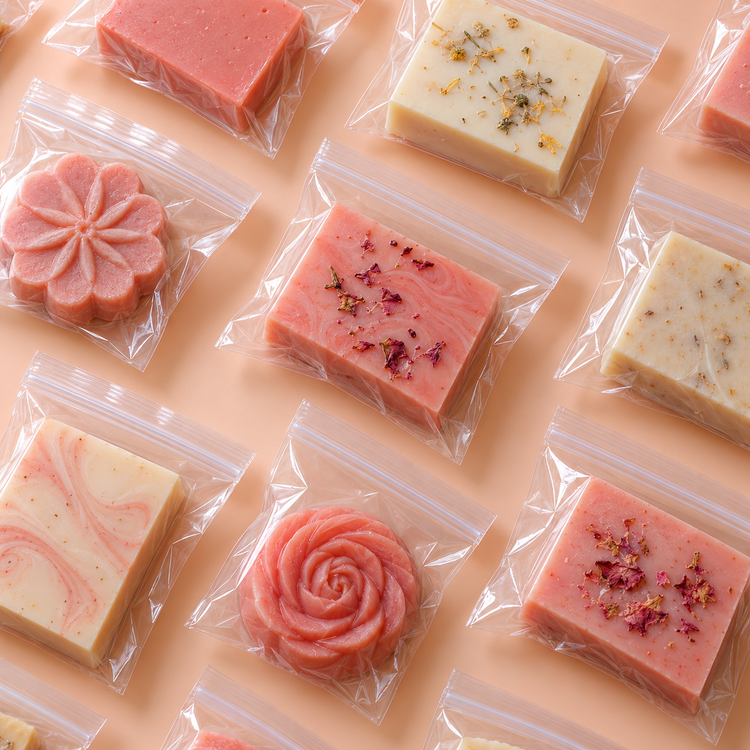
Clear bags put the soap on display. Colored bags can give a collection a coordinated appearance or distinguish different assortments. But which works best?
Clear bags are usually the most practical choice when the soap’s appearance helps communicate its appeal. Colored bags work well for identifying collections, organizing giveaways, and presenting individually wrapped sampler sets.
The soap’s formulation and packaging requirements should guide the material choice first. Color is a presentation decision made after confirming that the package suits the product.
Clear vs. Colored Soap Sample Bags
| Consideration | Clear Bags | Colored Bags |
|---|---|---|
| Showing swirls and layers | Usually easiest | Depends on tint, opacity, and printing |
| Showing the sample’s size | Clearly visible | May require opening |
| Coordinating collections | Works with labels and cards | Adds a visual collection cue |
| Identifying different assortments | Requires readable labels | Color can support written identification |
| Displaying pale soaps | Visible, though contrast may be subtle | Tint can change their apparent color |
| Mixed-fragrance sets | Requires compatibility testing | Requires the same testing |
| Moisture and fragrance performance | Depends on material and construction | Depends on material and construction |
| Direct-contact suitability | Requires assessment | Requires assessment |
Browse the Apple Zip Bags collection after establishing whether the bag will directly contact the soap or serve as outer packaging.
Why Clear Bags Work Well for Soap Samples
Customers Can See the Product
Clear packaging lets recipients inspect the sample without removing it.
This is useful for soaps with:
-
Swirls.
-
Contrasting layers.
-
Decorative shapes.
-
Textured surfaces.
-
Embedded designs.
-
Distinctive colors.
A visible sample can communicate details that a fragrance name alone cannot.
The Sample Size Is Easy to Understand
Clear bags show the actual portion.
This can be helpful when several sample formats appear in the same display or when the customer wants to understand what is included in a discovery set.
Keep labels positioned so they do not cover the entire product.
One Bag Style Can Support Several Products
A consistent clear format can work across a range of formulations and fragrances, provided each product passes the relevant compatibility assessment.
You can distinguish the products through labels rather than maintaining a different bag color for every scent.
This may simplify stock management when several samples share the same dimensions.
When Colored Bags Work Better
Colored packaging is most useful when the color communicates something specific.
Separating Collections
A business might assign one outer bag color to a seasonal assortment and another to its regular discovery set.
For example:
| Outer Bag Color | Example Collection |
|---|---|
| Pale green | Botanical assortment |
| Pink | Floral collection |
| Blue | Coastal-inspired set |
| Gold | Gift sampler |
| Clear | Individual product samples |
These are presentation examples. Use written product names alongside color so the contents remain identifiable.
Organizing Events and Giveaways
Different outer bag colors can help staff distinguish preassembled sets.
This may be useful when an event offers several assortments or when different groups receive different samples.
Include a clear set name or packing reference. Bag color should support the identification system rather than replace it.
Creating a Coordinated Gift Presentation
Colored outer bags can bring together individually wrapped samples, a product card, and other appropriately packaged items.
The outer packaging establishes the collection’s appearance while each sample retains its own identity.
For smaller purchasing quantities to evaluate, review the 100-pack small-size bag options. Confirm the selected dimensions, style, and pack count.
Understand Tinted, Opaque, and Printed Bags
“Colored packaging” covers several different styles.
Transparent Tinted Bags
Tinted film lets you see the product while adding color to the presentation.
However, it can change how the soap appears. A warm tint may alter a pale blue sample, while a dark tint may obscure subtle layers.
Judge the filled package under the lighting where it will be displayed.
Opaque Bags
Opaque packaging hides the soap.
This can suit a labeled gift assortment, but it removes the product’s visible design from the presentation. Customers will rely more heavily on the label or information card.
Printed Bags
Printed designs can leave some of the sample visible.
Check the pattern against the actual soap and label. A design that looks attractive when empty may compete with a detailed swirl or make small lettering harder to read.
Compare the small bag range with design selections using a complete sample arrangement.
Choose the Material Before the Color
Neither clear nor colored appearance establishes suitability for soap.
The relevant considerations include:
-
Soap formulation.
-
Packaging material.
-
Direct-contact compatibility.
-
Primary wrapping.
-
Expected storage conditions.
-
Distribution period.
-
Closure and construction.
Cold-Process Soap
Cold-process soap should complete its appropriate curing process before final packaging.
Bramble Berry’s explanation of soap curing describes the water loss and changes associated with this stage.
Do not use a sealed bag as a substitute for curing.
Melt-and-Pour Soap
Melt-and-pour soap may need suitable primary wrapping to address its moisture sensitivity.
Soap Queen’s guide to explaining and preventing glycerin dew discusses how glycerin can attract moisture from the surrounding air.
A colored bag does not eliminate that behavior, and clear film does not establish an adequate moisture barrier.
Follow the base supplier’s packaging recommendations.
Consider Individually Wrapped Samples Inside an Outer Bag
An outer resealable bag can provide presentation and organization without taking over the role of the primary wrapping.
For a discovery set:
-
Prepare each soap appropriately.
-
Apply suitable primary wrapping.
-
Keep identification with each sample.
-
Group the samples with a collection card.
-
Test the complete assortment.
Wholesale Supplies Plus provides melt-and-pour packaging FAQs for makers assessing wrapping requirements.
Bramble Berry’s explanation of shrink wrapping also distinguishes approaches for different soap types.
Test Fragrances in the Complete Assortment
A zipper closure does not necessarily prevent fragrance migration.
If different scents share an outer package, test them together over a period relevant to your distribution schedule.
Inspect each sample for unexpected changes rather than assuming that separate plastic packets fully isolate the fragrances.
Use the same labels, wrapping, bags, and cards planned for the final set.
Do Colored Bags Protect Soap from Light?
Do not assume that a tint provides verified light protection.
Visible color, opacity, and tested filtration are different properties. Without relevant specifications, choose the bag for presentation and assess storage needs separately.
Soap Queen’s guidance on storing handmade bath products discusses the effects of storage conditions on handmade products.
Follow recommendations appropriate to your formulation.
Labels Should Work with the Bag
A small sample still needs clear identification.
Plan the label before finalizing the package.
Useful information may include:
-
Brand.
-
Product or fragrance name.
-
Batch reference.
-
Relevant use information.
-
Other product information appropriate to the market.
On Clear Bags
Keep enough of the soap visible to show its design.
A separate information card may provide additional space without covering the entire sample.
On Colored Bags
Check contrast carefully. A label that looks readable against an empty bag may be harder to read once the product is inside.
On Outer Assortment Bags
Name the collection, but keep individual identification with each sample. Otherwise, recipients may lose track of products after opening the set.
For presentation ideas, explore Soap Queen’s soap packaging resources.
Fit Matters More Than Color
Measure the complete wrapped sample, including its depth and any inserts.
The bag should allow comfortable insertion, closure, and removal.
Avoid:
-
Compressing raised details.
-
Forcing corners through a narrow opening.
-
Pressing soap against the zipper.
-
Folding an information card to make it fit.
-
Overcrowding an assortment.
For larger sets, compare dimensions in the large resealable bag collection.
Does Color Affect Durability?
Bag color alone does not establish strength.
Compare material, thickness, seams, closure, and dimensions.
Apple Zip Bags lists 2.5 mil products among its options. Thickness contributes to handling performance, but it does not establish formulation compatibility or barrier performance.
Test the filled package under representative conditions.
A Simple Clear-vs.-Colored Packaging Trial
Prepare a few complete samples in each style you are considering.
Check Presentation
Can someone see the soap’s design? Does the packaging change its apparent color? Is the label readable?
Check Handling
Can the sample be inserted and removed comfortably? Does the closure remain clear?
Check Product Interaction
Look for sticking, surface moisture, color transfer, film distortion, and label lifting.
Check the Assortment
If samples share a bag, assess them together rather than testing only individual packets.
Check the Distribution Period
Inspect over a realistic period before ordering in volume.
Common Mistakes to Avoid
Choosing Color Before Compatibility
Establish material suitability first.
Assuming Dark Packaging Prevents Fading
Look for relevant performance information rather than relying on appearance.
Covering the Entire Soap with a Label
Preserve visibility where it helps customers understand the product.
Using Color Without Product Names
Keep every sample individually identifiable.
Treating the Outer Bag as Primary Wrapping
Confirm the role and requirements of each packaging layer.
Buying Bulk Before Testing
Evaluate the filled package before committing to a larger quantity.
Frequently Asked Questions
Are clear or colored bags better for soap samples?
Clear bags are usually better for showing the soap. Colored bags can distinguish collections or provide a coordinated outer presentation.
Can tinted bags change how soap colors appear?
Yes. Test the filled package under representative display lighting.
Can soap touch either type directly?
Direct-contact suitability depends on the formulation and specific packaging material. Assess and test the actual combination.
Are colored bags better at retaining fragrance?
Color does not establish fragrance-barrier performance. Check relevant specifications and test the formulation.
Do melt-and-pour samples need separate wrapping?
Follow the soap-base supplier’s recommendations. General-purpose zipper bags should not automatically replace suitable primary wrapping.
What works best for discovery sets?
Individually identified samples in suitable primary wrapping, grouped inside a comfortably sized outer package, can provide a practical arrangement.
Should I use a different color for every fragrance?
Only if it helps the system. A consistent bag style with clear labels may be easier to manage.
Let the Soap and Collection Guide the Presentation
Choose clear bags when the sample’s appearance helps communicate its appeal. Use colored or printed outer packaging when it makes a collection easier to recognize.
Confirm fit and material suitability, keep every sample identifiable, and test the complete package. For product-specific sizing and material questions, contact Apple Zip Bags with your intended application and sample dimensions.