
Bulk Bags for Diamond Painting Pieces: When to Buy 100 vs. 1,000
Posted by AppleZipBags Team on Oct 24th 2026
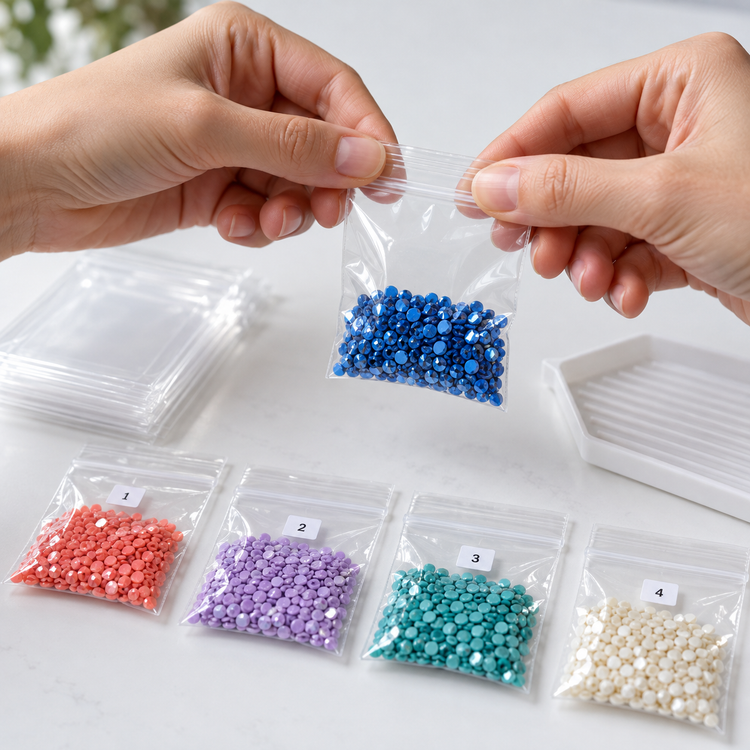
A new diamond painting project can introduce dozens of colors, each needing its own identified storage. Add leftover drills from finished canvases, and a small supply of resealable bags can disappear quickly.
But a larger pack is only useful when the bags fit your materials and your storage routine.
Buy 100 bags when you are testing a size, organizing a few projects, or storing occasional leftovers. Consider 1,000 bags when you have a proven format and enough recurring demand to use the larger supply.
The decision depends on how many separately identified portions you package—not simply how many canvases you own.
This guide explains how to estimate quantities, compare costs, and choose packaging that remains convenient throughout your diamond painting routine.
Buying 100 vs. 1,000 Drill Bags: Quick Comparison
| Consideration | 100 Bags | 1,000 Bags |
|---|---|---|
| Testing dimensions | Practical starting quantity | Better after a successful trial |
| A few personal projects | Often sufficient | May leave a substantial surplus |
| Extensive leftover collection | Depends on the number of portions | Can suit established storage needs |
| Recurring kit preparation | Requires more frequent replenishment | Supports consistent production |
| Changing storage systems | Easier to adjust | Greater commitment to one format |
| Shared purchasing | Suitable for limited group demand | Useful when members agree on specifications |
| Cost comparison | Check the delivered total | May offer a lower unit cost |
| Storage space | Smaller supply to accommodate | Needs a designated location |
Start by counting your requirements, then compare the formats in the Apple Zip Bags collection.
Count Separately Identified Portions
One drill color does not always equal one bag.
A small accent color may fit comfortably in one packet. A large background supply may need several. Meanwhile, original packets that remain suitable may not need replacing at all.
Count:
-
Colors requiring new packaging.
-
Additional packets for larger portions.
-
Leftovers needing separate identification.
-
Outer bags used to group projects.
Example: Three Projects
Suppose you are organizing these canvases:
| Project | Colors Needing One Packet Each | Additional Packets for Larger Portions | Small Bags Needed |
|---|---|---|---|
| Floral design | 28 | 3 | 31 |
| Landscape | 35 | 5 | 40 |
| Small ornament set | 18 | 1 | 19 |
| Total | 81 | 9 | 90 |
A 100-pack would cover the illustrated requirement with ten bags remaining.
A 1,000-pack would provide a much larger reserve. Whether that reserve is useful depends on your future projects and purchasing costs.
When Buying 100 Bags Makes Sense
You Are Testing a New Size
A smaller purchase lets you check the complete storage routine before committing to a larger quantity.
Fill a sample with a realistic portion and test whether you can:
-
Open it comfortably.
-
Pour drills into your tray.
-
Return unused pieces.
-
Keep the zipper clear.
-
Read the label.
-
Fit the packet inside your organizer.
Dimensions alone cannot establish how convenient the bag will be during a working session.
You Are Organizing a Limited Number of Canvases
A few projects may require fewer bags than expected, particularly when some original packaging remains usable.
Count the packets you actually intend to replace. There is little benefit in transferring every supply simply to make the packaging identical.
Diamond Art Club’s diamond painting storage tips discuss organizing colors and keeping their references connected to the project.
Your Storage Arrangement Is Changing
You may still be deciding between bags, containers, or a combined system.
A smaller purchase gives you room to experiment with label placement, organizer layout, and packet sizes.
You Need Several Formats
Small accent portions and larger reserve quantities may work better in different bag sizes.
Buying smaller quantities across a few useful formats can be more practical than purchasing 1,000 of a single untested size.
Review the 100-pack small-size bag options and confirm the selected variant’s dimensions and quantity.
When Buying 1,000 Bags Makes Sense
You Regularly Organize New Projects
Frequent diamond painters may use a consistent packet format across many canvases.
A larger supply can reduce reordering when your usage is established and the bags already work well.
You Maintain a Large Leftover Collection
An extensive reserve collection can require many separately identified packets.
Count the actual portions before ordering. Keep different shapes, finishes, suppliers, and uncertain matches separate.
DiamondPainting.com’s guide to organizing diamond drills discusses labeled bags and compartmental storage approaches.
You Prepare Kits Repeatedly
Businesses or activity organizers may have predictable requirements.
If the same format is used for each color portion, you can calculate demand from the number of kits and packets per kit.
A Group Can Share the Purchase
A shared order can make a larger pack practical without leaving one person responsible for the entire supply.
For example, ten hobbyists needing 100 bags each would use 1,000 bags collectively.
Agree on size, style, pack count, allocation, and cost before ordering.
For established requirements, compare the 1,000-pack small bag range.
Calculate Demand by Project
Use:
Small bags needed = separately identified portions requiring new packaging
For repeat kit preparation, use:
Monthly demand = kits prepared per month × bags of that size per kit
If you prepare 12 kits monthly and each uses 25 small packets:
12 × 25 = 300 small bags per month
At that usage:
-
100 bags cover approximately one-third of a month.
-
1,000 bags cover approximately 3.3 months.
Calculate outer project bags separately.
Estimate How Long Each Pack Will Last
| Average New Bags Used per Month | 100 Bags Last Approximately | 1,000 Bags Last Approximately |
|---|---|---|
| 10 | 10 months | 100 months |
| 25 | 4 months | 40 months |
| 50 | 2 months | 20 months |
| 100 | 1 month | 10 months |
| 250 | 0.4 months | 4 months |
These examples assume steady usage.
Count new bags consumed, rather than every opening of a reusable packet. If most of your supplies stay in existing containers, your requirement for new bags may be modest.
Compare Delivered Cost per Bag
Use the complete purchase cost:
Delivered cost per bag = total purchase cost ÷ bags received
Include applicable shipping, taxes, and discounts.
Hypothetical Cost Comparison
The following figures illustrate the calculation and are not Apple Zip Bags prices.
| Option | Delivered Cost | Quantity | Cost per Bag |
|---|---|---|---|
| Smaller pack | $9 | 100 | $0.09 |
| Larger pack | $35 | 1,000 | $0.035 |
The larger pack has the lower unit cost in this example. However, someone needing only 80 bags would spend less immediately on the smaller pack.
If you expect to buy several smaller packs, compare their combined cost against the larger option.
Compare Equivalent Products
Check:
-
Usable dimensions.
-
Material.
-
Film thickness.
-
Closure.
-
Printing or tint.
-
Pack quantity.
A lower price is less useful when the packet makes transfers awkward or hides essential labels.
Confirm Fit Before Buying in Bulk
Measure and test a filled packet.
Leave enough empty space below the zipper for comfortable handling. Keep drills out of the sealing area.
Try pouring into your usual tray and returning the pieces. If that process is difficult, adjust the size before purchasing more.
Account for Larger Portions
A large color supply may be easier to handle in two matching packets than one crowded bag.
Label both consistently, adding “1 of 2” and “2 of 2” where helpful.
Measure Project Groups Separately
An outer bag must accommodate the combined bulk of all inner packets.
Compare dimensions in the large resealable bag collection when grouping supplies by canvas.
Preserve Identification During Every Transfer
Prepare labels before opening original packets.
Useful information includes:
-
Supplier or kit brand.
-
Project name.
-
Supplied color code.
-
Canvas symbol, where useful.
-
Round or square shape.
-
Special finish.
A canvas symbol belongs to a particular project legend. Keep the supplied reference and project identity alongside it.
Do not combine leftovers based only on similar appearance. Confirm compatibility and keep uncertain matches separate.
Choose Bags, Containers, or Both
A bulk purchase should support your routine rather than require you to change a system that already works.
You might use:
-
Containers for active-project colors.
-
Bags for reserves.
-
Small packets for leftovers.
-
Larger outer bags for complete project groups.
For examples of structured alternatives, compare ARTDOT’s diamond painting storage containers.
Diamond Art Club’s storage organizers and containers provide another reference when assessing your preferred arrangement.
Label working containers and reserve bags consistently when they contain the same supply.
Consider Handling Alongside Thickness
Apple Zip Bags lists 2.5 mil options among its products. Thickness is one specification to assess with material, construction, closure, and size.
Test the actual fill rather than selecting by thickness alone.
Keep pointed tools appropriately protected. A tool stored with the project should not have an exposed point pressing against drill packets.
Examples of trays and tools in Diamond Art Club’s accessories collection can help you assess the space your complete setup requires.
Store Unused Bags by Size and Style
Keep unused packaging clean and separated.
Label each supply so similar dimensions do not become mixed. A smaller working quantity near the packing area can make stock easier to monitor.
Store filled drill packets in a supportive organizer with labels accessible. Avoid compressing the packets beneath heavy supplies.
Set a Reorder Point for Regular Use
Choose a stock level that allows time for replenishment.
Use:
Reorder point = expected use during replenishment time + a practical reserve
For example, if you use 80 bags weekly and plan around two weeks for replenishment, expected demand is 160 bags. A reserve of 40 gives a reorder point of 200.
Adjust the figures to your actual workload and ordering conditions.
Keep Small Parts Securely Stored
Close packets after handling and check for spilled drills.
Keep small components and loose packaging away from young children and animals.
The U.S. Consumer Product Safety Commission’s small-parts guidance provides information relevant to small parts in children’s products.
Common Bulk-Purchasing Mistakes
Buying Before Testing
Try pouring, refilling, labeling, and storage first.
Counting Colors Without Considering Volume
Large portions may need several packets.
Replacing Suitable Packaging Unnecessarily
Assess the bags and containers you already have.
Buying Equal Quantities of Every Size
Inner packets and outer project bags have different usage rates.
Ignoring Label Visibility
Check a filled sample, especially with printed designs.
Focusing Only on Unit Price
Consider total spending, fit, storage, and likely use.
Frequently Asked Questions
Should I buy 100 or 1,000 bags for diamond painting pieces?
Choose 100 for testing or limited projects. Consider 1,000 when the format is proven and recurring demand makes the larger supply useful.
How many bags does one canvas need?
Count the separately identified portions that require packaging. Large color supplies may need multiple bags.
Are larger packs always better value?
They may offer a lower unit cost, but compare equivalent products and delivered totals. Unused or unsuitable packaging can reduce the benefit.
Can a diamond painting group share a bulk pack?
Yes, provided everyone agrees on specifications, quantities, and cost allocation.
Should leftovers with the same code share one bag?
Confirm supplier, shape, finish, appearance, and fit first. Keep uncertain matches separate.
Can I reuse existing bags?
Reuse intact, clean bags when they remain suitable and their contents can be identified accurately. Replace damaged closures or seams.
When should I reorder?
Reorder when stock reaches expected use during replenishment plus an appropriate reserve.
Purchase Around Proven Fit and Actual Demand
A smaller pack gives you flexibility while testing. A larger pack supports established formats and repeat use.
Count the portions you need to package, calculate each size separately, and compare delivered costs. For product-specific help, contact Apple Zip Bags with your intended contents and expected quantity.