
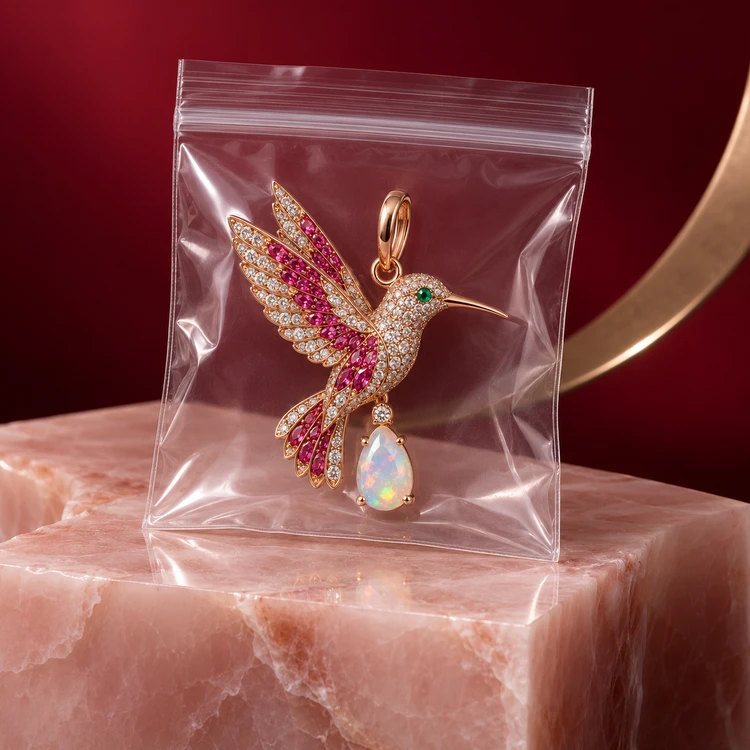
Best Small Resealable Bags for Jewelry
Posted by AppleZipBags Team on Sep 7th 2026
The best small resealable bags for jewelry should do more than simply hold a ring, pair of earrings, charm, or pendant.
For jewelry businesses, collectors, makers, resellers, and ecommerce sellers, a useful bag should help with:
-
Product separation
-
Inventory organization
-
Visual identification
-
SKU labeling
-
Order picking
-
Storage
-
Customer presentation
-
Repeated opening and closing
For many everyday jewelry applications, a small resealable bag around 2–2.5 mil provides a practical balance of flexibility, compactness, and durability.
Apple Zip Bags currently offers a range of small resealable jewelry bags made from 2.5 mil material and available in clear and colored configurations for small-product storage and packaging.
The best bag, however, is not determined by thickness alone.
You also need to choose the right:
size + film thickness + color + quantity + labeling system
for the jewelry being packaged.
Quick Answer: What Are the Best Small Resealable Bags for Jewelry?
For many jewelry businesses, a strong general-purpose choice is:
small clear 2.5 mil resealable bags in dimensions matched closely to the jewelry or jewelry card.
A practical starting point looks like this:
| Jewelry Type | Bag Approach | Practical Thickness |
|---|---|---|
| Rings | Extra-small resealable bag | 2–2.5 mil |
| Stud earrings | Extra-small or small | 2–2.5 mil |
| Hoop earrings | Small | 2.5 mil |
| Drop earrings | Small to medium | 2.5 mil |
| Pendants | Small | 2–2.5 mil |
| Charms | Extra-small | 2–2.5 mil |
| Beads | Extra-small to small | 2–2.5 mil |
| Findings | Extra-small | 2–2.5 mil |
| Bracelets | Small to medium | 2.5 mil |
| Necklaces | Small to medium | 2.5 mil |
| Watches | Medium or larger | 2.5 mil or appropriate alternative |
For most sellers:
clear bags are the best default.
They make it easier to identify the jewelry without opening every package.
Colored bags can be useful when color coding supports inventory management or branding.
Why Small Resealable Bags Work Well for Jewelry
Jewelry inventory often consists of hundreds of physically small products.
Those products may differ only slightly by:
-
Size
-
Stone
-
Metal
-
Finish
-
Color
-
Style
Without individual packaging, pieces can become:
-
Mixed together
-
Tangled
-
Difficult to label
-
Harder to count
-
Harder to pick accurately
A resealable bag gives each item or SKU:
its own defined inventory package.
That can be particularly valuable for ecommerce sellers processing many orders.
What Does Resealable Mean?
A resealable bag has a closure designed to be opened and closed repeatedly.
For jewelry businesses, this is useful because products may move through several stages before a sale:
-
Receiving
-
Inventory
-
Photography
-
Quality control
-
Order picking
-
Packing
-
Customer delivery
A resealable closure allows employees to access the jewelry without destroying the package each time.
Why Clear Bags Are Usually the Best Default
Clear jewelry bags allow staff to immediately see:
-
Product design
-
Stone color
-
Metal tone
-
Shape
-
Finish
-
Quantity
That means an employee can compare:
the physical product + the SKU label
before packing an order.
This is particularly valuable when several jewelry styles have similar names or product codes.
Clear Bags for Ecommerce Inventory
Imagine an ecommerce jewelry business with 300 ring SKUs.
A clear bag allows the picker to:
-
Read the SKU.
-
Inspect the ring.
-
Confirm the stone or finish.
-
Pack the order.
The package becomes part of the verification process.
Clear Bags for Photography
Clear packaging also helps when inventory needs to move repeatedly between:
-
Warehouse
-
Photography
-
Content creation
-
Product listing teams
Staff can locate the correct product visually before opening the bag.
When Colored Jewelry Bags Make Sense
Colored bags can add another layer of organization.
For example:
-
Pink = earrings
-
Green = rings
-
Blue = necklaces
-
Yellow = bracelets
Or color might represent:
-
Collection
-
Metal
-
Repair status
-
Department
-
Inventory status
Apple Zip Bags' current 1,000-pack small 2.5 mil jewelry bags include clear and multiple color options intended to help with identification and sorting.
Do Not Use Color Instead of a SKU
Color should communicate a broad category.
The SKU should identify the exact item.
For example:
Blue bag = necklaces
but:
NK-GD-184 = exact gold necklace SKU
The combination is much stronger than either system alone.
What Thickness Is Best for Small Jewelry Bags?
For many everyday jewelry applications, approximately 2–2.5 mil is a practical range.
A mil equals one-thousandth of an inch. Uline describes 2 mil as a common general-purpose thickness, with heavier films increasingly suited to more demanding physical applications. Uline Bag Guide
2 Mil Jewelry Bags
2 mil can work well for:
-
Lightweight jewelry
-
Flat pendants
-
Tiny components
-
Temporary storage
-
Lightweight charms
It can be sufficient when the item has:
-
Little weight
-
No sharp points
-
Limited handling
2.5 Mil Jewelry Bags
For many sellers, 2.5 mil is a strong all-around middle ground.
It provides slightly more physical substance while remaining:
-
Flexible
-
Compact
-
Easy to store
-
Easy to handle
Apple Zip Bags currently uses 2.5 mil material across its small jewelry-bag range.
4 Mil Jewelry Bags
4 mil may make more sense for:
-
Heavy components
-
Sharper products
-
Repeated handling
-
Multiple metal pieces in one bag
-
Larger findings
But thicker is not automatically better.
A lightweight pair of stud earrings generally does not require the same physical packaging strength as a bag containing dozens of heavy metal components.
Best Bag Size for Rings
Rings require very little space.
For loose rings, choose:
a compact bag with just enough clearance for easy insertion and closure.
Avoid placing a tiny ring inside a dramatically oversized bag.
That creates:
-
More product movement
-
More storage bulk
-
Less polished presentation
Rings Mounted on Cards
If a ring is attached to a:
-
Card
-
Tag
-
Foam insert
measure the entire assembly.
The bag is being sized to:
the finished package—not just the ring.
Best Small Bags for Stud Earrings
Stud earrings are among the smallest jewelry products.
A small resealable bag can contain:
-
Earrings
-
Earring backs
-
Small display card
without unnecessary space.
If you mount earrings on cards, standardizing card dimensions can make bag purchasing much easier.
Best Bags for Hoop Earrings
Hoops require more width than studs.
Measure:
the complete outside diameter.
Do not squeeze a large hoop into a smaller bag simply because the wire itself is thin.
The bag should allow the hoops to sit naturally.
Best Bags for Drop Earrings
Drop earrings require more vertical clearance.
Measure from:
the top of the earring card or hook to the lowest point of the jewelry.
Leave enough room below and above the earrings so they are not pressed against the bag closure.
Best Bags for Pendants
Small pendants work especially well with compact clear bags.
Visibility lets staff quickly identify:
-
Shape
-
Stone
-
Finish
-
Design
If the pendant comes with a chain, size for the complete chain-and-pendant configuration rather than the pendant alone.
Best Bags for Charms
Charms are ideal for small resealable bags because they are:
-
Small
-
Easy to lose
-
Often sold in multiple designs
-
Frequently handled in inventory
For identical charms sold in quantities, one bag may contain:
-
5
-
10
-
25
-
50
pieces.
Measure the complete intended quantity before selecting the bag.
Best Bags for Jewelry Beads
Bead packaging depends heavily on:
-
Bead diameter
-
Quantity
-
Material
-
Weight
Ten small seed beads require very little packaging.
Fifty gemstone beads require significantly more volume and may create much greater weight.
Choose according to:
the full packaged quantity.
Best Bags for Jewelry Findings
Small resealable bags are particularly useful for:
-
Jump rings
-
Clasps
-
Crimps
-
Ear wires
-
Earring backs
-
Connectors
-
Head pins
-
Eye pins
These products can look nearly identical.
The bag gives the seller somewhere to attach a precise label.
For example:
SKU: JR-SS-06
Item: Jump Ring
Diameter: 6mm
Material: Sterling Silver
Qty: 25
Best Bags for Necklaces
Necklaces require more careful sizing.
A bag that is too large can allow:
-
Chain movement
-
Tangling
A bag that is too small can force:
-
Tight folds
-
Compression
Arrange the necklace the way it will actually be stored or shipped.
Then measure:
that configuration.
Best Bags for Bracelets
Bracelets vary considerably.
A fine chain bracelet can pack very compactly.
A:
-
Bangle
-
Cuff
-
Heavy bead bracelet
requires more room.
Do not assume every bracelet belongs in the same bag simply because all of them are worn on the wrist.
Best Bags for Watches
Watches are considerably bulkier than most jewelry.
Consider:
-
Watch face
-
Case
-
Strap
-
Buckle
-
Overall thickness
A watch may require one of Apple Zip Bags' larger resealable bag sizes rather than the smallest jewelry-bag format.
For valuable watches, the bag should generally be considered an inventory or inner-packaging layer rather than complete protective storage.
How to Choose the Right Small Jewelry Bag Size
Start by measuring:
-
Width
-
Length
-
Thickness
-
Weight
For irregular jewelry, measure:
the widest and longest points.
Apple Zip Bags' packaging bag size guide also recommends considering product dimensions, weight, closure requirements, and real-world testing before ordering large quantities.
Do Not Choose Exact Product Dimensions
Suppose an earring card measures:
2 × 3 inches.
A bag with exactly the same usable dimensions may be too tight.
You still need room for:
-
Product thickness
-
Easy insertion
-
Closure
-
Manufacturing variation
Choose a comfortable fit rather than forcing the product into the smallest theoretically possible package.
Leave Space for the Zip Closure
Products should remain below the closure.
Beads, charms, and findings sitting directly in the zipper track can interfere with sealing.
A correctly sized bag should:
close easily without repositioning the product every time.
Why Oversized Jewelry Bags Are a Problem
A very large bag may technically work, but it creates unnecessary disadvantages.
These include:
-
More film
-
More movement
-
More storage space
-
Poorer presentation
-
Larger packaging footprint
For businesses storing thousands of packaged SKUs, even small amounts of excess space can compound across inventory.
Why Bags That Are Too Small Are Worse
Undersized bags can:
-
Stretch
-
Bulge
-
Fail to close
-
Bend jewelry
-
Stress the plastic
-
Slow packing
Employees should not have to force jewelry into its packaging.
If they do:
move up a size.
Small Bags and Jewelry Cards
Jewelry cards can make packaging much easier to standardize.
Common applications include:
-
Earrings
-
Pendants
-
Necklaces
-
Pins
-
Bracelets
If most of your cards use a limited number of dimensions, you can select bags around:
the card system rather than every individual jewelry design.
That reduces packaging complexity.
Small Bags and SKU Labels
A jewelry bag should have enough usable space for an inventory label.
Useful information may include:
-
SKU
-
Product name
-
Material
-
Size
-
Color
-
Quantity
-
Bin location
Do not choose a bag so small that the label:
covers the entire product.
Ideally, employees can see both:
label + jewelry.
Small Bags and Barcode Labels
Growing jewelry businesses may attach:
-
Barcode
-
QR code
-
SKU sticker
to the outer bag.
This lets employees scan products without placing permanent adhesive directly onto:
-
Jewelry
-
Display cards
-
Specialty boxes
A clear bag can become the inventory-information carrier.
Jewelry Material Descriptions Should Stay Accurate
Labels and packaging may identify products as:
-
Sterling silver
-
Gold plated
-
Lab-grown
-
Gemstone
-
Pearl
-
Platinum
The FTC Jewelry Guides emphasize truthful representations of characteristics including type, quality, quantity, metallic content, size, weight, treatment, and related product attributes. FTC Jewelry Guides
Packaging labels should therefore remain consistent with:
the actual product and ecommerce listing.
Can Small Resealable Bags Prevent Jewelry Scratches?
Individual packaging can help reduce direct contact between pieces.
That matters because jewelry stored loose together may rub or scratch.
GIA recommends keeping jewelry separated and notes that boxes, pouches, padded compartments, and suitable specialized storage can help prevent damage. GIA jewelry care and storage guidance
However:
a standard resealable bag should not automatically be treated as specialized scratch-proof storage.
For particularly delicate jewelry, consider:
-
Soft pouch
-
Padding
-
Box
-
Protective card
in addition to the bag.
Are Small Jewelry Bags Anti-Tarnish?
Not automatically.
A standard clear or colored resealable bag should not be described as:
-
Anti-tarnish
-
Archival
-
Hermetic
unless the actual product specification supports that claim.
GIA specifically notes specialized anti-tarnish storage for sterling silver.
Standard jewelry bags and specialized anti-tarnish packaging solve different problems.
Are Small Resealable Bags Waterproof?
Do not assume that a zip closure makes every bag:
waterproof.
A resealable bag may help contain and organize products, but specialized water resistance or waterproof performance should only be claimed when specifically supported by the product specifications.
Clear vs. Colored Small Jewelry Bags
For most jewelry sellers:
clear is the strongest general-purpose choice.
Clear bags are particularly useful for:
-
Inventory
-
Picking
-
Photography
-
Quality control
-
Ecommerce fulfillment
Colored bags make sense when color communicates something useful.
Example Color System
Pink = Earrings
Green = Rings
Blue = Necklaces
Yellow = Bracelets
Keep color categories simple.
A system requiring employees to memorize 15 nearly identical colors may reduce efficiency instead of improving it.
Clear Bags With Colored Labels
A highly practical alternative is:
clear bags + colored labels.
For example:
Clear bag + pink label = earrings
Clear bag + blue label = necklaces
Clear bag + green label = rings
This preserves full product visibility while reducing how many bag colors the business needs to stock.
Plain vs. Branded Small Jewelry Bags
For new or growing businesses, plain bags provide flexibility.
They work across:
-
Collections
-
Seasons
-
Product launches
-
Inventory changes
Branding can then be added using:
-
Stickers
-
Cards
-
Labels
-
Inserts
Apple Zip Bags' comparison of custom printed jewelry bags vs. plain bags explains how branding goals, volume, budget, and customer experience can influence that decision.
When Plain Bags Are Better
Plain bags make particular sense for:
-
Startups
-
Internal inventory
-
Wholesale sellers
-
Changing product catalogs
-
Businesses testing packaging
When Branded Packaging Is Better
Custom branding becomes more attractive when:
-
Packaging sizes are stable
-
Order volume is predictable
-
Brand recognition matters
-
Customer presentation is a priority
100-Pack vs. 1,000-Pack Small Jewelry Bags
Pack quantity should follow:
certainty + usage.
Choose 100 Packs When
Choose a smaller pack when:
-
Testing a size
-
Trying a new color
-
Launching a new collection
-
Packaging only a few products
-
Volume is unpredictable
Apple Zip Bags currently offers 100-pack small 2.5 mil jewelry bags for lower-volume purchasing and size testing.
Choose 1,000 Packs When
Larger quantities make more sense when:
-
Size is proven
-
Bag is used daily
-
Several SKUs use the same bag
-
Monthly consumption is predictable
-
Frequent reordering becomes inefficient
A useful rule is:
test with 100; scale with 1,000.
Example: Small Jewelry Startup
Suppose a new seller has:
-
15 ring designs
-
10 earring styles
-
5 necklaces
The seller is still testing:
-
Bag dimensions
-
Labels
-
Jewelry cards
Starting with smaller packs reduces the risk of buying hundreds of unusable bags.
Once the dimensions are confirmed:
bulk purchasing becomes safer.
Example: Established Ecommerce Jewelry Store
Suppose a business ships:
500 jewelry pieces per month.
If every piece uses one small bag:
500 bags are required monthly.
A 100-pack would last:
about six days.
A 1,000-pack would last:
about two months.
For an established size:
bulk purchasing is clearly more practical.
Example: Bead and Charm Seller
Suppose an average order contains:
-
1 bag of beads
-
1 bag of charms
-
1 bag of clasps
-
1 bag of jump rings
That means:
four bags per order.
At 250 monthly orders:
250 × 4 =
1,000 bags per month.
This type of business can consume packaging much faster than the order count suggests.
Calculate Cost Per Bag
Use:
pack price ÷ bag quantity = unit cost
Example:
100 bags for $8:
$8 ÷ 100 =
8¢ per bag
1,000 bags for $20:
$20 ÷ 1,000 =
2¢ per bag
If the size is proven and all 1,000 bags will be used, the larger package offers much stronger unit economics.
Do Not Bulk Buy the Wrong Size
A low cost per bag means little if:
-
Jewelry does not fit
-
Label does not fit
-
Closure is difficult
-
Customers dislike the package
Always test real jewelry before placing a large order.
Standardize Three to Five Core Bag Sizes
Many jewelry businesses do not need:
20 nearly identical bag dimensions.
Instead, consider several standardized categories.
Extra Small
Good for:
-
Seed beads
-
Crimps
-
Earring backs
-
Tiny charms
Small
Good for:
-
Rings
-
Earrings
-
Pendants
-
Charms
Medium
Good for:
-
Bracelets
-
Necklaces
-
Larger earring cards
Large
Good for:
-
Watches
-
Jewelry sets
-
Oversized cards
The exact dimensions should reflect your real product catalog.
Why Standardizing Bag Sizes Helps
Standardization simplifies:
-
Purchasing
-
Storage
-
Employee training
-
Inventory management
-
Reordering
Instead of an employee asking:
“Which of these 17 bags should I use?”
the packing guide might simply say:
SKU RG-451 → Small bag.
Create Packaging SKUs
A growing jewelry business can assign packaging internal identifiers.
For example:
BAG-XS-CLR
Extra-small clear bag
BAG-S-CLR
Small clear bag
BAG-M-CLR
Medium clear bag
Then map each jewelry SKU to its packaging SKU.
This is especially useful when multiple employees pack orders.
Small Bags for Jewelry Inventory
A resealable bag can start working before a customer ever places an order.
When inventory arrives:
-
Inspect jewelry.
-
Assign SKU.
-
Place in bag.
-
Apply label.
-
Store in assigned location.
When the order arrives:
-
Pick bag.
-
Verify SKU.
-
Verify jewelry.
-
Add presentation packaging.
-
Ship.
The item remains organized throughout its inventory lifecycle.
Small Bags for Jewelry Repairs
Small bags can also organize repair jobs.
A label may contain:
-
Repair number
-
Customer reference
-
Jewelry description
-
Date
-
Status
Colored bags or labels might indicate:
-
Received
-
Awaiting estimate
-
Waiting for parts
-
Repairing
-
Completed
The unique repair number should remain the primary identifier.
Small Bags for Wholesale Jewelry
Wholesale customers may order dozens of:
-
Rings
-
Earrings
-
Pendants
-
Charms
Individual bags can help the buyer:
-
Count products
-
Identify SKUs
-
Organize inventory
-
Prepare merchandise for resale
For wholesale packaging, practical organization may matter more than elaborate presentation.
Small Bags for Craft Shows
Jewelry sellers attending:
-
Markets
-
Fairs
-
Craft shows
-
Trade events
can pre-package backup inventory.
Clear resealable bags make it easy to:
-
Identify products
-
Restock displays
-
Count inventory
-
Repack unsold merchandise
This can make event setup and breakdown much faster.
Small Jewelry Bags Are Usually Inner Packaging
For ecommerce orders, the small resealable bag generally serves as:
product-level packaging.
It should not automatically be treated as the entire shipping system.
FedEx's current jewelry-shipping guidance recommends cushioning jewelry, using suitable inner packaging, and placing it within sturdy outer packaging that prevents movement. FedEx jewelry shipping guide
The final packaging requirements depend on:
-
Value
-
Fragility
-
Jewelry type
-
Carrier
-
Shipping service
Cushion Jewelry Appropriately
Small bags contain products.
Cushioning handles:
-
Impact
-
Movement
-
Compression
UPS recommends using suitable cushioning and securing contents to reduce movement during shipment. UPS packaging tips
For delicate jewelry, consider:
-
Soft pouch
-
Foam
-
Tissue
-
Protective insert
-
Inner box
as appropriate.
Common Small Jewelry Bag Mistakes
Choosing One Size for Everything
A seed bead and a watch do not need the same package.
Choosing Bags Too Small
Do not force the jewelry inside.
Buying Bags Far Too Large
Oversized bags waste space and create excessive movement.
Ignoring Product Thickness
Rings, beads, bracelets, and watches require depth.
Forgetting the Jewelry Card
Measure the complete package.
Blocking the Zip Closure
Keep products below the resealable track.
Using 4 Mil When 2.5 Mil Is Sufficient
More thickness is not always necessary.
Assuming Thickness Means Anti-Tarnish
Film thickness and specialized storage chemistry are different properties.
Assuming Clear Bags Are Waterproof
Do not make unsupported protection claims.
Using Color Instead of SKUs
Color should support inventory identification, not replace it.
Covering the Product With a Huge Label
Preserve visual identification.
Buying 1,000 Bags Before Testing
Test the actual product first.
Treating the Bag as Complete Shipping Protection
Use appropriate outer packaging and cushioning.
Small Resealable Jewelry Bag Buying Checklist
Before ordering, ask:
-
What jewelry am I packaging?
-
What is its width?
-
What is its length?
-
How thick is it?
-
How much does it weigh?
-
Is it attached to a card?
-
Is there an insert?
-
How many pieces go in each bag?
-
Is the item sharp?
-
Does it have earring posts?
-
Does it need extra backing protection?
-
Is 2 mil sufficient?
-
Would 2.5 mil provide a better balance?
-
Is 4 mil genuinely necessary?
-
Does the product fit comfortably?
-
Can the zipper close easily?
-
Is there excessive empty space?
-
Do I need clear visibility?
-
Would colored packaging help?
-
Would colored labels be easier?
-
Does a SKU label fit?
-
Can I still see the jewelry?
-
Is the bag for inventory?
-
Is it customer-facing?
-
Is it only inner shipping packaging?
-
Do I need cushioning?
-
Do I need a rigid box?
-
Have I tested the bag?
-
Should I start with 100?
-
Is the size proven enough for 1,000?
-
Can several products use the same standardized size?
-
Am I maintaining too many packaging SKUs?
Frequently Asked Questions
What are the best small resealable bags for jewelry?
For many jewelry businesses, small clear resealable bags around:
2–2.5 mil
provide a practical general-purpose solution.
A 2.5 mil bag is especially versatile for:
-
Rings
-
Earrings
-
Pendants
-
Charms
-
Beads
-
Findings
Is 2.5 mil good for jewelry bags?
Yes.
For many everyday jewelry applications, 2.5 mil offers a useful combination of:
-
Flexibility
-
Compactness
-
Reusability
-
Physical durability
Is 2 mil thick enough for jewelry?
It can be for lightweight products.
Consider the:
-
Jewelry weight
-
Sharpness
-
Handling frequency
before deciding.
Do I need 4 mil bags for jewelry?
Usually not for every product.
4 mil is more appropriate when heavier or sharper items justify additional film thickness.
What size resealable bag should I use for a ring?
Use a compact bag slightly larger than the ring or its display card.
Leave room for:
-
Easy insertion
-
Closure
-
Labeling
What size bag should I use for earrings?
Measure the earrings in their actual packaged configuration.
If they are attached to a card:
measure the card + earrings.
What size bag should I use for necklaces?
Arrange the necklace the way it will be packaged and measure that configuration.
Avoid excessive space that allows unnecessary movement and tangling.
Are clear jewelry bags better?
For general inventory:
clear is usually the best default.
They make product identification and order verification easier.
Are colored jewelry bags useful?
Yes.
They can help with:
-
Category coding
-
Collections
-
Repairs
-
Inventory status
-
Branding
Should I use clear bags with colored labels?
This is often an excellent system.
You maintain full product visibility while using labels for easy category identification.
Can resealable bags protect jewelry from scratches?
Individual packaging can help reduce direct contact between separate pieces, but delicate jewelry may require additional:
-
Padding
-
Pouches
-
Boxes
depending on the material and product.
Are standard jewelry bags anti-tarnish?
Not automatically.
Use purpose-designed anti-tarnish materials when specialized tarnish protection is required.
Are resealable jewelry bags waterproof?
Do not assume so unless the specific product is explicitly designed and tested for waterproof performance.
Should each jewelry piece have its own bag?
For individually inventoried ecommerce products:
one piece or SKU per bag
can simplify picking, counting, and fulfillment.
Identical beads or findings sold as one SKU may be packaged together.
Should I buy 100 or 1,000 jewelry bags?
Choose:
100 when testing a new size or color.
Choose:
1,000 once the size is proven and usage is predictable.
How many jewelry bag sizes should I stock?
Many jewelry businesses can cover much of their product catalog with:
3–5 standardized sizes.
Are small resealable bags enough for shipping jewelry?
Usually not by themselves.
Use appropriate:
-
Cushioning
-
Presentation packaging
-
Inner boxes
-
Outer shipping packaging
depending on the jewelry.
Final Verdict: Best Small Resealable Bags for Jewelry
The best small resealable bags for jewelry combine:
correct size + appropriate thickness + easy visibility + reliable organization.
For many:
-
Rings
-
Earrings
-
Pendants
-
Charms
-
Beads
-
Findings
a small clear bag around:
2–2.5 mil
is a practical starting point.
For broad everyday jewelry use:
2.5 mil is an especially versatile middle ground.
Choose clear bags when:
-
Product visibility matters
-
Staff needs fast SKU verification
-
Jewelry varies by color or design
Use colored bags or colored labels when:
-
Categories need visual coding
-
Collections need separation
-
Workflow status matters
For size:
measure the complete packaged product—not merely the jewelry itself.
Include:
-
Jewelry card
-
Holder
-
Insert
-
Product thickness
-
Quantity
-
Closure clearance
For quantity:
test new sizes with smaller packs.
Once a dimension has proven itself across real inventory and customer orders:
move toward 1,000-pack quantities for regularly used core sizes.
And remember that small resealable bags solve primarily:
containment + organization + visibility.
They should not automatically be expected to provide:
-
Anti-tarnish protection
-
Archival storage
-
Waterproof protection
-
Impact protection
-
Complete shipping protection
When additional protection is needed, combine the bag with:
-
Jewelry card
-
Pouch
-
Cushioning
-
Box
-
Suitable outer shipping package
The best jewelry-bag system is ultimately the one that lets your business:
store it → identify it → pick it → verify it → package it
quickly and consistently while using no more packaging than the product actually needs.