
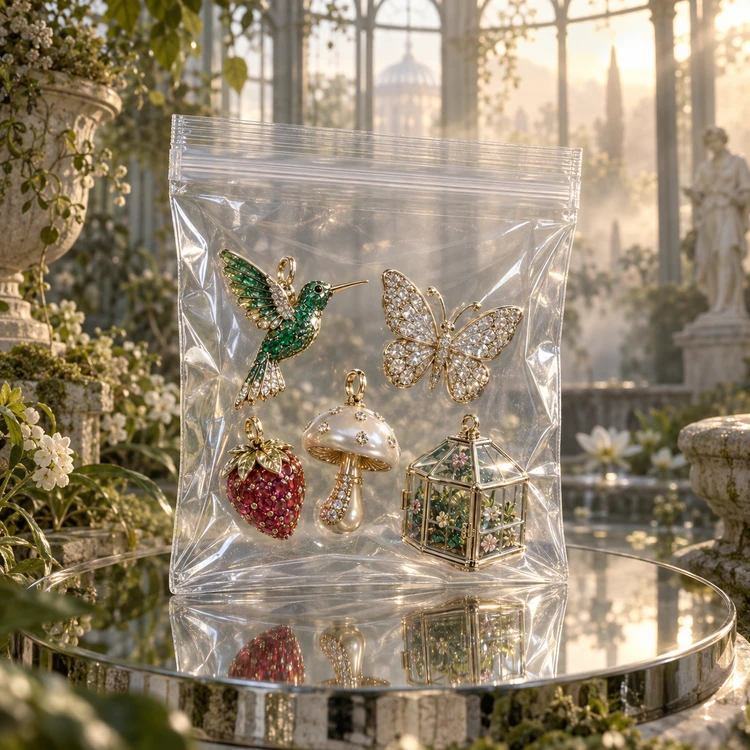
Best Small Resealable Bags for Gemstones
Posted by AppleZipBags Team on Sep 15th 2026
The best small resealable bags for gemstones should keep individual stones or gemstone parcels separated, visible, labeled and easy to organize without forcing the contents into an unnecessarily tight package.
Gemstones create different packaging challenges from ordinary jewelry components.
A gemstone may be:
-
Tiny or several centimeters across
-
Faceted or cabochon cut
-
Polished or rough
-
Flat or deeply cut
-
Lightweight or relatively dense
-
Durable or comparatively delicate
-
Sold individually or in parcels
Gem materials also differ substantially in hardness and toughness. For example, sapphire is relatively hard at 9 on the Mohs scale, while garnet commonly ranges from 6.5 to 7.5 depending on variety. Hardness itself also does not tell the entire durability story.
For gemstone sellers, lapidaries, jewelers and collectors, the strongest general packaging strategy is:
identify the gemstone → determine whether it is loose, rough or mounted → measure its complete dimensions → separate stones where appropriate → choose a comfortable bag size → label precisely → test → standardize.
Quick Answer: What Are the Best Small Bags for Gemstones?
For many ordinary inventory and sorting applications, a practical starting point is:
a small clear 2.5 mil resealable bag sized to the actual gemstone or gemstone parcel.
Clear packaging is particularly useful because gemstones are highly visual.
You can see:
-
Color
-
Shape
-
Cut
-
Approximate size
-
Parcel contents
without opening every package.
Use this framework:
| Gemstone Format | Packaging Approach | Main Concern |
|---|---|---|
| Tiny loose gemstone | Extra-small bag | Handling and labeling |
| Single faceted stone | Small individual bag | Separation |
| Cabochon | Small bag | Complete dimensions |
| Large loose stone | Small–medium bag | Depth and weight |
| Rough gemstone | Size to actual specimen | Irregular edges |
| Matching gemstone pair | Package as intentional pair | Keep set together |
| Small gemstone parcel | Size to complete parcel | Quantity and weight |
| Large gemstone parcel | Larger bag | Combined weight |
| Gemstone on card | Size to card | Complete assembly |
| Mounted gemstone jewelry | Size to entire jewelry item | Setting and protection |
Why Small Resealable Bags Work Well for Gemstones
Loose gemstones can be extremely small.
A structured packaging system can keep:
stone + SKU + gemstone information
together.
This can help:
-
Gemstone dealers
-
Jewelers
-
Lapidaries
-
Jewelry designers
-
Etsy sellers
-
Wholesale suppliers
-
Collectors
-
Repair departments
Apple Zip Bags offers jewelry bags for jewelry and other small products.
Gemstones Should Not Simply Be Tossed Together
This is one of the most important principles in gemstone organization.
Different gem materials have different physical properties.
GIA warns against simply tossing jewelry together because contact can contribute to scratches and gemstone damage. It also specifically notes that harder gemstones can scratch softer materials.
For loose gemstones:
individual separation or intentional parcel separation can therefore be valuable.
One Gemstone SKU Per Bag
For individually sold stones, a simple inventory approach is:
one SKU per bag.
That does not necessarily mean one physical stone per bag.
If one SKU represents:
a parcel of 10 matching stones,
those 10 stones can remain together.
The important distinction is:
one sellable inventory unit per package.
Best Bags for Faceted Gemstones
Faceted stones may include:
-
Round
-
Oval
-
Cushion
-
Pear
-
Emerald cut
-
Marquise
-
Princess
-
Trillion
-
Radiant
Choose the bag according to:
the complete dimensions of the stone.
Do not assume carat weight alone determines the appropriate bag size.
Two gemstones with the same weight can have different:
-
Dimensions
-
Shapes
-
Depths
Best Bags for Cabochons
Cabochons typically have:
a polished domed top
rather than a faceted crown.
They may be:
-
Round
-
Oval
-
Pear
-
Square
-
Freeform
Measure:
length × width × depth.
A large cabochon may require considerably more space than a small faceted stone.
Best Bags for Rough Gemstones
Rough gemstones require additional attention.
They may have:
-
Irregular surfaces
-
Uneven edges
-
Projections
-
Significant thickness
Do not size packaging using only:
the longest dimension.
Consider the complete three-dimensional specimen.
Best Bags for Tumbled Gemstones
Tumbled stones are generally smoother than rough specimens.
They may be packaged:
-
Individually
-
By gemstone type
-
In intentional sets
-
By weight
Size the bag according to:
the actual selling unit.
Best Bags for Gemstone Pairs
Matching gemstone pairs may be intended for:
-
Earrings
-
Side stones
-
Jewelry designs
Keeping the pair together can preserve the inventory relationship.
Label the package as:
PAIR
when appropriate.
Best Bags for Gemstone Sets
A set might contain:
3
5
10
or more stones.
Choose a bag based on:
the complete set volume and weight.
Best Bags for Gemstone Parcels
Gemstone dealers frequently work with parcels rather than individual stones.
A parcel might be organized according to:
-
Gem type
-
Cut
-
Size
-
Color
-
Grade
-
Weight
The bag should comfortably hold the entire parcel while leaving room for:
-
Closure
-
Handling
-
Labeling
Do Not Overfill Gemstone Bags
A bag may technically hold:
50 stones.
That does not mean:
50 is the ideal quantity.
Consider:
-
Combined weight
-
Stone-to-stone contact
-
Ease of counting
-
Ease of inspection
-
Bag handling
Best Bags for Amethyst
Amethyst is quartz and ranks 7 on the Mohs hardness scale. GIA notes that it has good toughness but still requires appropriate precautions against scratching and can be affected by abrupt temperature changes and prolonged intense light.
For inventory packaging:
choose a bag that allows comfortable fit and separation from harder materials where appropriate.
Best Bags for Sapphire
Sapphire belongs to the corundum family and ranks 9 on the Mohs scale. GIA describes corundum as relatively hard with excellent toughness.
Even durable stones still benefit from:
organized, labeled packaging.
Best Bags for Emeralds
Emerald requires more nuanced care.
GIA reports emerald at approximately 7.5–8 on the Mohs scale but with fair-to-good toughness, and notes that many fashioned natural emeralds contain filled fractures.
This illustrates an important point:
hardness alone does not determine how carefully a gemstone should be handled.
Best Bags for Garnets
Garnet hardness varies by type, commonly ranging from approximately:
6.5–7.5 Mohs.
GIA describes garnet toughness as fair to good.
Keep gemstone type identified on the package.
Best Bags for Zircon
Zircon is another example where careful separation matters.
GIA notes that zircon can be brittle and recommends avoiding hard rubbing against other materials.
A dedicated bag can help keep a zircon SKU separated from other loose stones during inventory organization.
Best Bags for Iolite
Iolite ranks around:
7–7.5 Mohs
but GIA notes that it has perfect cleavage in one direction and is not especially tough.
Again:
Mohs hardness is not the same thing as overall gemstone durability.
Do Not Choose Gemstone Packaging by Mohs Hardness Alone
Mohs hardness measures resistance to:
scratching.
It does not fully describe:
-
Toughness
-
Cleavage
-
Stability
-
Treatment sensitivity
That means a gemstone with a respectable Mohs number can still require careful handling.
Measure Gemstones in Three Dimensions
When selecting a bag, consider:
length × width × depth.
This is particularly important for:
-
Deeply cut gemstones
-
Cabochons
-
Rough stones
-
Large specimens
Example
Gemstone A:
10 × 8 × 4 mm
Gemstone B:
10 × 8 × 8 mm
From above:
they look identical.
But Gemstone B has:
twice the depth.
It may need more packaging room.
Do Not Choose Bag Size by Carat Weight Alone
Carat is:
a measure of weight.
It is not a direct measurement of:
length, width or depth.
Different gem materials have different densities, and different cuts distribute weight differently.
Therefore:
measure the actual stone.
Choose the Smallest Comfortable Bag
Avoid two extremes:
too tight
and:
unnecessarily oversized.
A practical bag should allow the gemstone to be:
-
Inserted
-
Positioned
-
Removed
-
Repacked
without unnecessary difficulty.
Leave Zipper Clearance
Do not place the stone directly inside:
the zipper area.
Leave enough room for:
comfortable closure and reopening.
Extra-Small Bags for Tiny Gemstones
Tiny stones may require very compact packaging.
However:
the smallest theoretical bag may be difficult to:
-
Hold
-
Open
-
Label
Packaging usability still matters.
Small Bags for Everyday Loose Gemstones
Small bags can work well for:
-
Individual faceted stones
-
Cabochons
-
Matching pairs
-
Small parcels
when appropriately sized.
Larger Bags for Bigger Gemstone Specimens
Some rough gemstones, large cabochons or gemstone sets require more room.
Apple Zip Bags offers larger bag options for products that do not comfortably fit smaller packaging.
Clear Bags Are Usually Best for Gemstones
For general gemstone inventory:
clear packaging is typically the strongest default.
Gemstones are visual.
Clear packaging makes it possible to see:
-
Color
-
Cut
-
Shape
-
Parcel contents
without opening the bag.
Clear Bags for Gemstone Color
Consider a collection containing:
-
Amethyst
-
Citrine
-
Garnet
-
Peridot
-
Aquamarine
Clear packaging allows quick visual differentiation.
Clear Bags for Cut Identification
A gemstone dealer may carry:
-
Round
-
Oval
-
Cushion
-
Pear
-
Emerald cut
-
Marquise
Clear packaging helps staff identify:
shape
before reading the label.
Colored Bags for Gemstones
Colored packaging can still serve specific organizational purposes.
For example:
Clear = available inventory
Blue = wholesale
Green = inspected
Yellow = photography required
The key is:
the color should mean something.
Do Not Let Bag Color Replace Labels
A colored bag cannot communicate:
-
Exact gemstone
-
Carat weight
-
Dimensions
-
SKU
-
Quantity
Use color only as:
a secondary organizational signal.
What Thickness Works for Gemstone Bags?
Apple Zip Bags currently lists its small jewelry bags at:
2.5 mil.
One mil equals:
0.001 inch.
Therefore:
2.5 mil = 0.0025 inch.
For many ordinary inventory applications:
2.5 mil provides a practical middle ground between:
-
Flexibility
-
Visibility
-
Compact storage
-
Everyday handling
Thickness Is Not the Same as Protection Level
Do not assume:
4 mil automatically means “safe for every gemstone.”
Or:
2.5 mil automatically means “safe for every gemstone.”
Suitability depends on:
-
Stone size
-
Weight
-
Shape
-
Quantity
-
Handling
-
Additional protection
Thickness Cannot Fix an Undersized Bag
If a large rough stone is squeezed into:
an undersized bag,
moving to thicker film does not solve the main problem.
Choose:
correct dimensions first.
Gemstone Bags Should Not Automatically Be Called Scratch-Proof
A standard plastic bag can provide:
separation and organization.
Do not automatically claim that it makes a gemstone:
scratch-proof.
Gemstone durability varies substantially, and harder materials can scratch softer ones.
Use Additional Protection When Appropriate
High-value, delicate or vulnerable gemstones may need:
-
Gem papers
-
Padded containers
-
Individual boxes
-
Foam
-
Other specialized protection
A resealable bag can still be useful for:
inventory organization,
but should not automatically replace specialized gemstone storage.
Gemstone Bag Labels Are Extremely Important
Gemstones can look similar.
A bag label may include:
-
SKU
-
Gemstone type
-
Shape
-
Dimensions
-
Weight
-
Quantity
-
Treatment information where relevant to your inventory system
Example Gemstone Label
SAP-OV-BLU-001
Sapphire
Oval
Blue
7 × 5 mm
1.12 ct
Qty: 1
Another Example
AMY-RND-06-P10
Amethyst
Round
6 mm
Parcel
Qty: 10
Use Unique SKUs
Shopify explains that SKUs can help businesses track inventory and improve picking and fulfillment accuracy.
For gemstone businesses:
unique SKUs can distinguish:
-
Gem type
-
Cut
-
Size
-
Color
-
Parcel
One Gemstone Type Per Bag
Avoid casually mixing:
different gemstone materials
in one inventory bag.
Keep them separated unless:
the mixed assortment itself is the intentional product.
Separate Different Sizes
Suppose you sell:
6 mm amethyst
8 mm amethyst
10 mm amethyst
Keep them separately identified.
Separate Different Cuts
Likewise:
Round sapphire
Oval sapphire
Pear sapphire
should remain separately identifiable.
Separate Different Colors
This is particularly important for stones sold by:
color variation.
Separate Different Lots
Gemstone dealers may also need to preserve:
lot identity.
Do not combine lots simply because:
the stones look similar.
Standardize Gemstone Bag Sizes
You do not necessarily need:
one bag dimension per gemstone SKU.
A practical system might use:
Extra small = tiny faceted stones
Small = ordinary loose stones and pairs
Medium = parcels and larger cabochons
Large = rough specimens and larger sets
Why Standardization Helps
Standardization reduces:
-
Packaging inventory
-
Storage complexity
-
Ordering complexity
-
Staff mistakes
Test Representative Gemstones
Before standardizing one bag size:
test:
-
Smallest stone
-
Largest stone
-
Deepest stone
-
Roughest specimen
-
Heaviest parcel
This provides a much better picture of:
actual suitability.
Start With 100 When Testing
Apple Zip Bags' 100-pack small 2.5 mil jewelry bags can provide a smaller quantity for testing:
-
Gemstone fit
-
Labels
-
Parcel quantities
-
Storage workflow
before committing to bulk packaging.
Move to 1,000 When the Size Is Proven
Once a bag size works across:
many gemstone SKUs,
bulk purchasing becomes more practical.
Apple Zip Bags' 1,000-pack small jewelry bags can suit businesses with established recurring packaging requirements.
100 vs. 1,000 Gemstone Bags
| Situation | Better Starting Point |
|---|---|
| New gemstone business | 100 |
| New bag size | 100 |
| Testing labels | 100 |
| New gemstone category | 100 |
| New parcel quantity | 100 |
| Low volume | 100 |
| Proven size | 1,000 |
| Many gemstone SKUs | 1,000 |
| Wholesale business | 1,000 |
| High monthly usage | 1,000 |
| Frequent reordering | 1,000 |
The strongest sequence is:
test → validate → standardize → bulk buy.
Calculate Monthly Gemstone Bag Demand
Do not simply use:
number of customer orders.
One customer order may contain:
several separately packaged gemstones.
Use:
monthly orders × average individually packaged gemstone SKUs per order = approximate monthly bag demand.
Example
Monthly orders:
100
Average separately packaged gemstone SKUs:
3
100 × 3 =
300 bags per month.
Include Gemstone Parcels
Suppose another:
100 bags
are used monthly for:
wholesale parcels.
Total monthly demand becomes:
400 bags.
Include Samples and Internal Uses
Also account for:
-
Samples
-
Photography
-
Sorting
-
Replacement stones
-
Temporary inventory organization
Keep Safety Stock
Packaging itself is inventory.
Running out of gemstone bags can interrupt:
-
Sorting
-
Receiving
-
Picking
-
Fulfillment
Maintain an appropriate buffer based on:
-
Usage
-
Supplier lead time
-
Sales variability
Plain vs. Branded Gemstone Bags
Plain bags can be flexible across:
-
Gem types
-
Colors
-
Cuts
-
Collections
Branding can be added using:
-
Labels
-
Stickers
-
Inserts
-
Cards
Apple Zip Bags' guide to custom-printed vs. plain jewelry bags discusses the tradeoffs between flexible plain packaging and customized presentation.
Gemstone Packaging for Etsy Sellers
An Etsy gemstone seller may carry:
hundreds of variations.
Clear individual packaging can help keep:
SKU + gemstone
together.
Gemstone Packaging for Jewelers
Jewelers may organize loose stones according to:
-
Customer
-
Repair
-
Custom design
-
Gemstone type
-
Project
Precise labels become particularly important.
Gemstone Packaging for Lapidaries
Lapidaries may need packaging for:
-
Rough material
-
Preforms
-
Finished cabochons
-
Faceted stones
These stages can have very different:
dimensions and handling requirements.
Gemstone Packaging for Wholesalers
Wholesale sellers may use:
large numbers of bags.
One order might contain:
50 separate gemstone parcels.
If each parcel requires:
one bag,
one customer order consumes:
50 bags.
Gemstone Packaging for Collectors
Collectors can use individual bags for:
identification and organization.
However:
specialized storage requirements should still be considered for delicate or valuable specimens.
Gemstone Packaging for Craft Businesses
Craft businesses may use gemstones for:
-
Wire wrapping
-
Jewelry making
-
Resin crafts
-
Decorative projects
Small resealable bags can organize materials by:
type, color or size.
Gemstone Bags Are Usually Inner Packaging
A small resealable bag is useful for:
-
Separation
-
Organization
-
Identification
-
Containment
But it should not automatically be considered:
complete shipping protection.
Use appropriate outer packaging based on:
-
Stone value
-
Fragility
-
Weight
-
Shipment conditions
Avoid Loose Movement During Shipping
High-value or fragile gemstones may need:
additional cushioning or a more protective inner container.
The appropriate solution depends on:
the gemstone.
Do Not Assume Resealable Means Waterproof
A standard resealable bag should not automatically be described as:
-
Waterproof
-
Hermetically sealed
-
Leakproof
unless specifically documented.
Do Not Assume Standard Bags Are Archival
Likewise:
standard plastic packaging should not automatically be described as:
-
Archival
-
Museum-grade
-
Long-term conservation storage
unless the material is specifically designed and documented for that use.
Gemstone Care Varies by Material
This is particularly important.
Gemstones should not all be treated as though they have identical:
-
Hardness
-
Toughness
-
Stability
-
Treatment sensitivity
GIA's gemstone-care guidance shows that different materials can respond differently to heat, light, chemicals and physical handling.
Therefore:
the bag is only one component of an appropriate gemstone-storage system.
Common Mistakes When Choosing Bags for Gemstones
Choosing by Carat Weight Alone
Carat measures weight.
Measure physical dimensions too.
Ignoring Gemstone Depth
Deep cuts and cabochons require more room.
Mixing Different Gemstones Together
Separate materials where appropriate.
Mixing Different SKUs
Keep inventory identifiable.
Ignoring Gemstone Hardness Differences
Harder materials can scratch softer ones.
Assuming Hardness Equals Toughness
It does not.
Overfilling Gemstone Parcels
Consider weight and handling.
Choosing the Tightest Possible Bag
Choose comfortable fit.
Forgetting Zipper Clearance
Leave working room.
Buying 1,000 Before Testing
Validate first.
Using Clear Bags Without Labels
Visual identification is not precise enough for inventory.
Using Colored Bags Instead of SKUs
Color should only supplement labels.
Assuming Plastic Is Scratch-Proof
Do not make unsupported protection claims.
Assuming Resealable Means Waterproof
Do not make unsupported sealing claims.
Assuming Standard Plastic Is Archival
Specialized conservation storage requires appropriate materials.
Treating a Small Bag as Complete Shipping Protection
Fragile or valuable stones may require additional protection.
Gemstone Bag Buying Checklist
Before ordering, ask:
-
What gemstone am I packaging?
-
Is it loose, rough or mounted?
-
Is it faceted or cabochon?
-
What is its maximum length?
-
What is its maximum width?
-
What is its depth?
-
Is the shape irregular?
-
Does it have sharp edges?
-
How much does it weigh?
-
Is it being sold individually?
-
Is it a matching pair?
-
Is it a set?
-
Is it a parcel?
-
How many stones are in the parcel?
-
What is the combined parcel weight?
-
Is there enough working room?
-
Is there zipper clearance?
-
Is the bag unnecessarily large?
-
Is the film thickness suitable?
-
Should the package be clear?
-
Would color coding provide a useful purpose?
-
Is there enough room for a label?
-
Is the SKU displayed?
-
Is gemstone type displayed?
-
Is shape displayed?
-
Are dimensions displayed?
-
Is weight displayed when needed?
-
Is quantity displayed?
-
Are different SKUs separated?
-
Are different lots separated where required?
-
Could harder stones contact softer stones?
-
Does the stone require specialized protection?
-
Can bag sizes be standardized?
-
Should 100 bags be tested first?
-
Is the size proven enough for 1,000?
-
What is monthly bag demand?
-
Is safety stock included?
-
Is appropriate shipping protection planned?
-
Have unsupported waterproof claims been avoided?
-
Have unsupported archival or scratch-proof claims been avoided?
Frequently Asked Questions
What are the best small resealable bags for gemstones?
For many everyday gemstone inventory applications:
small clear 2.5 mil resealable bags
provide a practical starting point when correctly sized to the stone or parcel.
What size bag should I use for loose gemstones?
Choose according to:
length × width × depth
rather than carat weight alone.
Can I store different gemstones in one bag?
For ordinary inventory:
separating different gemstone SKUs is usually more practical.
It also reduces unnecessary direct contact between different materials.
Can gemstones scratch each other?
Yes.
Gemstone hardness varies, and harder materials can scratch softer materials. GIA specifically cautions against storing harder and softer gems together without appropriate separation.
Is Mohs hardness the same as gemstone durability?
No.
Overall durability also involves factors such as:
-
Toughness
-
Cleavage
-
Stability
Are clear bags best for gemstones?
For many inventory applications:
yes.
They allow the gemstone's:
-
Color
-
Shape
-
Cut
-
General appearance
to remain visible.
When should I use colored gemstone bags?
Colored bags can help with:
-
Workflow coding
-
Wholesale separation
-
Inventory status
-
Departments
What thickness works for gemstone bags?
Apple Zip Bags currently lists its jewelry bags at:
2.5 mil.
This can be practical for many ordinary inventory uses.
Is 2.5 mil scratch-proof?
No such assumption should be made.
The bag can provide separation, but gemstone-specific care and additional protection may still be necessary.
Should each gemstone have its own bag?
For individually sold gemstones:
one sellable SKU per bag is a simple approach.
Intentional pairs, sets and parcels can remain together.
What should a gemstone bag label include?
Depending on the inventory:
-
SKU
-
Gem type
-
Shape
-
Dimensions
-
Weight
-
Quantity
may be useful.
Should I put carat weight on the bag?
If carat weight is important to the SKU:
yes.
But carat weight should not replace:
physical dimensions
when selecting the bag.
Can rough gemstones use resealable bags?
Yes, for many organization applications.
Measure the actual irregular specimen and consider:
-
Edges
-
Weight
-
Depth
before choosing the bag.
Should I buy 100 or 1,000 gemstone bags?
Choose:
100
when testing.
Choose:
1,000
when the size is proven and regularly consumed.
How do I calculate gemstone bag demand?
Use:
monthly orders × average separately packaged gemstone SKUs per order
and add:
-
Parcels
-
Samples
-
Internal use
-
Safety stock
Are resealable gemstone bags waterproof?
Do not assume standard resealable bags are waterproof or hermetically sealed unless specifically documented.
Are standard plastic bags archival?
Not automatically.
Specialized long-term conservation storage may require specifically designed materials.
Are gemstone bags enough for shipping?
They are generally best treated as:
inner organizational packaging.
Valuable or fragile gemstones may need:
additional cushioning and protective outer packaging.
Final Verdict: Best Small Resealable Bags for Gemstones
The best small resealable bags for gemstones should keep stones:
-
Separated
-
Visible
-
Organized
-
Properly labeled
-
Easy to handle
For many everyday inventory applications:
small clear 2.5 mil resealable bags provide a practical starting point.
But gemstone packaging should never be selected according to:
carat weight alone.
Measure:
length × width × depth.
Then consider:
-
Gemstone type
-
Shape
-
Rough vs. polished condition
-
Weight
-
Quantity
-
Durability
-
Intended storage period
For inventory:
use clear packaging when visual identification is valuable.
Then add:
precise SKU labels
to identify:
-
Gemstone
-
Cut
-
Dimensions
-
Weight
-
Quantity
where appropriate.
Separate different gemstone SKUs instead of casually mixing loose stones together, particularly because gemstone hardness and toughness vary.
For purchasing:
start with:
100 bags
when testing an unproven size.
Move to:
1,000 bags
once:
-
Fit is confirmed
-
Labels work
-
Multiple gemstone SKUs use the same size
-
Consumption is predictable
The strongest gemstone-packaging process is:
identify the gemstone → measure length, width and depth → consider hardness and toughness → determine individual stone, pair, set or parcel → choose comfortable bag size → select thickness → choose clear or colored → label precisely → test → standardize → calculate demand → buy proven sizes in bulk.
That creates a gemstone packaging system designed for:
better separation, faster identification, cleaner inventory organization and scalable fulfillment.