
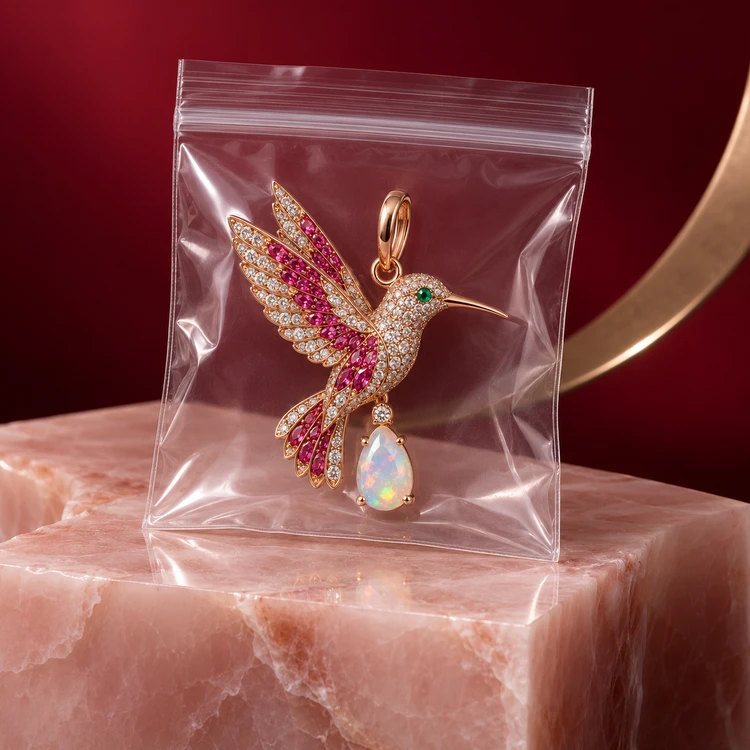
Best Small Resealable Bags for Beads, Charms and Findings
Posted by AppleZipBags Team on Sep 7th 2026
The best small resealable bags for beads, charms and findings should do three things well:
keep tiny pieces contained, keep SKUs organized and make contents easy to identify.
Jewelry makers routinely work with components that are:
-
Tiny
-
Lightweight
-
Easy to mix together
-
Difficult to replace once lost
-
Often purchased in dozens or hundreds of variations
That includes:
-
Seed beads
-
Glass beads
-
Gemstone beads
-
Pearls
-
Charms
-
Jump rings
-
Clasps
-
Crimp beads
-
Earring backs
-
Ear wires
-
Head pins
-
Eye pins
-
Spacer beads
-
Bead caps
-
Chain connectors
-
Small pendants
For many of these products, a:
small clear resealable bag made from approximately 2–2.5 mil plastic
provides an excellent balance between:
-
Visibility
-
Flexibility
-
Durability
-
Compact storage
-
Reusability
Apple Zip Bags' current small jewelry bag collection is designed around this type of small-item storage and organization, with 2.5 mil resealable bags aimed at jewelry, beads, charms and similar products.
For higher-volume jewelry makers and sellers:
1,000-count packs
can make sense once your preferred sizes are established.
For testing new dimensions:
100-count packs
may be the safer starting point.
The best bag is therefore not simply the smallest bag available.
It should match:
component size + component quantity + film thickness + workflow.
Quick Answer: What Bags Are Best for Beads and Findings?
| Item | Bag Size Strategy | Thickness to Consider | Main Priority |
|---|---|---|---|
| Seed beads | Extra small | 2–2.5 mil | Containment |
| Small gemstone beads | Extra small–small | 2.5 mil | Visibility |
| Large beads | Small–medium | 2.5 mil | Capacity |
| Charms | Extra small–small | 2–2.5 mil | Organization |
| Jump rings | Extra small | 2–2.5 mil | SKU separation |
| Lobster clasps | Extra small–small | 2–2.5 mil | Visibility |
| Crimp beads | Extra small | 2–2.5 mil | Loss prevention |
| Earring backs | Extra small | 2–2.5 mil | Containment |
| Ear wires | Small | 2.5 mil | Shape protection |
| Head pins | Small–medium | 2.5–4 mil | Point protection |
| Eye pins | Small–medium | 2.5 mil | Length |
| Chains | Small–medium | 2.5 mil | Tangle control |
| Small pendants | Small | 2.5 mil | Visibility |
| Heavy metal findings | Small–medium | 2.5–4 mil | Durability |
For everyday jewelry-making components:
2.5 mil resealable bags are a particularly useful all-purpose option.
Why Small Resealable Bags Work So Well for Jewelry Making
Jewelry makers can own hundreds of different components.
A single workbench may contain:
-
2mm gold jump rings
-
4mm gold jump rings
-
4mm silver jump rings
-
Lobster clasps
-
Toggle clasps
-
Crimps
-
Bead caps
-
Chain extenders
-
Earring hooks
-
Post backs
Without individual storage, visually similar parts can quickly become mixed together.
Small resealable bags let you:
separate one component type from another.
That improves:
-
Inventory accuracy
-
Production speed
-
Reordering
-
SKU management
-
Workspace organization
Small Bags vs. Large Containers
Plastic organizer boxes can be excellent for frequently used components.
Rio Grande, for example, sells compartment systems specifically designed to organize beads and small findings so jewelers can access them quickly while working. See Rio Grande's bead organizer example
But individual resealable bags offer advantages that organizers do not.
They can be:
-
Labeled individually
-
Removed from the main storage system
-
Given to production staff
-
Packed into orders
-
Stored inside drawers
-
Sorted by project
-
Transported easily
Many professional jewelry workspaces use:
bags inside larger organizers.
Best Bags for Seed Beads
Seed beads are one of the strongest use cases for very small resealable bags.
They are:
-
Tiny
-
Numerous
-
Easy to spill
-
Often purchased in many colors and sizes
A small clear bag allows you to identify:
-
Color
-
Finish
-
Size
-
Quantity
without opening it.
Useful labeling might include:
Color: Matte Black
Size: 11/0
SKU: SB-1142
Qty: 250
For seed beads, the priority is:
secure containment without unnecessary bag volume.
Why Oversized Bags Are Poor for Seed Beads
Suppose you store 50 tiny seed beads in a:
4 × 6 inch bag.
The bag technically works.
But most of the packaging is empty.
That creates:
-
Excess storage space
-
Harder counting
-
Less efficient drawer organization
-
More bag movement
A smaller bag keeps the beads:
concentrated and visible.
Best Bags for Gemstone Beads
Gemstone beads can be:
-
Tiny rounds
-
Large faceted beads
-
Chips
-
Nuggets
-
Pearls
-
Specialty shapes
Choose the bag based on:
the complete quantity being stored.
A small sample of 10 stones needs much less packaging than a strand of:
50–100 beads.
For many gemstone beads:
2.5 mil film
provides a useful balance because stones can be denser and heavier than lightweight plastic beads.
Best Bags for Glass Beads
Glass beads can become surprisingly heavy in bulk.
A few beads may fit comfortably inside a thin small bag.
Several hundred beads create a much greater load.
Instead of asking only:
“Will the beads fit?”
also ask:
“How much weight will the bag carry?”
For larger quantities:
-
Use stronger bags
-
Divide beads into smaller lots
-
Consider rigid containers
Best Bags for Pearls
Pearls benefit from:
-
Separation
-
Gentle handling
-
Clear identification
For pearl inventory, individual bags can help separate:
-
Sizes
-
Colors
-
Grades
-
Strands
-
Suppliers
-
SKUs
However, delicate or valuable pearls may require additional storage precautions beyond a standard plastic bag.
Do not assume a generic resealable bag is:
archival storage for every jewelry material.
Best Bags for Charms
Charms vary enormously.
They may be:
-
Tiny
-
Flat
-
Heavy
-
Three-dimensional
-
Sharp-edged
For lightweight charms:
2–2.5 mil
is often sufficient.
For larger metal charms:
2.5 mil
provides a more substantial everyday option.
Apple's current 1,000-pack small 2.5 mil jewelry bags specifically lists beads, charms and small jewelry components among their intended uses.
Best Bags for Jump Rings
Jump rings are tiny, inexpensive and extremely easy to mix up.
The problem is that:
two jump rings can look nearly identical while having different specifications.
They may differ by:
-
Diameter
-
Gauge
-
Metal
-
Finish
-
Open vs. closed design
Small resealable bags make it easy to maintain separate SKUs.
For example:
4mm / 22 gauge / gold-filled
should not be mixed with:
5mm / 20 gauge / gold-plated.
A separate labeled bag for each specification can prevent production mistakes.
Best Bags for Clasps
Clasps include:
-
Lobster clasps
-
Spring rings
-
Toggle clasps
-
Magnetic clasps
-
Box clasps
-
Hook clasps
For most:
extra-small to small resealable bags
work well.
If clasps are heavy or ornate, choose slightly larger bags so they can sit naturally without stressing the film.
Best Bags for Crimp Beads
Crimp beads and tubes are extremely small.
They can easily:
-
Spill
-
Roll away
-
Mix between sizes
-
Disappear into drawers
A tiny resealable bag is ideal.
Label:
-
Diameter
-
Metal
-
Finish
-
Supplier
-
Quantity
This converts an easily lost component into:
a clearly managed inventory SKU.
Best Bags for Earring Backs
Earring backs are another perfect small-bag item.
Separate:
-
Butterfly backs
-
Silicone backs
-
Screw backs
-
Gold backs
-
Silver backs
-
Different post sizes
into individually labeled bags.
For these tiny components:
bag size matters more than heavy-duty thickness.
Best Bags for Ear Wires
Ear wires require slightly more room because of their shape.
A bag that is too short can force them into an awkward bend.
Choose enough height for the wire to sit naturally.
For standard ear wires:
2–2.5 mil
is typically appropriate.
Best Bags for Head Pins
Head pins introduce a different concern:
pointed ends.
Even lightweight metal can concentrate pressure at one tiny point.
For head pins:
-
Use enough bag length
-
Keep sharp points oriented safely
-
Avoid overfilling
-
Consider 2.5–4 mil if puncture stress is significant
Rio Grande currently describes its 4-mil zip bags as appropriate for larger, heavier or sharply angled jewelry pieces and findings. See Rio Grande's 4-mil jewelry and findings bags
This illustrates why:
the shape of a finding matters as much as its weight.
Best Bags for Eye Pins
Eye pins tend to be less puncture-prone than sharp head pins but still require enough length.
Do not force:
2-inch pins
into a very short bag.
Choose dimensions that allow components to lie flat.
Best Bags for Bead Caps
Bead caps are:
-
Tiny
-
Lightweight
-
Often visually similar
Small clear bags work especially well because you can inspect:
-
Finish
-
Size
-
Shape
without opening the package.
For craft businesses carrying dozens of bead-cap styles, color coding can improve organization further.
Best Bags for Spacer Beads
Spacer beads are often stored in high quantities.
Small clear resealable bags let you divide inventory by:
-
Finish
-
Diameter
-
Material
-
Hole size
instead of keeping all spacer beads in one container.
This is particularly valuable when production recipes require:
specific component dimensions.
Best Bags for Chains
Chain segments need more room than tiny findings.
For chains, prioritize:
-
Enough bag length
-
Controlled arrangement
-
Tangle reduction
-
Easy identification
A bag that is too large may allow the chain to move excessively.
A bag that is too small can force:
tight bends and knots.
Best Bags for Small Pendants
Small pendants work well in clear resealable bags because they can be:
-
Identified quickly
-
Separated from chains
-
Labeled by SKU
-
Protected from direct piece-to-piece contact
For retail production, you can keep:
pendants and matching chains in separate small bags
until final assembly.
How Small Should a Bead Bag Be?
The bag should be:
slightly larger than the contents—not dramatically larger.
Apple's packaging bag size guide recommends measuring the product and allowing enough extra space for practical packing and closure while avoiding unnecessary oversizing.
For beads and findings, measure:
-
Width of the component group
-
Length
-
Approximate depth
-
Quantity
-
Total weight
Do Not Forget the Zip Area
The upper section of a resealable bag includes the closure.
Do not fill every millimeter of vertical space.
Leave room so:
the zip can close completely without components entering the seal area.
For very tiny beads, this also reduces the chance of pieces becoming trapped in the closure.
Small Bag Size Examples
Common small-item storage may look like this:
Extra-small bags
Good for:
-
Seed beads
-
Crimps
-
Earring backs
-
Tiny jump rings
-
Small charms
Small bags
Good for:
-
Clasps
-
Beads
-
Pendants
-
Ear wires
-
Small chain sections
Medium-small bags
Good for:
-
Larger bead quantities
-
Long findings
-
Chains
-
Heavy charms
-
Jewelry-making kits
The right size depends on the actual product rather than a universal chart.
Why Clear Bags Are Excellent for Beads
Clear plastic provides immediate visibility.
That means a jewelry maker can identify:
-
Color
-
Shape
-
Finish
-
Size
without opening dozens of bags.
Fire Mountain Gems currently maintains an entire category of storage bags for beads and jewelry-making supplies, including clear resealable options, reflecting how commonly this storage method is used in jewelry making.
Clear vs. Colored Bags for Findings
Clear bags maximize:
product visibility.
Colored bags maximize:
visual organization.
For example:
Clear: finished jewelry
Pink: charms
Blue: clasps
Green: jump rings
Yellow: earring components
This lets employees identify product families at a glance.
Color Coding by Metal Type
Another system:
Gold bag: gold-tone findings
Clear bag: silver-tone findings
Blue bag: stainless steel
Pink bag: rose-gold tone
The color does not replace labeling.
It provides:
another layer of visual identification.
Color Coding by Production Status
Jewelry workshops can also organize workflow.
For example:
Clear: Available inventory
Green: Ready for assembly
Yellow: Low stock
Red: Reorder required
Packaging can become:
part of your inventory system.
What Thickness Should Bead Bags Be?
For many jewelry-making components:
2–2.5 mil
provides a useful everyday range.
Thin bags offer:
-
Flexibility
-
Compactness
-
Easy handling
Slightly thicker 2.5 mil bags offer:
-
More substantial feel
-
Better everyday durability
-
Better suitability for denser beads and metal findings
Why 2.5 Mil Is Useful for Findings
Apple Zip Bags currently specifies its small jewelry bags at:
2.5 mil.
Its 100-pack small 2.5 mil jewelry bags provide a lower-quantity option for jewelry makers testing sizes or managing smaller inventories.
For everyday components, 2.5 mil gives:
more substance than very thin film without moving into heavy-duty packaging.
When Is 4 Mil Better?
Consider thicker packaging when findings are:
-
Heavy
-
Sharp
-
Repeatedly handled
-
Stored in significant quantities
Examples:
-
Heavy metal charms
-
Large clasps
-
Sharp head pins
-
Wire components
-
Dense findings
The thicker bag should solve:
a real durability requirement.
Do not choose 4 mil simply because more thickness sounds better.
2 Mil vs. 2.5 Mil vs. 4 Mil for Jewelry Findings
| Thickness | Good For | Main Benefit |
|---|---|---|
| 2 mil | Lightweight beads and findings | Flexibility |
| 2.5 mil | General beads, charms and findings | Balanced durability |
| 4 mil | Heavy or sharp components | More substantial protection |
For the majority of small jewelry-making inventory:
2.5 mil is a highly practical middle ground.
What Does “Mil” Mean?
One mil equals:
0.001 inch.
Therefore:
2 mil = 0.002 inch
2.5 mil = 0.0025 inch
4 mil = 0.004 inch
ASTM maintains standardized methods for evaluating plastic-film thickness, including ASTM D6988 for plastic-film test specimen thickness.
Mil describes thickness.
It does not automatically tell you everything about:
-
Strength
-
Seal quality
-
Material quality
-
Puncture resistance
Are Resealable Bags Better Than Self-Adhesive Bags?
Both can work.
Resealable zip bags
Good for:
-
Repeated access
-
Inventory
-
Active jewelry production
-
Reuse
Adhesive flap bags
Can work for:
-
Finished retail presentation
-
Temporary product packaging
For working jewelry inventory, zip closures often provide greater convenience because components may be accessed repeatedly.
Rio Grande also sells 1.8-mil adhesive bags specifically for inventory, repairs, findings and jewelry pieces, showing that multiple closure formats can work depending on the workflow. See Rio Grande's self-adhesive jewelry and findings bags
Why Resealability Matters for Jewelry Makers
Consider how many times a production bag may be opened.
A jeweler might:
-
Take out one clasp.
-
Reseal the bag.
-
Use another clasp.
-
Recount inventory.
-
Add new stock.
-
Reseal it again.
This makes repeated access an everyday requirement.
A dependable zip closure can therefore be more important than:
premium presentation.
100 Bags vs. 1,000 Bags
Quantity matters almost as much as size.
Choose:
100-count packs
when:
-
Testing sizes
-
Starting a jewelry business
-
Managing low-volume findings
-
Trying new organizational systems
Choose:
1,000-count packs
when:
-
Your preferred size is established
-
You package products daily
-
You manage a large component inventory
-
You sell jewelry-making supplies
-
You need bags for ecommerce fulfillment
Calculate Your Bag Usage
Suppose your jewelry workshop creates:
300 finished pieces per month.
You use:
-
1 component bag for production
-
1 bag for finished item storage
Not every bag is discarded each month because component bags are reused.
But your packaging demand could still become:
hundreds of bags per month.
At that volume, repeated 100-pack purchasing becomes inefficient.
Example: Hobby Jewelry Maker
Inventory:
-
20 bead colors
-
10 charm styles
-
10 clasp types
-
15 findings
Total categories:
55.
A 100-pack may provide enough bags to organize the entire collection with room for expansion.
Example: Etsy Jewelry Seller
Suppose you have:
250 active component SKUs.
You also package:
150 finished pieces per month.
A 1,000-pack becomes much more practical.
Example: Bead Supplier
Suppose you sell:
2,000 small bead orders per month.
If each item requires one bag:
2,000 bags per month.
At that volume, purchasing in 100-count packs creates unnecessary:
-
Reordering
-
Receiving
-
Storage administration
Bulk quantities are more appropriate.
Label Every Bag
One of the strongest reasons to use individual bags is labeling.
A good label may include:
-
SKU
-
Component name
-
Size
-
Finish
-
Material
-
Quantity
-
Supplier
Example:
JR-GF-04
4mm Jump Ring
Gold Filled
22 Gauge
Qty 100
This prevents visually similar products from being confused.
Label Bead Sizes Carefully
A bag labeled only:
“blue beads”
is often insufficient.
Consider including:
-
Diameter
-
Shape
-
Hole size
-
Finish
-
Material
Example:
6mm faceted glass / cobalt / 1mm hole
That makes future reordering significantly easier.
Use Bags Inside Drawer Systems
Small resealable bags can be stored inside:
-
Drawers
-
Bins
-
Dividers
-
Organizer boxes
-
Cases
This creates two levels of organization:
bag = individual SKU
drawer = product family
For example:
Drawer 1: Jump rings
Drawer 2: Clasps
Drawer 3: Earring findings
Drawer 4: Charms
Why Loose Compartments Can Become Difficult
Compartments are convenient until you need to:
-
Move a component
-
Send it to another workstation
-
Pack a custom order
-
Reorganize a drawer
Individual bags make inventory:
portable.
You can take the exact SKU you need without transferring loose pieces.
Small Bags for Jewelry Repair Shops
Repair shops can use resealable bags for:
-
Replacement clasps
-
Spare links
-
Watch components
-
Stones
-
Broken parts
-
Customer jewelry
Each repair bag can be labeled with:
-
Customer name
-
Job number
-
Date
-
Repair notes
For larger customer pieces, Apple also offers larger 2.5 mil resealable bag sizes for applications that need more room.
Small Bags for Jewelry Kits
Jewelry-making kits may include separate bags for:
-
Beads
-
Clasps
-
Wire
-
Charms
-
Instructions
This can make kits:
-
Easier to assemble
-
Easier to count
-
Easier for customers to use
A single kit may contain:
three to ten individual component bags.
For businesses selling kits at scale, bulk packaging quantities become important quickly.
Small Bags for Craft Shows
Craft sellers can pre-package:
-
Replacement charms
-
Small pendants
-
Loose beads
-
Findings kits
-
Repair components
Clear bags let customers see the contents without opening them.
They also make setup and teardown significantly easier.
Small Bags for Ecommerce Orders
A bead or jewelry-supply order may contain:
-
2 clasps
-
20 jump rings
-
10 charms
-
50 beads
Rather than mixing everything into one bag, use:
separate labeled inner bags.
This makes order verification easier for both:
-
Fulfillment staff
-
Customer
Plain vs. Custom Printed Bags
Plain clear bags work especially well for:
-
Internal inventory
-
Workbench organization
-
Wholesale components
-
Repairs
Custom-branded packaging can make more sense for:
-
Retail kits
-
Ecommerce orders
-
Consumer-facing bead packs
Apple's guide to custom printed jewelry bags vs. plain bags explains how the choice changes depending on branding goals, budget and customer presentation.
Do Bead Bags Prevent Tarnish?
Do not assume they do.
A standard plastic resealable bag can help:
-
Separate components
-
Reduce handling
-
Keep dust away
but standard plastic packaging is not automatically:
an anti-tarnish system.
Rio Grande specifically offers anti-tarnish storage products for sterling and fine-silver beads and findings, illustrating that tarnish control is a separate storage requirement. See Rio Grande's anti-tarnish organizer
For silver or other tarnish-sensitive materials, use storage solutions appropriate to that requirement.
Do Small Bags Prevent Scratches?
Individual packaging can reduce:
piece-to-piece contact.
That is particularly useful for:
-
Polished metal charms
-
Gemstones
-
Finished pendants
But a standard bag cannot guarantee scratch prevention.
Very delicate materials may need:
-
Tissue
-
Soft pouch
-
Protective card
-
Individual compartment
Do Small Bags Protect Against Moisture?
A resealable bag can reduce general exposure.
However, do not automatically describe a standard bag as:
-
Waterproof
-
Moisture-proof
-
Hermetic
unless those claims are supported by the specific product.
How Many Bag Sizes Should You Stock?
For most jewelry-making businesses:
three or four core small sizes
can cover a surprisingly broad inventory.
Example:
Extra small
Crimps, backs, jump rings
Small
Beads, charms, clasps
Medium-small
Chains, long findings, larger bead quantities
Medium
Kits, heavy charms, finished jewelry
Standardizing core sizes reduces:
-
Purchasing complexity
-
Warehouse space
-
Packing mistakes
Do Not Use One Size for Everything
Using one large bag for:
-
Crimp beads
-
Chains
-
Charms
-
Earring backs
sounds simple but wastes space.
Tiny findings become difficult to locate at the bottom of oversized bags.
Use:
the smallest practical size that allows easy access and secure closure.
Do Not Buy Too Many Sizes Either
The opposite problem is having:
20 nearly identical bag dimensions.
That creates:
-
More SKUs
-
More purchasing
-
More storage
-
More confusion
Group similar components and standardize.
Test Before Buying in Bulk
Before purchasing 1,000 or more bags of one size:
-
Put real beads inside.
-
Test the zip closure.
-
Test the intended quantity.
-
Apply your label.
-
Store the bag in your drawer system.
-
Open it repeatedly.
-
Test heavier findings.
-
Check whether components enter the zip.
Then decide whether the size is right.
Common Mistakes When Buying Bags for Beads and Findings
Choosing Bags That Are Too Large
Tiny pieces get lost visually inside them.
Choosing Bags That Are Too Small
Do not stress the zip closure.
Ignoring Quantity
Fifty beads require more room than five.
Ignoring Weight
Glass and gemstone beads become heavy quickly.
Choosing Film That Is Too Thin for Sharp Findings
Head pins and wire may require more protection.
Automatically Buying 4 Mil
Most tiny findings do not require heavy-duty film.
Mixing Different Sizes in One Bag
Separate SKUs.
Failing to Label Bags
Tiny parts can look identical.
Putting Beads Into the Zip Track
Leave closure clearance.
Assuming Standard Bags Prevent Tarnish
Use specialized anti-tarnish storage when needed.
Assuming Plastic Bags Prevent Every Scratch
Delicate pieces may need added protection.
Buying 1,000 Before Testing Size
Start smaller when uncertain.
Constantly Buying 100-Packs at High Volume
Once a size is proven, bulk ordering can simplify inventory.
Using One Giant Bag Size for Every Finding
Standardize several useful sizes instead.
Small Resealable Bag Buying Checklist
Before ordering, ask:
-
What component am I storing?
-
Is it a bead, charm or finding?
-
What are its dimensions?
-
How many pieces go into one bag?
-
What is their combined weight?
-
Is the item sharp?
-
Does it contain pins or wire?
-
Is extra puncture protection needed?
-
What bag width is appropriate?
-
What bag height is appropriate?
-
Is there enough room below the zip?
-
Is there excessive empty space?
-
Is 2 mil sufficient?
-
Would 2.5 mil be better?
-
Do I genuinely need 4 mil?
-
Do I want clear bags?
-
Would colored bags improve organization?
-
Will I label every SKU?
-
Is the label large enough?
-
Will the bag fit inside my organizer?
-
Will employees open it repeatedly?
-
Does the closure reseal easily?
-
Will the bag be used for inventory?
-
Will it be customer-facing?
-
Do I need custom printing?
-
Do I need anti-tarnish storage instead?
-
Do delicate contents need extra protection?
-
Should I buy 100 bags first?
-
Is this size already proven?
-
Would 1,000 bags be more practical?
-
What is my monthly usage?
-
How many sizes should I standardize?
-
Do I have a reorder point?
-
Have I tested the bag with real products?
Frequently Asked Questions
What are the best small bags for beads?
For many beads:
small clear resealable bags around 2–2.5 mil
provide an excellent balance between visibility, organization and durability.
What bags should I use for jewelry findings?
Use compact resealable bags that fit:
-
Clasps
-
Jump rings
-
Crimps
-
Earring parts
-
Pins
-
Connectors
without excessive empty space.
Is 2.5 mil good for bead storage?
Yes.
For many bead and finding applications:
2.5 mil
provides a useful middle ground between thin general-purpose film and heavier 4 mil packaging.
Is 2 mil enough for beads?
For many lightweight beads:
yes.
Heavier glass, gemstone or metal bead quantities may benefit from slightly thicker bags.
Do I need 4 mil for charms?
Usually not for ordinary small charms.
Consider 4 mil when charms are:
-
Heavy
-
Sharp
-
Frequently handled
What bag should I use for jump rings?
Extra-small clear resealable bags work particularly well.
Label each bag with:
-
Diameter
-
Gauge
-
Material
-
Finish
What bag should I use for earring backs?
Use a very small bag.
The goal is:
containment and SKU separation.
What bag should I use for head pins?
Choose enough length to prevent bending.
Because head pins can be sharp, consider stronger film or added protection where necessary.
Are clear bags better for beads?
Clear bags are excellent because you can see:
-
Color
-
Shape
-
Quantity
-
Finish
without opening each bag.
Are colored bags useful?
Yes.
They can help color-code:
-
Product families
-
Metals
-
Departments
-
Inventory status
Should every bead color have its own bag?
For organized inventory:
yes, usually.
Separating colors, sizes and finishes prevents accidental mixing.
Should every jewelry finding SKU have its own bag?
For professional jewelry production:
one SKU per bag
is often the cleanest system.
How many beads should I put in one bag?
There is no universal number.
Choose based on:
-
Bag capacity
-
Bead size
-
Total weight
-
How inventory is sold or consumed
Should I buy 100 or 1,000 bags?
Choose:
100
when testing sizes or working at low volume.
Choose:
1,000
once the size is proven and regularly used.
Do zip bags stop silver from tarnishing?
Do not assume a standard resealable bag provides specialized anti-tarnish performance.
Use an appropriate anti-tarnish storage system when that protection is required.
Can I use small bags for finished jewelry too?
Yes.
The same bags can be useful for:
-
Rings
-
Earrings
-
Pendants
-
Small chains
provided the dimensions and material are appropriate.
Are resealable bags good for ecommerce bead orders?
Yes.
They are particularly useful for separating several different findings or bead SKUs inside one customer order.
How many bag sizes should a jewelry maker keep?
For many businesses:
three or four standardized small sizes
can cover most components.
What is the best general-purpose thickness?
For everyday:
-
Beads
-
Charms
-
Findings
-
Small jewelry components
approximately 2.5 mil
is a very practical all-around choice.
Final Verdict: Best Small Resealable Bags for Beads, Charms and Findings
The best small resealable bags for beads, charms and findings should make tiny components:
easy to see, easy to separate, easy to label and difficult to lose.
For:
-
Seed beads
-
Crimps
-
Jump rings
-
Earring backs
choose:
extra-small bags.
For:
-
Charms
-
Clasps
-
Gemstone beads
-
Pendants
-
Ear wires
choose:
small bags.
For:
-
Chains
-
Long findings
-
Large bead quantities
-
Heavy charms
move toward:
slightly larger or stronger bags.
For thickness:
2–2.5 mil
is suitable for many ordinary jewelry-making components.
2.5 mil
is especially versatile because it provides additional everyday durability while remaining flexible and compact.
Move toward:
4 mil
when products are genuinely:
-
Heavy
-
Sharp
-
Frequently handled
For purchasing quantity:
start with 100 when testing a new size.
Once the size has become a regular part of your jewelry-making workflow:
1,000-count packs can make far more operational sense.
The strongest storage system is usually:
one component SKU per labeled resealable bag → grouped into larger drawers or organizers.
That lets jewelry makers quickly find:
-
The right bead
-
The right charm
-
The correct jump-ring size
-
The correct clasp
-
The correct finish
without digging through mixed containers or repeatedly counting loose parts.
For jewelry makers, bead shops, ecommerce sellers and craft businesses, properly sized small resealable bags are not just packaging.
They become: