
Best Bags for Jewelry Packaging: Sizes, Thicknesses and Quantities
Posted by AppleZipBags Team on Sep 7th 2026
The best bags for jewelry packaging depend on three practical decisions:
size, thickness and quantity.
A ring does not need the same bag as a watch.
A pair of stud earrings does not need the same packaging space as a long necklace.
And a jewelry maker shipping five orders per week does not need to purchase packaging the same way as a retailer preparing hundreds of pieces every day.
For many jewelry businesses, a strong starting point is:
small resealable bags made from approximately 2–3 mil plastic
with enough room for the jewelry to sit comfortably without excessive empty space.
Apple Zip Bags currently offers jewelry packaging made from:
2.5 mil plastic
with resealable zip closures and clear or colored options designed for jewelry, beads, charms, coins and other small items.
For smaller businesses:
100-count packs
can make sense for testing sizes or packaging lower order volumes.
For established jewelry sellers:
1,000-count packs
can reduce how frequently packaging needs to be reordered and make inventory planning easier.
The best jewelry bag is therefore not simply the smallest or thickest option.
It is the bag that fits the jewelry properly, protects it during handling, looks professional and matches your actual packaging volume.
Quick Answer: What Bags Do You Need for Jewelry Packaging?
| Jewelry Type | Practical Bag Size Range | Thickness to Consider | Typical Quantity Strategy |
|---|---|---|---|
| Stud earrings | Very small | 2–2.5 mil | 100 for testing, 1,000 for regular sales |
| Rings | Very small | 2–2.5 mil | 100–1,000 |
| Loose stones | Very small | 2.5 mil+ | 100–1,000 |
| Charms | Small | 2–2.5 mil | 100–1,000 |
| Pendants | Small | 2–2.5 mil | 100–1,000 |
| Small chains | Small to medium | 2.5 mil | 100–1,000 |
| Earrings | Small to medium | 2–2.5 mil | 100–1,000 |
| Bracelets | Medium | 2.5 mil | 100–1,000 |
| Watches | Medium to large | 2.5 mil+ | Depends on sales volume |
| Necklaces | Medium to large | 2.5 mil | 100–1,000 |
| Jewelry sets | Medium to large | 2.5 mil+ | Depends on assortment |
| Inventory storage | Size to item | 2.5 mil | 1,000+ often practical |
| Wholesale jewelry | Multiple sizes | 2.5 mil | 1,000+ per core size |
For many everyday jewelry packaging applications:
2.5 mil resealable bags
offer a useful balance between flexibility and durability.
Why Jewelry Packaging Bag Size Matters
A bag that is too small can:
-
Bend chains
-
Put pressure on clasps
-
Make packaging difficult
-
Stress the zip closure
-
Compress delicate pieces
-
Create an unprofessional appearance
A bag that is too large can:
-
Allow excessive movement
-
Waste packaging material
-
Take up additional storage space
-
Make small jewelry look lost inside the package
-
Increase packing inconsistency
The ideal fit is:
large enough for easy insertion and removal, but not dramatically larger than the jewelry.
Apple Zip Bags' guide to choosing packaging bag size recommends measuring the product itself and allowing adequate room for protection and closure rather than simply selecting an oversized bag.
How to Measure Jewelry for a Bag
Before buying jewelry bags, measure:
1. Width
Measure the widest point of the jewelry.
2. Height or length
Measure the longest dimension.
3. Thickness
Consider how far the jewelry projects outward.
This becomes particularly important with:
-
Rings
-
Brooches
-
Watches
-
Thick bracelets
-
Gemstone settings
-
Statement earrings
Flat jewelry can fit into relatively compact bags.
Bulky jewelry needs additional room.
Do Not Choose a Bag Exactly the Same Size as the Jewelry
Suppose a pendant measures:
2 inches wide × 2.5 inches long.
A bag measuring exactly:
2 × 2.5 inches
may be difficult or impossible to use comfortably because you still need room for:
-
The thickness of the pendant
-
The chain
-
Easy insertion
-
Zip closure
-
Product movement
Instead, choose some practical clearance.
The goal is:
a close fit—not a forced fit.
Allow Space Below the Zip Closure
The usable interior space of a resealable bag may not be identical to its overall outside dimensions.
The closure itself occupies space near the top.
When measuring jewelry packaging, leave enough room so the jewelry does not interfere with:
the zip seal.
This helps the bag close consistently.
Best Bag Size for Rings
Rings generally require very little packaging space.
For:
-
Fashion rings
-
Wedding bands
-
Engagement rings
-
Signet rings
-
Small gemstone rings
a compact jewelry bag is usually preferable.
The bag should allow the ring to lie naturally without excessive movement.
For valuable pieces, the resealable bag may also serve as:
an inner organizational layer
inside a jewelry box, pouch or shipping package.
Why Rings Should Not Be Packed in Oversized Bags
A small ring in a very large bag can:
-
Slide around excessively
-
Look poorly presented
-
Take more storage space
-
Become harder to inventory efficiently
For jewelry businesses processing hundreds of SKUs, consistency matters.
Using:
one or two standardized small bag sizes
for rings and similar products can simplify fulfillment.
Best Bags for Stud Earrings
Stud earrings are among the smallest jewelry products.
A compact bag is generally enough for:
-
One pair of studs
-
Small backs
-
Small earring cards
If the earrings are already mounted on a display card, size the bag around:
the card—not just the earrings.
For loose earrings, use enough room that:
-
Posts do not excessively stress the plastic
-
Backs remain together
-
Pieces can be removed easily
Best Bags for Hoop Earrings
Hoops require more width than studs.
Small hoops may fit into small jewelry bags.
Large hoops may require:
medium-width packaging.
Do not compress large hoops simply to fit into a smaller bag.
A better fit keeps the piece:
-
Flat
-
Organized
-
Easy to inspect
-
Easy to remove
Best Bags for Drop and Dangle Earrings
Long earrings need:
additional vertical space.
Choose a bag that lets the earrings lie naturally.
If the pair is mounted to an earring card, measure:
card width + card height
rather than estimating from the earrings alone.
This creates a more professional presentation.
Best Bags for Pendants
Pendants are usually easy to package individually.
A small resealable bag works well for:
-
Charms
-
Pendants
-
Lockets
-
Small medallions
If a chain is attached, however, the required size increases.
You need enough room to prevent:
tight bunching and unnecessary tangling.
Best Bags for Necklaces
Necklaces require more planning than rings or earrings.
The biggest issue is:
tangling.
A necklace bag should allow the chain to rest in a controlled arrangement.
For fine chains, consider:
-
Carefully coiling the chain
-
Securing it to a card
-
Separating pendant and chain movement
-
Using an appropriately sized bag rather than an oversized one
The bag should not be so large that the chain can move freely and knot itself.
Should You Fold a Necklace to Fit a Smaller Bag?
You can arrange a chain carefully.
You should not:
force or sharply bend jewelry simply to use a smaller bag.
The packaging should adapt to the product.
The product should not be distorted to fit the packaging.
Best Bags for Bracelets
Bracelets generally require more width than rings.
Packaging needs vary depending on whether the bracelet is:
-
Chain
-
Beaded
-
Cuff
-
Bangle
-
Charm bracelet
-
Tennis bracelet
Flexible bracelets can often fit into smaller bags.
Rigid bangles need:
larger width.
Always measure the actual piece.
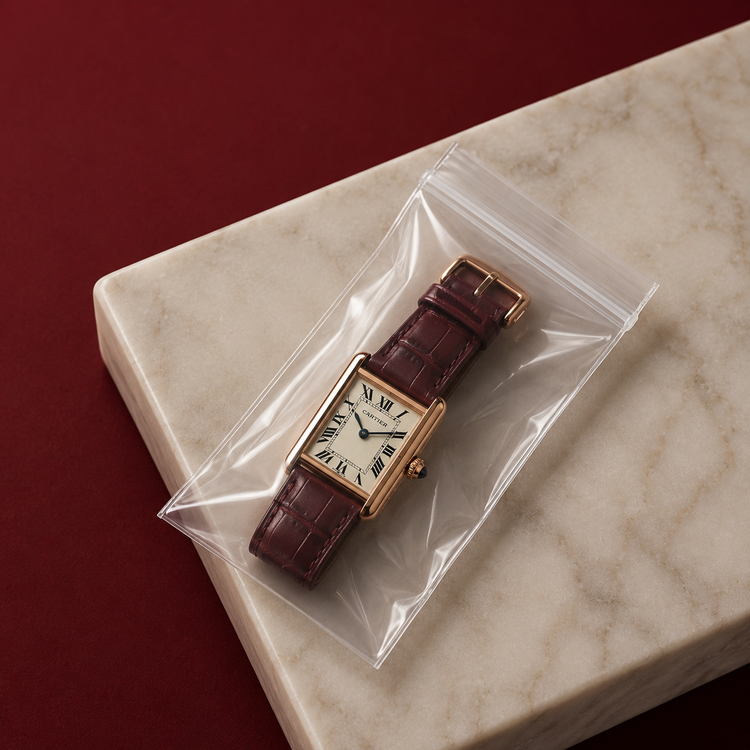
Best Bags for Watches
Watches require substantially more packaging space than rings or earrings.
Consider:
-
Case diameter
-
Strap length
-
Bracelet width
-
Overall thickness
-
Protective wrapping
A watch should generally not be squeezed into a small flat jewelry bag.
If a resealable bag is used, it may function as:
an organizational or protective inner layer
before the watch is placed into a stronger presentation or shipping package.
Best Bags for Loose Gemstones
Loose:
-
Diamonds
-
Sapphires
-
Rubies
-
Emeralds
-
Crystals
-
Beads
need packaging that helps prevent loss.
Small clear resealable bags offer a major advantage:
visibility.
The item can be identified without repeatedly opening the package.
For high-value stones, however, a simple plastic bag should generally be only one component of a more controlled storage and security system.
FTC guidance for jewelry sellers also emphasizes accurate representations concerning gemstones, precious metals, weight, size and other material characteristics. See the FTC Jewelry Guides.
Best Bags for Beads
Beads are particularly well suited to resealable packaging.
Jewelry makers may use bags for:
-
Seed beads
-
Glass beads
-
Metal beads
-
Gemstone beads
-
Pearls
-
Findings
Choose capacity based on:
the quantity of beads per SKU.
A sample of 20 beads needs much less space than a wholesale quantity of 500.
Best Bags for Charms
Small charms can be packaged similarly to:
-
Rings
-
Tokens
-
Pendants
-
Small jewelry components
Clear packaging makes it easier to:
-
Identify SKU
-
Count inventory
-
Check finish
-
Confirm color
without repeatedly opening each bag.
Best Bags for Brooches
Brooches may require additional width and thickness because of:
-
Pins
-
Clasps
-
Raised stones
-
Decorative elements
A thicker or more durable bag can make sense for pieces with:
hard edges or protruding components.
Do not choose a bag so tight that the pin presses aggressively against the film.
Best Bags for Jewelry Sets
Sets may include:
-
Necklace + earrings
-
Bracelet + earrings
-
Ring + pendant
-
Multiple coordinated pieces
You have two basic options:
individual bags inside one outer package
or:
one larger bag holding the set.
Individual packaging usually offers better organization and helps reduce direct contact between pieces.
Why Separate Jewelry Pieces?
When pieces move against each other, they may:
-
Scratch
-
Tangle
-
Chip
-
Rub finishes
-
Damage delicate details
For inventory and fulfillment:
one item per bag
is often the cleanest system.
Apple Zip Bags describes its jewelry bags collection as suitable for keeping pieces organized individually while reducing exposure to dust and unnecessary contact.
What Does “Mil” Mean in Jewelry Bags?
Mil refers to plastic-film thickness.
1 mil = 0.001 inch.
It does not mean millimeter.
For example:
2.5 mil = 0.0025 inch.
Uline's current plastic bag thickness guide similarly defines one mil as one-thousandth of an inch and shows how increasing mil thickness generally corresponds to progressively heavier-duty applications.
Is 1 Mil Good for Jewelry Packaging?
Very thin bags can work for:
-
Lightweight temporary organization
-
Low-risk items
-
Short-term applications
But jewelry frequently contains:
-
Metal edges
-
Posts
-
Clasps
-
Gemstone settings
-
Pins
so extremely thin film may provide less durability than desired for routine retail use.
For everyday jewelry packaging:
a somewhat thicker bag is generally more practical.
Is 2 Mil Good for Jewelry?
A 2 mil bag is a common general-purpose plastic-bag thickness.
It can be appropriate for many:
-
Rings
-
Earrings
-
Chains
-
Lightweight accessories
For jewelry businesses, however, slightly more thickness can provide:
-
Better handling
-
More substantial feel
-
More resistance to ordinary tears
-
Better reuse potential
Why 2.5 Mil Works Well for Jewelry Packaging
Apple Zip Bags currently uses:
2.5 mil plastic
for its jewelry bag range.
This provides a useful middle ground between:
-
Very thin disposable film
-
Heavy industrial packaging
Apple describes the material as suitable for:
-
Jewelry
-
Beads
-
Charms
-
Coins
-
Samples
-
Small hardware
with a resealable closure for repeated access.
For many jewelry businesses:
2.5 mil is a highly practical everyday thickness.
When Should You Use Thicker Jewelry Bags?
Heavier film may be useful for:
-
Sharp jewelry components
-
Heavy metal pieces
-
Large brooches
-
Thick pendants
-
Industrial handling
-
Frequent reuse
-
Long-term inventory situations
However:
more thickness is not automatically better.
Very heavy plastic may make packaging:
-
Bulkier
-
Stiffer
-
More expensive
-
Less elegant for small delicate jewelry
Choose thickness based on actual handling requirements.
2 Mil vs. 2.5 Mil vs. 4 Mil for Jewelry Packaging
| Thickness | Best Use | Main Advantage | Main Tradeoff |
|---|---|---|---|
| 1–2 mil | Lightweight temporary packaging | Flexible, economical | Less substantial |
| 2.5 mil | General jewelry packaging | Strong balance of flexibility and durability | Slightly more material |
| 3–4 mil | Heavier or sharper pieces | More resistance to tears/punctures | Bulkier and stiffer |
| 6 mil+ | Specialized heavy-duty uses | Maximum durability | Usually excessive for normal jewelry |
For most:
-
Rings
-
Earrings
-
Necklaces
-
Bracelets
-
Charms
-
Small jewelry pieces
2–2.5 mil
is generally a practical range.
Thickness Does Not Replace Proper Packaging
A thicker bag cannot compensate for poor packing.
For example, a delicate gemstone pendant shipped loose inside only a plastic bag may still be vulnerable to:
-
Impact
-
Crushing
-
Movement
-
Abrasion
The jewelry bag should often be treated as:
inner packaging.
For shipping, additional protection may be required.
Jewelry Bag vs. Shipping Packaging
A jewelry zip bag and a shipping package have different jobs.
Jewelry bag
Designed primarily for:
-
Organization
-
Separation
-
Visibility
-
Dust reduction
-
Inventory handling
Shipping package
Designed for:
-
Impact protection
-
Structural protection
-
Transit security
-
Carrier handling
Do not confuse the two.
How to Ship Jewelry Safely
If jewelry is being shipped to customers, place the individually packaged piece inside appropriate protective shipping materials.
FedEx currently recommends wrapping and cushioning jewelry, placing it in a snug inner box and then securing that inside a sturdy outer corrugated box for shipping. See FedEx's jewelry shipping guide.
A jewelry bag can therefore serve as:
the first organizational layer—not necessarily the entire shipment.
Protect Sharp Jewelry Components
Jewelry can include:
-
Earring posts
-
Brooch pins
-
Sharp clasps
-
Wire ends
-
Prong settings
These can put pressure on plastic film.
If the piece contains sharp points:
-
Position it carefully
-
Consider a backing card
-
Use cushioning
-
Consider heavier film when necessary
Do not assume plastic thickness alone eliminates puncture risk.
Why Resealable Closures Are Useful
A resealable zip closure allows jewelry bags to be:
-
Opened
-
Inspected
-
Closed again
-
Reused
This can be especially helpful for:
-
Retail inventory
-
Jewelry repair
-
Wholesale distribution
-
Craft production
-
Photography
-
SKU organization
Apple Zip Bags' current jewelry bags specifically use resealable zip closures.
Clear vs. Colored Jewelry Bags
Clear bags are useful when:
visibility matters most.
They allow staff to identify items without opening each package.
Colored bags can be useful for:
-
Branding
-
Categorization
-
Inventory coding
-
Product collections
-
Size differentiation
For example:
Clear = gold jewelry
Pink = earrings
Blue = bracelets
Green = repair orders
Color can become an operational tool.
Clear Bags for Retail Inventory
Clear packaging is especially useful when handling many similar SKUs.
It helps staff quickly inspect:
-
Style
-
Stone color
-
Finish
-
Chain type
-
Size
-
Quantity
without repeatedly opening bags.
That reduces:
handling time.
Colored Bags for SKU Organization
Suppose your jewelry business carries:
-
200 rings
-
150 necklaces
-
300 earrings
You could assign different bag colors to each product category.
This creates:
visual inventory management.
The packaging itself helps employees find the right product faster.
Custom Printed vs. Plain Jewelry Bags
Jewelry sellers also need to decide whether packaging should be:
plain
or:
custom branded.
Plain bags are useful for:
-
Storage
-
Back-room inventory
-
Small businesses
-
Low-cost packaging
-
Temporary needs
Custom printed bags can be useful for:
-
Retail packaging
-
Brand presentation
-
Ecommerce orders
-
Premium positioning
Apple Zip Bags discusses these tradeoffs in its guide to custom printed jewelry bags vs. plain bags.
When Plain Bags Make More Sense
Choose plain bags when:
-
Branding is not required
-
Bags remain internal
-
You are still testing packaging
-
You carry many temporary SKUs
-
Cost control is the priority
For back-room storage:
function usually matters more than branding.
When Branded Bags Make More Sense
Custom packaging can make sense for:
-
Boutique jewelry brands
-
Premium sellers
-
Gift packaging
-
Ecommerce stores
-
Trade-show orders
Branding can include:
-
Logo
-
Brand colors
-
Contact information
-
Product category
-
Artwork
But packaging should remain functional.
A beautiful bag that does not fit the jewelry correctly is still:
poor packaging.
100-Pack vs. 1,000-Pack Jewelry Bags
Quantity is one of the biggest purchasing decisions.
Should you buy:
100 bags
or:
1,000 bags?
The correct answer depends on:
-
Monthly sales
-
SKU variety
-
Packaging sizes
-
Storage space
-
Cash flow
-
Growth rate
When a 100-Pack Is Better
A 100-pack can be ideal when:
-
Testing a new bag size
-
Launching a new jewelry line
-
Packaging low-volume products
-
Comparing colors
-
Running a small shop
-
Selling at occasional craft fairs
Apple Zip Bags currently offers 100-pack small 2.5 mil jewelry bags for this type of lower-volume need.
Buying smaller quantities initially helps avoid getting stuck with:
hundreds of bags in the wrong size.
When a 1,000-Pack Is Better
A 1,000-pack becomes more practical when:
-
The bag size is already proven
-
Monthly order volume is predictable
-
Jewelry is packaged individually
-
You operate a retail store
-
You fulfill ecommerce orders daily
-
You sell wholesale
-
You need reliable packaging inventory
Apple Zip Bags currently sells a 1,000-pack of small 2.5 mil jewelry bags for higher-volume packaging.
Calculate Jewelry Bag Usage Before Ordering
A simple formula is:
Monthly bags needed = average monthly jewelry units packaged × bags per unit
Suppose you sell:
400 jewelry pieces per month
and each piece uses:
1 bag.
Monthly usage:
400 bags.
A 100-pack lasts:
approximately one week
at that volume.
A 1,000-pack lasts:
approximately 2.5 months.
That makes bulk purchasing much more practical.
Example: Small Etsy Jewelry Seller
Suppose you sell:
40 pieces per month.
Annual bag usage:
40 × 12 =
480 bags.
A 100-pack may make sense when testing new sizes.
Once your preferred size is established:
larger quantities become easier to justify.
Example: Growing Ecommerce Jewelry Brand
Orders:
300 per month
Average pieces per order:
1.4
Estimated bags:
300 × 1.4 =
420 bags per month.
A 1,000-pack lasts roughly:
2.4 months.
At this volume, buying only 100 bags at a time creates unnecessary reordering.
Example: High-Volume Retailer
Suppose a retailer packages:
2,500 pieces monthly.
Annual usage:
2,500 × 12 =
30,000 bags.
At that level, the business should think in terms of:
-
Bulk purchasing
-
Packaging forecasts
-
Multiple core sizes
-
Reorder points
-
Storage space
-
Wholesale pricing
How Many Bag Sizes Should a Jewelry Business Stock?
You do not necessarily need a unique bag size for every product.
A better strategy may be:
standardize around several core sizes.
For example:
Extra small
-
Rings
-
Stud earrings
-
Loose stones
-
Charms
Small
-
Earrings
-
Pendants
-
Small chains
-
Pins
Medium
-
Bracelets
-
Necklaces
-
Watches
-
Larger jewelry
Large
-
Jewelry sets
-
Oversized necklaces
-
Larger accessories
This creates:
simpler inventory.
Why Too Many Bag Sizes Can Be a Problem
Suppose your jewelry store stocks:
15 different bag dimensions.
That means:
-
More inventory locations
-
More reordering
-
More packaging mistakes
-
More money tied up in stock
-
More training requirements
Sometimes the better strategy is to select:
3–5 versatile sizes
that cover most of the catalog.
Why One Bag Size for Everything Is Also a Mistake
The opposite extreme creates problems too.
Using one large bag for:
-
Rings
-
Earrings
-
Bracelets
-
Necklaces
-
Watches
may appear simple, but it leads to:
-
Excess plastic
-
Poor presentation
-
More product movement
-
Larger storage footprint
-
Less efficient fulfillment
Standardization should not mean:
one-size-fits-all.
Use Product Families to Choose Bag Sizes
Group jewelry into families:
Group A: Tiny
-
Rings
-
Studs
-
Charms
-
Loose stones
Group B: Small
-
Earrings
-
Pendants
-
Brooches
-
Small chains
Group C: Medium
-
Bracelets
-
Necklaces
-
Watches
Group D: Large
-
Sets
-
Statement necklaces
-
Large accessories
Then assign:
one primary bag size to each family.
This makes purchasing far easier.
Keep Jewelry SKUs Separate
For inventory-heavy businesses:
one SKU per bag
often makes sense.
This can make:
-
Counting
-
Picking
-
Packing
-
Auditing
-
Photography
-
Returns
much easier.
You can also apply:
-
SKU labels
-
Barcode labels
-
Product names
-
Size indicators
to the outside of the bag.
Use Labels Instead of Opening Bags
Clear jewelry bags make labels more powerful.
A label might show:
SKU: RG-1023
Product: Gold Star Ring
Size: 7
Qty: 1
Employees do not need to open the bag to confirm basic inventory information.
This helps reduce:
unnecessary handling.
How Jewelry Bags Help With Returns
Resealable packaging can simplify:
-
Returns
-
Exchanges
-
Repairs
-
Quality inspection
Instead of using disposable packaging every time a product is handled, a reusable zip closure allows the bag to be opened and closed repeatedly.
That can be especially helpful in:
inventory and repair departments.
Jewelry Bags for Repair Shops
Jewelry repair businesses may use bags to organize:
-
Customer rings
-
Watches
-
Loose stones
-
Chains
-
Replacement parts
Each bag can carry:
-
Customer ID
-
Repair number
-
SKU
-
Notes
Colored bags can also indicate:
-
Pending
-
Completed
-
Awaiting parts
-
Priority
Jewelry Bags for Trade Shows
Trade-show sellers benefit from compact packaging.
Bags can help:
-
Organize inventory
-
Separate pieces
-
Reduce tangling
-
Make setup faster
-
Make teardown faster
Clear bags also help sellers quickly identify merchandise behind the table.
Jewelry Bags for Craft Sellers
Handmade jewelry businesses often have:
-
Many designs
-
Small production runs
-
Seasonal products
-
Custom orders
This makes smaller initial quantities attractive.
Start with:
100 packs
while testing sizing.
Once a bag size becomes a permanent part of the packaging system:
move toward bulk purchasing.
Jewelry Bags for Wholesale
Wholesale jewelry requires a different mindset.
A wholesale order may contain:
hundreds of individual pieces.
In that environment, bags must support:
-
Speed
-
SKU identification
-
Consistency
-
Bulk handling
-
Storage efficiency
A 1,000-pack becomes much more logical.
How Much Inventory Buffer Should You Keep?
Do not wait until your final 20 bags to reorder.
If packaging is required for every order:
running out stops fulfillment.
Consider maintaining enough bags to cover:
-
Normal reorder lead time
-
Unexpected sales spikes
-
Promotions
-
Holiday periods
For a business using:
500 bags per month
holding an extra several weeks of packaging inventory may be more practical than ordering at the last possible moment.
Do Not Overstock Unproven Sizes
There is also a danger in buying too much too soon.
Suppose you order:
10,000 bags
before testing fit.
Then discover:
-
The opening is too small
-
Necklaces tangle
-
Watches do not fit
-
Staff dislikes the size
You now own thousands of unsuitable bags.
The smarter sequence is:
test → validate → standardize → buy in bulk.
Packaging for Ecommerce Jewelry
Online jewelry brands need packaging that works for:
-
Inventory
-
Picking
-
Packing
-
Shipping
-
Presentation
The small jewelry bag can be used as the:
primary item-level organizer.
It may then be placed inside:
-
Pouch
-
Jewelry box
-
Gift box
-
Protective inner carton
before entering the shipping package.
Jewelry Bags Are Not a Substitute for Shipping Protection
This is particularly important with:
-
Expensive watches
-
Gemstones
-
Fragile jewelry
-
High-value precious metals
UPS recommends choosing appropriate boxes, cushioning internal items and securing products so they do not move excessively during transport. See UPS packaging guidelines.
Think of the jewelry bag as:
item-level organization.
Think of the shipping box as:
transit protection.
Use the Right Outer Package Size
Oversized outer packaging can create:
-
More empty space
-
More movement
-
More cushioning needs
-
Potentially higher shipping expense
Undersized packaging can cause:
-
Compression
-
Damage
-
Seal stress
USPS even offers small Priority Mail packaging specifically described as suitable for items including jewelry and other compact products. See USPS Priority Mail small-box guidance.
Jewelry Packaging for Luxury Brands
For luxury jewelry, a simple resealable bag can still be useful behind the scenes.
It may function as:
-
Inventory protection
-
Back-room organization
-
SKU storage
-
Repair storage
-
Pre-pack organization
But customer-facing packaging may additionally include:
-
Branded pouch
-
Jewelry box
-
Tissue
-
Insert
-
Certificate
-
Gift packaging
The right packaging system can have:
multiple layers.
Do Jewelry Bags Prevent Tarnish?
A resealable bag may help reduce direct exposure to:
-
Dust
-
Handling
-
Ambient moisture
but a standard plastic jewelry bag should not automatically be treated as a specialized:
anti-tarnish system.
Tarnishing behavior depends on:
-
Metal
-
Environment
-
Humidity
-
Airborne compounds
-
Storage conditions
If long-term anti-tarnish protection is required, choose packaging specifically designed and tested for that purpose.
Do Jewelry Bags Prevent Scratches?
Separating jewelry into individual bags can reduce:
piece-to-piece contact.
That is useful for preventing one item from rubbing directly against another.
However, a bag alone cannot guarantee that a delicate surface will never scratch.
Highly polished or fragile pieces may benefit from:
-
Soft wrapping
-
Protective cards
-
Pouches
-
Boxes
in addition to the bag.
Do Jewelry Bags Keep Out Moisture?
A resealable closure can help reduce direct environmental exposure.
But do not automatically describe a standard zip bag as:
completely waterproof or hermetically sealed
unless the manufacturer specifically makes and supports that claim.
Use accurate packaging descriptions.
Food Grade Does Not Mean Jewelry Grade
Plastic packaging may be marketed for many applications.
But for jewelry:
the relevant question is whether it suits the item's physical storage requirements.
Consider:
-
Plastic composition
-
Thickness
-
Closure
-
Long-term storage
-
Surface sensitivity
For particularly valuable museum-grade, archival or chemically sensitive items, seek packaging specifically qualified for that application.
How to Compare Jewelry Bags Before Buying
Compare:
Size
Will the jewelry fit comfortably?
Thickness
Is the film appropriate for the item's weight and edges?
Closure
Does the seal open and close reliably?
Clarity
Can the product be identified easily?
Quantity
Does the pack size match your sales volume?
Color
Would color coding improve inventory?
Branding
Do you need plain or custom bags?
Storage
How much room will bulk packaging occupy?
Cost per bag
How does unit cost change with quantity?
Do Not Choose Jewelry Bags Based Only on Price
The cheapest bag can become expensive if it:
-
Tears
-
Does not fit
-
Creates packing delays
-
Requires double bagging
-
Looks unprofessional
-
Must be replaced
Instead evaluate:
cost per usable bag.
A slightly more durable bag may offer better operational value.
Cost Per Bag Formula
Use:
Total pack cost ÷ number of bags = cost per bag
Example:
Pack cost:
$10
Quantity:
1,000
Cost per bag:
$0.01
This makes it easier to compare:
-
100 packs
-
1,000 packs
-
Bulk purchases
Do not compare pack price alone.
Calculate Packaging Cost Per Order
Suppose:
Jewelry bag = $0.01
Jewelry box = $0.65
Insert = $0.08
Outer mailer = $0.25
Total packaging:
$0.99 per order
Knowing the cost of each layer helps jewelry brands control margins.
How Much Should You Order?
A simple starting formula:
Monthly jewelry units × months of inventory desired = target bag quantity
Example:
Monthly units:
300
Desired inventory:
3 months
300 × 3 =
900 bags
A:
1,000-pack
fits this usage pattern well.
Add Quantity for Damaged or Extra Bags
Do not assume every single bag will be used exactly once.
You may need extras for:
-
Samples
-
Returns
-
Internal organization
-
Photography
-
Repairs
-
Packaging errors
Build some operational flexibility into your inventory.
Jewelry Packaging Quantity by Business Size
| Business Type | Approximate Strategy |
|---|---|
| Hobby seller | 100-pack testing |
| Craft-market seller | 100–1,000 depending frequency |
| Small ecommerce store | 1,000 of proven core sizes |
| Growing brand | Multiple 1,000 packs |
| Retail store | Bulk core-size inventory |
| Wholesale jewelry business | High-volume bulk purchasing |
| Repair shop | Multiple sizes, moderate bulk |
The correct quantity depends more on:
monthly usage
than business label.
Why 1,000 Bags Is Not Necessarily Too Many
If you use:
20 bags every business day
then:
20 × 5 days = 100 bags per week
A 1,000-pack lasts about:
10 working weeks.
For a busy jewelry business, 1,000 pieces is not necessarily a huge quantity.
Why 100 Bags Can Disappear Quickly
At:
10 orders per day
with:
one bag per order
a 100-pack lasts:
10 days.
If customers sometimes order multiple pieces:
it lasts even less.
Businesses should calculate consumption instead of judging quantity by appearance.
Jewelry Packaging Inventory Example
Suppose an ecommerce store uses:
Small bags: 600/month
Medium bags: 250/month
Large bags: 100/month
Three-month inventory target:
Small:
600 × 3 = 1,800
Medium:
250 × 3 = 750
Large:
100 × 3 = 300
You do not need to purchase:
equal quantities of every size.
Buy based on actual usage.
Standardize Your Most Common Size
If:
70%
of your catalog fits into one bag size, make that your:
core packaging SKU.
Keep larger or smaller options for exceptions.
This simplifies:
-
Ordering
-
Storage
-
Training
-
Fulfillment
Test Jewelry Packaging Before Scaling
Before purchasing large quantities:
-
Put real jewelry inside.
-
Close the zip.
-
Remove the item.
-
Reclose the bag.
-
Test different shapes.
-
Test any labels.
-
Test stacking and storage.
-
Pack a normal customer order.
-
Test shipping configuration.
Then decide whether to buy in bulk.
Common Jewelry Packaging Mistakes
Choosing the Bag Before Measuring the Jewelry
Measure first.
Buying an Exact-Fit Bag
Allow room for thickness and closure.
Using Oversized Bags
Excess space creates unnecessary movement and poor presentation.
Using Bags That Are Too Small
Do not force jewelry into packaging.
Ignoring Earring Posts
Sharp posts can stress thin film.
Ignoring Jewelry Thickness
A flat measurement does not capture bulky pieces.
Ignoring the Zip Area
Leave room for closure.
Assuming Thicker Is Always Better
Extra thickness can add cost and stiffness.
Buying Extremely Thin Film for Heavy Jewelry
Match thickness to the piece.
Treating the Bag as the Entire Shipping Package
Use appropriate outer protection.
Buying 1,000 Bags Before Testing
Validate fit first.
Buying 100 Bags Every Week at High Volume
Bulk quantities can reduce repetitive purchasing.
Stocking Too Many Sizes
Standardize when possible.
Using One Oversized Size for Everything
Different jewelry families need different packaging.
Mixing Multiple SKUs in One Bag
Individual packaging can simplify inventory.
Assuming Clear Bags Are Waterproof
Only make claims supported by product specifications.
Assuming Standard Bags Prevent All Tarnish
Specialized storage requirements may require specialized materials.
Jewelry Packaging Buying Checklist
Before ordering, ask:
-
What jewelry am I packaging?
-
Is it a ring, earring, necklace, bracelet or watch?
-
What is its width?
-
What is its length?
-
What is its thickness?
-
Is it mounted on a card?
-
Does the card fit?
-
Is there enough room below the zip?
-
Can the jewelry be inserted easily?
-
Can it be removed easily?
-
Is there excessive empty space?
-
Could the piece tangle?
-
Does it have sharp posts?
-
Does it have protruding clasps?
-
Is the film thick enough?
-
Is 2 mil sufficient?
-
Would 2.5 mil be better?
-
Do I genuinely need heavier film?
-
Do I need clear bags?
-
Would colored bags improve organization?
-
Do I want branded packaging?
-
Is plain packaging better for internal use?
-
How many pieces do I package monthly?
-
How many bags do I use per order?
-
Should I start with 100?
-
Is the size already proven?
-
Would 1,000 be more economical operationally?
-
How much storage space do I have?
-
How quickly will I consume the bags?
-
Do I need multiple sizes?
-
Can I standardize around three or four sizes?
-
Do I need labels?
-
Will bags be used for inventory?
-
Will they be used for customer-facing packaging?
-
Will they be used inside another pouch or box?
-
Is additional shipping protection required?
-
Have I tested the packaging before buying bulk?
-
Do I know my cost per bag?
-
Do I know my packaging cost per order?
-
Do I have a reorder point?
Frequently Asked Questions
What are the best bags for jewelry packaging?
For many everyday jewelry products:
small resealable clear bags around 2–2.5 mil thickness
provide a practical combination of visibility, flexibility and durability.
The best size depends on the actual jewelry.
What thickness should jewelry bags be?
For many:
-
Rings
-
Earrings
-
Chains
-
Pendants
-
Bracelets
2–2.5 mil
is a practical everyday range.
Heavier or sharper pieces may benefit from thicker packaging.
Is 2.5 mil good for jewelry bags?
Yes.
2.5 mil provides a useful balance between flexibility and durability for many jewelry applications.
Apple Zip Bags currently uses 2.5 mil material across its jewelry bag offerings.
What does 2.5 mil mean?
One mil equals:
0.001 inch.
Therefore:
2.5 mil = 0.0025 inch.
Is 4 mil too thick for jewelry?
Not necessarily.
It can be useful for:
-
Heavy pieces
-
Sharp items
-
Frequent handling
But it may be excessive for ordinary lightweight rings or earrings.
What size bag should I use for rings?
Use a compact bag that comfortably accommodates the ring without excessive empty space.
Leave enough clearance for easy insertion and closure.
What size bag should I use for earrings?
Choose based on whether the earrings are:
-
Loose
-
On a card
-
Studs
-
Hoops
-
Long drop earrings
Measure the complete packaged configuration.
What bag should I use for necklaces?
Use enough room for the chain to lie in an organized arrangement without being forced or sharply folded.
Avoid excessive empty space that can promote movement and tangling.
What bag should I use for bracelets?
Flexible bracelets may use medium bags.
Rigid bangles need enough width to fit without distortion.
Can watches go in jewelry zip bags?
Yes, if the bag is large and durable enough.
However, for retail presentation or shipping, additional protective packaging is usually appropriate.
Should jewelry bags be clear?
Clear bags are excellent for:
-
Inventory
-
SKU identification
-
Product inspection
-
Retail organization
Colored bags can be better for color coding or branding.
Are resealable bags good for jewelry?
Yes.
They are particularly useful for:
-
Inventory
-
Storage
-
Retail
-
Repairs
-
Wholesale
-
Ecommerce fulfillment
because they can be opened and closed repeatedly.
Do jewelry bags stop tarnish?
A resealable bag may reduce general environmental exposure, but standard plastic packaging should not automatically be treated as a specialized anti-tarnish solution.
Do jewelry bags prevent scratches?
Separating pieces can reduce jewelry-to-jewelry contact.
Very delicate pieces may still require softer protective materials.
How many jewelry bags should I order?
For testing:
100 bags
can be practical.
For established sizes and regular sales:
1,000 bags
may be more efficient.
Calculate based on your actual monthly usage.
Should I buy 100 or 1,000 jewelry bags?
Choose 100 when:
-
Testing sizes
-
Launching products
-
Selling at low volume
Choose 1,000 when:
-
Size is proven
-
Orders are consistent
-
You use several hundred bags monthly
How many months of jewelry packaging should I keep?
This depends on:
-
Lead time
-
Storage
-
Sales variability
-
Cash flow
Use your monthly consumption to establish an appropriate inventory buffer and reorder point.
Should every jewelry item have its own bag?
For inventory-heavy operations:
one piece or SKU per bag
often makes organization easier and can reduce direct contact between jewelry pieces.
Are jewelry bags enough for shipping?
Not always.
Jewelry bags provide item-level organization.
Fragile or valuable jewelry generally needs additional cushioning and a suitable outer shipping package.
What is the best general-purpose jewelry bag thickness?
For many jewelry businesses:
approximately 2.5 mil
is a strong general-purpose choice because it balances flexibility with everyday durability.
Final Verdict: What Are the Best Bags for Jewelry Packaging?
The best bags for jewelry packaging are not determined by one universal size.
You need to choose according to:
size + thickness + quantity.
For:
-
Rings
-
Stud earrings
-
Charms
-
Loose stones
choose:
compact bags that closely fit the product.
For:
-
Pendants
-
Earrings
-
Small chains
-
Pins
move toward:
small to medium sizes.
For:
-
Necklaces
-
Bracelets
-
Watches
-
Jewelry sets
choose:
larger bags with enough room for the product to sit naturally.
For everyday film thickness:
2–2.5 mil
is a strong practical range for many jewelry products.
Apple Zip Bags' current:
2.5 mil resealable jewelry bags
sit directly in that useful middle ground.
For purchasing quantity:
start with 100 when testing.
Once you know the size works and packaging volume becomes predictable:
move toward 1,000-piece quantities for core sizes.
The smartest jewelry-packaging strategy is therefore:
measure the jewelry → select the smallest practical bag → choose appropriate thickness → test the fit → standardize core sizes → purchase proven sizes in bulk.
That gives jewelry businesses packaging that is:
-
Easier to organize
-
Easier to store
-
Faster to fulfill
-
More professional
-
Better matched to actual sales volume
without overbuying bag sizes, thickness or quantities that the business does not need.